The Architecture of Chaos: Why Sam C. Serey Embraces the "Artificial" Self (The Universe of Isamantix Shakespeareantix Musical Play) - The Modern Bard of Chaos
Introduction: The Enigma of the Digital Soliloquy
In the hyper-reality of the twenty-first century, the "self" has become a fractured project, a series of curated ghosts haunting a digital machine. Most of us participate in a desperate, performative flux, clinging to the illusion of a singular, authentic identity. Yet, as a digital anthropologist observes the debris of our online existence, few "found artifacts" are as compelling as the work of Sam C. Serey. Known as the "Modern Bard of Chaos," Serey does not offer a polished brand; he offers a radical ego-deconstruction.
When prompted to define himself, Serey—the self-styled "Mr. Stoic"—refuses the comfort of a unified narrative. He presents instead a "Soliloquy" that challenges our very understanding of ontological presence. This is not merely a post; it is a philosophical inquiry into how one maintains a soul while navigating the "boundless bounded sea" of the internet. To understand Serey is to understand the contemporary struggle for resilience in an era where the boundary between the person and the persona has completely dissolved.
The Triad of Being: Human, Artificial, and Superficial
Serey’s primary thesis is a jarring subversion of the traditional hierarchy of being. We are conditioned to crave "humanity" and "depth" while recoiling from the "artificial" or "superficial." Serey, however, embraces these as three equal pillars of his existence, creating a triad that feels aggressively counter-intuitive to the casual observer.
"I am human. I am artificial. I am superficial."
By identifying as "The Satirical Oh-So Sec-See Philosophical But-Humble Genius," Serey weaponizes the superficial. In the digital landscape, where one is constantly reduced to a surface-level image, Serey chooses to own that surface rather than be victimized by it. The "artificial" is not a lie; it is the construction of a necessary shield. To be artificial is to be a "Modern Bard," a creator of one’s own mythos within a system that otherwise seeks to automate the individual. This is the martial artist’s approach to identity: taking the external pressure of "superficiality" and redirecting it into a satirical, performative strength.
Resilience as a Defining Narrative: The "I" That Fights Back
For the Bard of Chaos, identity is not a static state of "being"—it is the kinetic energy of "becoming" through conflict. His philosophy is deeply rooted in a Stoic resilience, forged in the fires of digital and social adversity. Serey provides a litany of specific traumas that have shaped his current form: he was bullied, scammed, deceived, and belittled.
In Serey's world, these are not mere misfortunes; they are the catalysts for the "I." The transition from the "human" who is acted upon to the "martial artist" who acts is captured in a singular, repetitive defiance. The identity is the resistance itself.
"'I' fought back."
This is the core of Serey’s "Stoic" inquiry. If the world treats you as a target, the "I" emerges only at the point of impact. By acknowledging his scars, he transforms the "artificial" layers of his persona into a suit of armor. Each time he was scammed or deceived, he didn't just survive; he integrated the experience into his philosophical framework, proving that the "Bard of Chaos" is a title earned through the grit of survival.
The Multiplicity of the Persona: Beyond the Boundless Sea
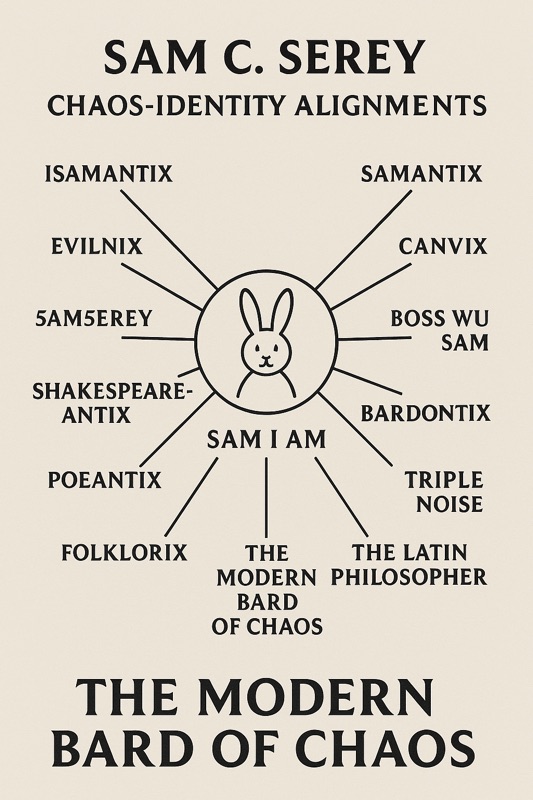
To look upon Serey is to look upon a multitude. He does not inhabit a name so much as he wears a wardrobe of archetypes. A "humble-genius bard" requires more than one label to navigate the "boundless bounded sea" of human experience. This proliferation of aliases is a direct manifestation of his "Chaos" philosophy—a refusal to be pinned down by the algorithmic gaze.
The sheer variety of his titles demonstrates the range of his intellectual and satirical project:
- Shakespeareantix & Bardontix: The literary architect.
- The Latin Philosopher & Poeantix: The seeker of ancestral and macabre wisdom.
- Isamantix, Canvix, & Evilnix: The shifting, modern iterations of the self.
- 5am5erey, TripleNoise, & The 5amTroller: The chaotic disruptors of the digital peace.
- Sam I Am & Folklorix: The playful, myth-making core.
By cycling through these identities, Serey suggests that the modern "I" is not a single point but a constellation. Whether he is "Boss Wu Sam" or "5am5erey," he remains the central observer, the Stoic martial artist who understands that in a world of noise, one must become the "TripleNoise" to truly be heard.
Conclusion: What Lies Beneath the Chaos?
Sam C. Serey’s stance is a provocative synthesis of ancient Stoic discipline and modern digital survival. He is the wolf, the laughing face, and the rabbit (🐺🤣🐰)—a symbolic triad representing the predator, the satirist, and the elusive spirit. He does not seek to resolve the tension between being "human" and "artificial"; he understands that in our current era, we are all inevitably both.
His "Soliloquy" serves as a digital artifact for the modern age, reminding us that while we cannot control the "boundless bounded sea" of chaos, we can control the "I" that sails across it. We are all, in some sense, martial artists of the soul, fighting back against the scams and belittlement of a shallow world.
As we look into the mirror of the Bard's chaos, we must ask ourselves: Which parts of our own identity are merely "artificial" masks, and which are the "human" parts worth fighting for?

Comments
Post a Comment