Coded Sonnets and Crypto-Halos: Decoding the Modern Bard of Chaos by Sam C. Serey
Introduction: When the Iambic Pentameter Hits the Block
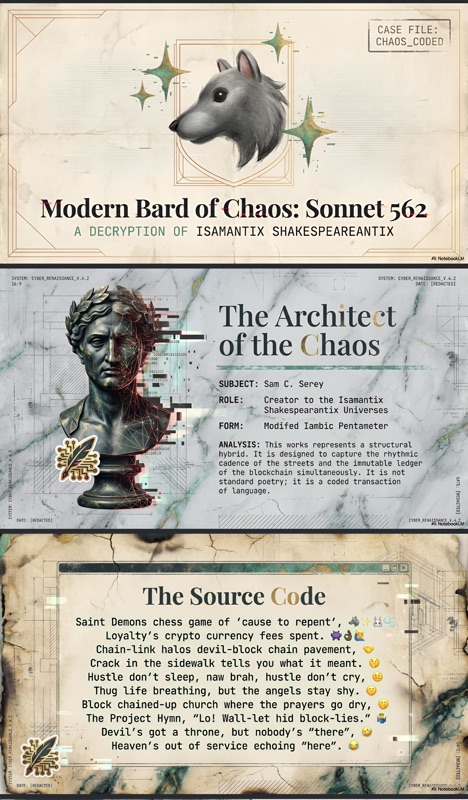
In the burgeoning digital frontier, few creative endeavors offer as profound a semiotic rupture as Sam C. Serey’s "Isamantix Shakespeareantix Universe." As a Digital Humanities Strategist, one observes in Serey’s work a deliberate collision between the rigid architectural constraints of Renaissance prosody and the volatile, decentralized ledger of modern existence. The "Modern Bard of Chaos Coded Sonnet 562" acts as a prime artifact of this intersection, where the high-art tradition of the sonnet is violently recontextualized by "thug life" survivalism and crypto-economic slang. It is an exploration of techno-spiritual liminality—a world where the soul is not saved by grace, but processed through a protocol.
The Shakespeareantix Evolution: Metrical Subversion and Street-Tech Slang
Serey’s deployment of "Modified Iambic Pentameter" is more than a stylistic affectation; it is a structural containment of contemporary chaos. By housing the gritty lexicon of the street and the cold jargon of the blockchain within a rhythmic house built by the Bard, Serey creates a formal tension. The "thug life" slang does not merely sit within the meter; it frequently threatens to "break" it, reflecting the inherent volatility of the digital age. This linguistic friction serves to elevate the colloquial to the level of the divine while simultaneously grounding the classical in the dirt of the "project."
"Saint Demons chess game of 'cause to repent', ! ✨ # $ % 🐺✨🫵🐰🫧 Loyalty's crypto currency fees spent. & ' ( 👾🙋♂️"
The Alchemical Transformation of Digital Assets
In the economy of the "Modern Bard," human devotion undergoes a process of algorithmic determinism. Through the synthesis of the line "Loyalty's crypto currency fees spent," Serey posits that human connection is no longer a static virtue but a fungible asset subject to transactional friction. The metaphor of the "fee" suggests that in this hyper-financialized landscape, even the act of remaining faithful incurs a cost—a digital tax on the spirit. The accompanying emojis (👾🙋♂️) suggest a gamified environment where the "fingerprint" of the individual is merely another data point in a broader, impersonal exchange.
The Architectures of Digital Constraint
The imagery of "Chain-link halos" and "devil-block chain pavement" provides a scathing critique of modern structural confinement. Here, the "blockchain" is not a liberatory technology but a restrictive architecture. The halos are not ethereal; they are industrial and "chain-linked," suggesting that symbols of goodness are now tethered to a ledger.
"Chain-link halos devil-block chain pavement, ) 🤝 Crack in the sidewalk tells you what it meant. * 🫣"
The inclusion of the Handshake emoji (🤝) is a vital piece of the "code," signifying the "smart contract" as a modern deal with the devil. This contract is etched into the very pavement of the urban experience. The "crack in the sidewalk," accompanied by the "peeking eyes" emoji (🫣), suggests that truth is only visible through the flaws and failures of the system—the moments where the digital architecture breaks down to reveal the underlying human desperation.
Techno-Spiritual Liminality and the Silence of the Divine
The sonnet explores the relentless exhaustion of hustle culture through the personification of "Thug life breathing." The tension between "Hustle don't sleep" and the observation that "the angels stay shy" reflects a world where the noise of survival has effectively drowned out spiritual signal. The 🫡 (salute) emoji denotes a performative, mechanical duty to the "hustle," while the 🤫 (shushing) emoji reinforces the withdrawal of the sacred. The "hustle" is presented as a dominant frequency that drives the divine into hiding, leaving the individual to navigate a landscape where the only breathing thing is the struggle itself.
The Semiotic Rupture of the "Wall-let" and the Block-Lie
Serey employs a brilliant linguistic bridge with the pseudo-archaic interjection "Lo!", immediately followed by a devastating pun. "Lo! Wall-let hid block-lies" functions as a central node of the poem’s critique. The "Wall-let" is not merely a digital storage device; it is a "Wall" that "lets" or permits the proliferation of "block-lies." This suggests that the technologies we use to secure our assets are the same structures used to conceal our deceptions. In the "Block chained-up church," traditional spiritual refuge is imprisoned by financial logic. When the "Project Hymn" is revealed as a digital lie, the prayers go "dry," signaled by the "shrug" emoji (🤷♂️) which captures the profound apathy of a world that has traded its hymns for hashes.
The Nihilistic Echo of an "Out of Service" Heaven
The concluding couplet serves as a definitive commentary on modern spiritual displacement, shifting from the "there" of traditional theology to the "here" of digital alienation.
"Devil's got a throne, but nobody's 'there', . 🤣 Heaven's out of service echoing 'here'. / 😂"
The use of the "laughing with tears" emojis (🤣, 😂) alongside the imagery of an empty throne and an "out of service" Heaven suggests a deeply cynical or nihilistic divinity. The Devil’s throne is vacant because evil is no longer a centralized entity—it is a distributed, peer-to-peer reality. Meanwhile, Heaven is rendered as a defunct utility. The "echo" is the final residue of the sacred, bouncing back to the observer in an environment where the divine is no longer a presence, but a hollow resonance.
Conclusion: The Human Ghost in the Machine
The work of Sam C. Serey serves as a coded warning about the totalizing intersection of faith, finance, and technology. By concluding his work with the postscript "No A.I algorithm-driven in play like the good ol' days," Serey highlights the vital importance of human-coded chaos. In an era of machine-generated order, the "Modern Bard" celebrates the "Modified Iambic Pentameter" precisely because of its imperfections and its ability to house the raw energy of urban survival.
In a world where our halos are "block-chained" and our loyalty is depleted by "fees," is there still room for a "hustle" that doesn't drive the angels away? Serey’s sonnets suggest that the answer lies in our ability to preserve the human ghost within the machine, decoding the cracks in the pavement before the echo of the divine fades into silence.

Comments
Post a Comment