The Glitch in the Crown: Why Isamantix is the Only Bard Willing to Let Language Burn by Sam C. Serey (The Modern Bard of Chaos)
1. Introduction: The Struggle of the Modern Bard
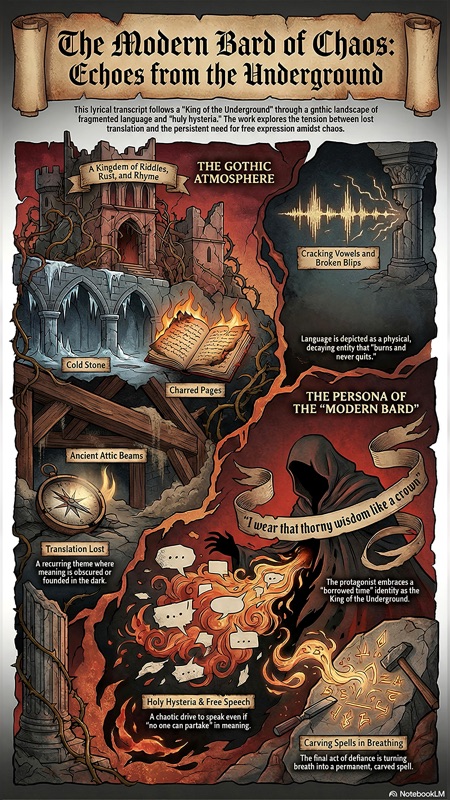
We inhabit a state of permanent semiotic collapse. The universal human condition is no longer merely being "lost in translation"; it is a linguistic haunting where our intent is murdered in the rafters before it even hits the air. Into this vacuum of "gothic echoing" steps Sam C. Serey, known as Isamantix—the architect of Shakespeareantix. He is the "Modern Bard of Chaos," a title that suggests not a preservation of the old world, but a violent deconstruction of it. As the self-anointed "King of the Underground," Serey navigates a landscape of "broken blips" and "evermore sound," where the act of speaking is a desperate, ritualistic necessity performed amidst the ruins of classical authority.
2. The Infinite Doorway: Why Words Refuse to Close
In the Isamantix ethos, language is never a destination; it is an inescapable threshold. He posited the counter-intuitive nightmare that "Every word is a door that refuses to close." Rather than providing the finality of an answer, each syllable births a new haunting, a new question "written on the wall." There is a brutal physicality to his phonetics—the "stone vowels" do not flow; they "crack and split" under the pressure of their own weight. Communication here is not a fluid exchange but a taxing, tectonic shift. As the critic observes the "glitch" in the Bard’s throat, we see the struggle to forge meaning from the debris:
"Is it cold or a curse or a glitch in my throat? ... Translation lost in the rafters in ghosts under my eyes. I mouth their crooked laughter."
3. Thorny Wisdom: The Heavy Price of Creative Authority
To wear the crown in Shakespeareantix is to accept a sentence of "borrowed time." Serey’s "King of the Underground" does not preside over gold and glory, but over a "kingdom on riddles, rust, and rhyme." This "thorny wisdom" is a burden of creative authority that isolates the artist within his own architecture of decay. The recurring, desperate inquiry—"Who beside me names this low queen tonight?"—reveals the profound solitude of the subterranean sovereign. It is the loneliness of a man juggling "broken blips" by the "candles’ drip light," wondering if any other soul dares to "talk to the sky" from the depths of the ash.
4. Holy Hysteria: Finding Meaning in the "Glitch"
Serey’s most provocative move is the embrace of "holy hysteria," where the "tongue like a turning key" unlocks a truth that logic cannot reach. He sneers at the "Lord concretion"—and in a brilliant linguistic slip, the "long creatarian"—rejecting the polished lie that speech should be "free" or unburdened. For Isamantix, the "glitch" is the only honest signal left. By prioritizing the "cracked and crooked cry" over the smooth delivery of the orator, he suggests that technical and emotional errors are the only places where the soul actually leaks through. He laughs at the solidification of language, choosing instead the volatile "hysteria" of a meaning that refuses to stay put.
5. The Architecture of Decay: Creation Amidst the Ruins
The world of Isamantix is upholstered in "dust on the lexicon" and "pages like winter skin." This is an aesthetic of the attic—where old words are "murdered through attic beams" and "ghosts under eyes" serve as the only witnesses to the creative act. Even when the artist admits that "silence is all I buy," there is a defiant persistence in the way he chooses to "carve this spell in breathing." The metaphor of "juggling broken blips" that "burn and never quit" captures the dangerous, kinetic energy of his process. It is an exhausting, perpetual motion performed in a space where the "translation is lost," yet the "mark" left by the burning page remains impossible to extinguish.
6. Conclusion: The Echo That Remains
The "Gothic echoing" of Isamantix is not merely a stylistic choice; it is a manifesto on the endurance of the human voice. Through the "riddles, rust, and rhyme," Serey demands to know who else "dares talk to the sky" when the heavens are silent and the lexicon is in shards. The takeaway is as cynical as it is hopeful: meaning may never be fully "passed" or "partaken," yet the "spell in breathing" must be carved regardless. We are left with the "evermore sound" of a King who refuses to be silenced, proving that even in the heart of chaos, the howl remains.

Comments
Post a Comment