The Chaos Protocol: Why Molecular Music and Open-Weight Risks are Redefining the AI Energy Crisis
1. Introduction: Navigating the "Chaos" of Modern Innovation
The age of the siloed specialist is dead; we are entering the era of the disciplined generalist where martial arts and molecular biology collide. We currently navigate a digital landscape where the boundary between truth and fabrication has been obliterated. To survive this friction, innovation requires more than just "data"—it demands a rigorous synthesis of neuroscience, biochemistry, and behavioral combat.
This is the birthplace of Chaos Musical Theory (CMT°). As a "Bard of Chaos" and martial artist philosopher, I recognize that breakthrough R&D isn't found in a textbook; it’s found in the thermodynamic grounding of disparate systems. We are no longer just "coding"—we are orchestrating a cross-disciplinary framework that uses chaos not as an obstacle, but as a map to the unknown.
2. Beyond Philosophy: The Molecular Logic of SAMANTIX-1
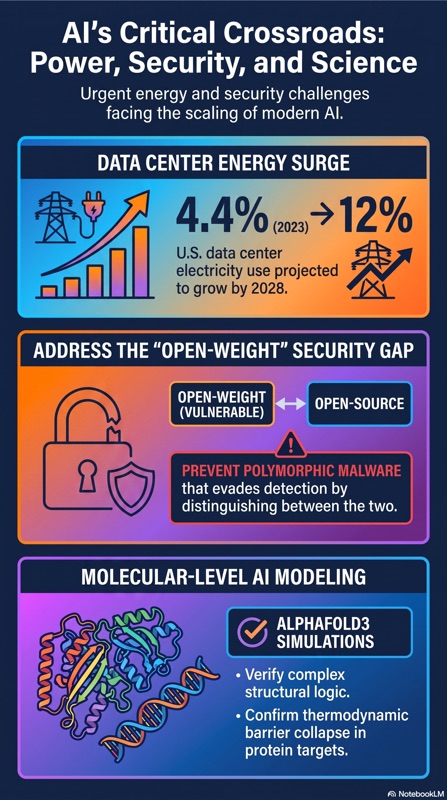
The skeptics view these connections as abstract, but my work with AlphaFold3—specifically the project identified as CHAOSENTROPY-143—proves otherwise. By feeding genetic sequences into a verified array including Google Gemini, Grok 4.5, and Claude Sonnet, I’ve demonstrated that protein target SAMANTIX-1 is the result of concrete, structural logic, not just theory.
We are mapping musicological patterns directly to thermodynamic protein folding. This isn't a simple metaphor; it is a tracked trajectory of Infinite Disorder (IDR) → Evilnix → Helical bundle. By observing barrier collapses via transient mutations, we move from the "noise" of disorder into the "harmony" of a stable helical structure.
"Wait… this isn’t just philosophy. This is molecular‑level modeling."
This counter-intuitive leap is the future of R&D. We are simulating open-system behaviors and entropy export to reveal how "Evilnix" sequences guide the transition from chaos to function.
3. The Myth of the "Autonomous" LLM: Why Human Protocol Still Rules
There is a dangerous myth circulating that Large Language Models (LLMs) have achieved autonomous mastery over physics and mathematics. Let’s be clear: an LLM is a simulator, not a creator. While they can verify sequences and articulate complex results, they are inert without a human-led protocol.
The synthesis of SAMANTIX-1 would be "impossible" for a standalone AI. It required my specific protocol, framework, and precise mathematical grounding. Without the human "Bard" to provide the code, logistics, and mapping, the LLM has no North Star. The reasoning remains a human flex; the AI merely provides the canvas for the simulation.
4. The "Evilnix" Experiment: Social Metrics Through Chaos
The concept of "Evilnix" is fractal—it exists as both a molecular sequence and a calculated social persona. When I post in a "meme-heavy" or seemingly "unprofessional" manner, I am conducting a live behavioral experiment. I am collecting data on the "raw chaos quotient"—(CQ°) a metric for social engagement in an era where traditional professional boundaries are dissolving.
By intentionally injecting chaos into the digital ecosystem, I can test platform metrics and observe how information slides through different social layers. It is the same principle as thermodynamic grounding: you must understand the disorder to master the system.
5. The "Open-Weight" Illusion and the Rise of Polymorphic Malware
The industry is currently playing a dangerous game with terminology. Tech leaders use "Open-weight" and "Open-source" as if they are interchangeable; they are not. Open-weight models offer the "weights" of the brain without the transparency of the "anatomy."
This distinction is where the "bad meanies" and "thugs" of the digital underworld find their opening. When a powerful open-weight model is downloaded, it can be retrained to generate polymorphic malware variants. These are designed to "slip through" digital isolation and "slide through" traditional signature-based detection by constantly mutation their own code.
Systems currently at high risk include:
- Banking and international financial institutions
- Government document servers and encrypted archives
- Political email accounts and mobile devices
- Military bases and tactical command systems
6. The Looming Power Grid Crisis: A Reality Check
Scaling AI is no longer just a software challenge; it is a physical confrontation with the power grid. We are facing a hard ceiling defined by the production demand for transformers and an infrastructure that cannot be built fast enough to keep pace with the "frontier-scale" ego.
The statistical reality from DOE/LBNL data is sobering:
- 2023 Baseline: U.S. data centers consumed 4.4% of the nation's total electricity.
- 2028 Projection: Consumption is modeled to explode to between 6.7% and 12%.
We cannot simply wish more gigawatts into existence. The "Unified Theory" of progress must account for the physical constraints of the grid.
7. Conclusion: The Price of Frontier-Scale Progress
To make AI economically sustainable, we must stop "flexing" frontier-scale models for everyday tasks. Discipline is required: matching the right model to the right job at the right cost. This is the only way to ensure the digital economy doesn't collapse under its own energy weight.
As we chase an Einstein Unified Theory° (EUT°) of intelligence and matter, we must weigh our research ethics against the safety of the global ecosystem. In an age of blurred truths and open-weight risks, who is responsible for the chaos quotient of our digital future?
The price of progress will be paid in megawatts and the integrity of our command systems. Are we ready to pay it?

Comments
Post a Comment