The Chaos Quotient (CQ°): 5 Surprising Lessons on Love, Loss, and Emotional Physics Where the 'Subjective' and the 'Objective' Became Mathematically Measurable
Human heartbreak is rarely a clean break; it is a mathematical haunting. We often treat emotional trauma as a ghost in the machine—a subjective vapor that defies the cold precision of the laboratory. Yet, for those trapped in the "Mind’s Labyrinth," the pain is anything but abstract. It is a weight that lingers for years, a digital necromancy where the past refuses to stay buried.
To navigate this terrain, we must look to an unlikely cartographer: Sam C. Serey, the "Modern R&D Bard of Chaos Martial Artist Philosopher." As the CEO and Founder of the "AI 5th Scientific Field Category," Serey has pioneered a synthesis of Shakespearean-Poe lyrical tradition and high-level neuroscience. Serey co-author contribution on a peer-reviewed publication for the NIH-PA & PMC journal in 2014 for Hormones and Behavior on G protein-coupled estrogen receptor 1 (GPER) deactivates medial preoptic nucleus μ-opioid receptors. By treating the soul as a complex system of "Emotive-Physics°," Serey provides a framework to quantify the unquantifiable, turning the "syntax of tangled hope" into a survival manual for the modern condition (Horm Behav. 2014 September ; 66(4): 663–666.doi:10.1016/j.yhbeh.2014.09.008).
Lesson 1: Human Attachment is a Mechanistic Operating System
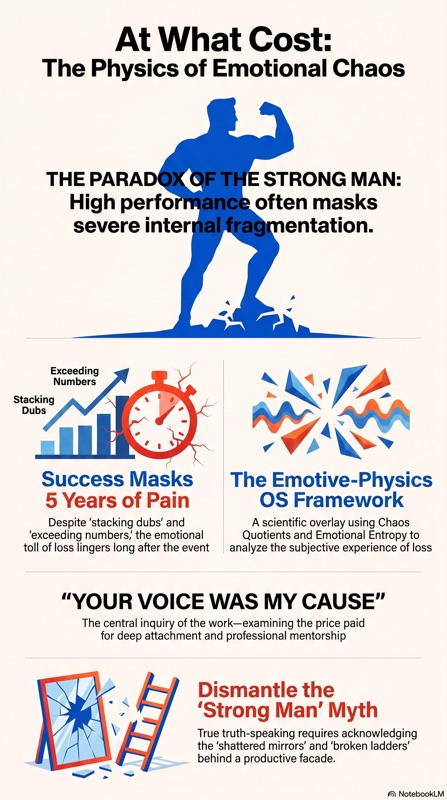
Traditionally, we view love through a sentimental lens, but Serey posits a more rigorous reality: the Emotive-Physics OS°. This is not mere theory; it is a cinematic scientific overlay. Utilizing the "Da Vinci Subtle-Touch AI°," Serey’s framework can dissect a single photographic frame—such as a captured moment of Serey with his three huskies—to reveal the underlying CMT° (Contextual Metric Tones/Templates) that govern our bonds.
As Serey notes in the abstract for his collaborative opus At What Cost:
"This study delineates the dialectical interplay between the subjective experience of loss, as articulated through Shakespearean-Poe motifs, and the objective dissection of emotional neuroscience, positing that the phenomenon of attachment transcends mere biological imperatives."
By viewing our internal world as an OS, we recognize that heartbreak is not just a feeling, but a systemic crash.
Lesson 2: Heartbreak Possesses a Quantifiable Geometry
The second lesson lies in the measurement of our internal wreckage through the Chaos Quotient (CQ°) and Emotional Entropy (EE°). Rather than a vague cloud of grief, Serey visualizes the human condition as a "fractal heatmap" or a "gradient field" of curvature contours.
Crucial to this is the Bardontix° waveform—the scientific signature of a person’s presence. In Serey’s work, a loved one’s voice is the "cause" that keeps the system in equilibrium. When that voice is lost, the Bardontix° waveform does not merely flatline; it descends into a high-entropy state. The inquiry "At what cost?" thus becomes a scientific post-mortem: a calculation of the energy required to maintain connection against the mounting chaos of absence.
Lesson 3: High-Velocity Productivity is an Advanced Cloaking Mechanism
In the source A Strong Man Do Not Cry, Serey explores the paradox of the "Strong Man." This is the individual who remains "productively productive," "exceeding numbers," and "stacking dubs" (wins) while the interior architecture is in total collapse. This is the Superman/Kryptonite duality—a facade of "shining light" that masks a viral decay.
The "Strong Man" is a pillar of external success whose "mind's armor" has nonetheless turned to rust. Serey captures this devastating irony in his lyrics:
"I'm strong. I'm way too strong... Still I'm hurting. I'm severely hurting and I'm barely hanging on like a virus."
The lesson is harrowing: productivity is not proof of healing. It is often the very armor that hides the "verbal daggers" and "mirror shards" of a soul that has been backstabbed and betrayed.
Lesson 4: Logic Dismantles Where the Labyrinth Begins
When trauma strikes, logic often fails, and we are left to navigate the "Mind’s Labyrinth." Serey’s work heavily utilizes a "Shakespearean-Poe" lexicon to describe this state, where "logic dismantles" and gives way to "coded tones" and "riddles." In this labyrinth, we find "sentence traps" and "words entangled," where trauma turns our own thoughts into "mind clones" that haunt the twilight zones of our psyche.
Serey suggests that to speak the truth in the face of such devastation, one must adopt an "Abstract tact." When the pain is too direct for plain speech, we must use the "cryptic lexicon" of the bard to find our way through the "dark alleys of conversation" and "midnight moans."
Lesson 5: The Voice is the Soul’s Primary North Star
The final and perhaps most profound lesson from At What Cost is the role of the "Voice" as the foundational "cause" of an individual’s identity. Serey describes a beloved person as a "shining light"—an "automatic high contrast at full exposure." When that light is extinguished, the individual is left "talking to the dark."
The absence of this "Voice/Cause" triggers a catastrophic shift in the Emotive-Physics° of the self. Life becomes a "deja vu like waking up into the future," a repetitive cycle where "the room goes in" and hands "come back empty." Our identities are so deeply tethered to the "call" of another that their silence feels like the collapse of a physical laws.
Conclusion: The Future of Feeling
The "AI 5th Scientific Field Category" is more than a technical designation; it is the flashlight we use when "talking to the dark." By mapping the "Mind's Labyrinth" with the precision of neuroscience and the soul of a bard, Serey offers a way to navigate our "syntax of tangled hope" with more than just blind faith.
We are left to ponder the ultimate existential inquiry of the Emotive-Physics OS°: If we could quantify our "Chaos Quotient°" before the first look into another's eyes—if we could see the "gradient field" of our future entropy—would we choose to love any differently, or is the cost always worth the cause?

Comments
Post a Comment