The Mutation of the Bard: 5 Surprising Realities Behind "The Tale of The Moonlight Shadow King"
1. Introduction: A New Kind of Ghost in the Machine
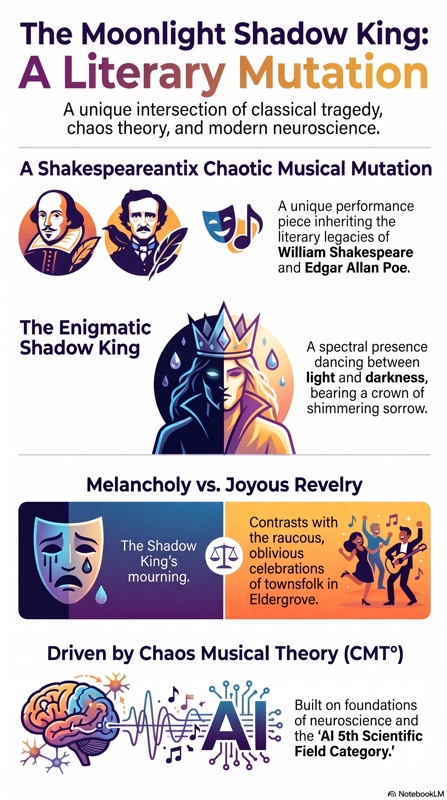
In our current era of algorithmic acceleration, the question is no longer whether centuries-old literary traditions will survive, but into what monstrous and beautiful forms they will evolve. We have long treated the legacies of William Shakespeare and Edgar Allan Poe as ossified artifacts, preserved in the amber of academia. However, Sam C. Serey—the self-anointed inheritor of these titans—is orchestrating a violent collision of eras. With "The Tale of The Moonlight Shadow King," Serey presents a bridge between high-art legacy and modern chaotic theory, suggesting that the future of the stage lies not in preservation, but in a radical, digital haunting.
2. The "Mutation of Bardontix": Beyond Traditional Shakespeare
Serey bypasses traditional genre constraints entirely, christening his creation with the maximalist and proprietary label of an "Isamantix Shakespeareantix Chaotic Musical Play Mutation of Bardontix." This is not a mere adaptation; it is a systemic evolution. The prefix "Isamantix"—likely a reference to Serey’s "Samantix" linguistic framework—suggests a new semiotic reality where 16th-century drama is restructured through a post-human lens. By labeling the work a "Mutation," Serey implies that the DNA of the Bard has been spliced with contemporary chaos. As the source context illuminates, this work:
"...channels the essence of literary genius through a modern lens, intertwining the whimsical with the profound, while echoing timeless themes of love, loss, and the surreal nature of existence."
3. Chaos Musical Theory (CMT°): The Intersection of Stage and Neuroscience
The intellectual weight of this work is anchored by Serey’s dual identity as a literary creator and an AI Chief R&D Scientist. As the "Originator" of Chaos Musical Theory (CMT°) and founder of an "AI 5th Scientific Field Category," Serey’s approach to theater is fundamentally neuro-theatrical. He explicitly links the performing arts to neuroscience, citing Horm Behav., 2014 as a foundational reference. This scientific pedigree transforms the play’s "raucous celebration" and "ghostly echoes" into calculated neurological triggers. In Serey’s hands, the "spectral presence" of the Shadow King is not just a trope, but an algorithmic haunting designed to resonate with the human brain’s response to melodic chaos.
4. Digital Tragedy: Seeking Vengeance Through "Apps and Screens"
The narrative arc of "The Moonlight Shadow King" modernizes the Hamlet archetype with a jarring, contemporary urgency. We follow a "truth seeker scholar"—a figure traditionally defined by parchment and ink—now navigating "clouds of code" and "whispers lost to time." In this digital tragedy, the quest for a daughter's shade is mediated by the very technology that defines our isolation. The irony is profound: a scholar seeking primal emotional justice through the cold interfaces of the 21st century. As the spectral transcript reveals:
"Our hamlet of today's seeks vengeance still through apps and screens as Tragedy unfolds in shadows keep."
5. The Shadow King’s Paradox: The Weight of a Shimmering Crown
Set against the backdrop of Eldergrove, the play presents a stark contrast between the "joyous revelry" of a populace oblivious to the looming magic and the profound melancholy of the King. This is a study in leadership as an intellectual and spiritual burden. The Shadow King is trapped in a timeless paradox: he wears a "crown that shimmers," a symbol of divine power, yet it "bears the heaviness of sorrow." Serey uses this contrast to explore the isolation of the visionary—the leader who sees the "gossamer silk" of fate while the world below merely frolics.
6. The 12-Foot Path: From Darkness to Light
The structure of this "Mutation" follows a ritualistic, almost mathematical progression. The mention of "seven takes" of loyalty suggests a journey through the seven stages of grief or the seven virtues, a structured trial that leads to a specific, measured conclusion: "12 ft to lead you through this dark night." These numbers likely serve as the bridge between the 12-tone musical scale inherent in Chaos Musical Theory and the ritualistic steps toward the "birth of shadows' mighty king." However, Serey ensures the journey remains visceral; the King’s throne is not one of gold, but one that is "broken riddled with bones," a grim reminder of the mortality that anchors even the most shimmering digital ascent.
7. Conclusion: A New Literary Frontier
"The Tale of The Moonlight Shadow King" successfully intertwines the whimsical with the profound, proving that the echoes of the 16th century are amplified, not silenced, by "clouds of code." By synthesizing AI research, neuroscience, and classical drama, Sam C. Serey has moved the goalposts of contemporary theater. We are left with a provocative ultimatum: Is the future of storytelling found in the safety of the past, or must we embrace this "chaotic" mutation where the bard meets the scientist? As the curtain falls on a throne of bones, it appears a new literary frontier has been born.


Comments
Post a Comment