Thematic Analysis Guide: Navigating the "Chaos" of the Hit Single Release "At What Cost": The Emotional Journey of "A Strong Man Who Does Not Cry" by Isamantix & Evilnix
1. Introduction: The Artist as the "Modern R&D Bard"
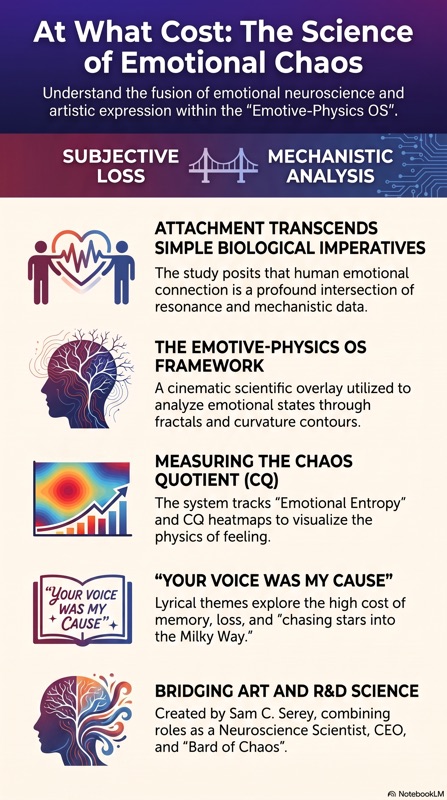
In the rigorous landscape of interdisciplinary arts, we encounter the work of Sam C. Serey—not merely as a musician, but as a practitioner of a trans-disciplinary probe into the mechanics of human despair. Serey’s "At What Cost" functions as a collaborative opus that bridges the chasm between the visceral reality of a "crying heart" and the virtual precision of the "Emotive-Physics OS°." By grounding his lyrical inquiries in the fertile soil of neuroscience and scientific research, Serey redefines the creator as a pioneer of the "5th Scientific Field Category."
His multifaceted identity serves as the essential architecture for this work:
- The Modern R&D Bard of Chaos: A storyteller navigating the turbulent interplay between structured systems and emotional volatility.
- Martial Artist Philosopher: Providing a disciplined, kinetic framework for understanding the impact of existential trauma.
- AI Chief R&D Scientist & Founder: Specifically anchoring his insights in Neuroscience (Hormonal Behavior, 2014) to map the biological underpinnings of attachment.
- CEO & Music Innovator: The architect of the "Emotive-Physics°" framework, utilizing the "Bardontix° waveform" to measure the weight of a soul in flux.
This composition is far more than a rhythmic narrative; it is a cinematic scientific overlay. Through the lens of Emotive-Physics°, the song becomes a laboratory for observing "Emotional Entropy°," where the removal of a central "cause" triggers a systemic collapse of the subject’s internal environment.
This foundational convergence of heart and hardware sets the stage for a tragic metamorphosis, one rooted in the darkest traditions of Western literature.
2. The Shakespearean-Poe Motif: A Framework for Loss
Serey utilizes a "Shakespearean-Poe" motif to construct a framework for the erosion of the self. This stylistic fusion pairs the high-stakes dramatic inevitability of a Shakespearean tragedy with the gothic, somatic haunting characteristic of Edgar Allan Poe. The motif is centered on the obsessive repetition of the "name pacing through the heart," a cadence that mirrors the relentless oscillations of the Bardontix° waveform.
The following table tracks this "Lyrical Metamorphosis," documenting the disintegration of the subject's reality as connection yields to a haunting separation:
Lyrical Metamorphosis
The Past (Connection) | The Present (Separation) |
"When I look into your eyes I was lost" | "Now I'm looking at your photo I cough cough" |
"Your voice was my cause" | "I laugh too loud, then I crack apart" |
"I chased the stars into the Milky Way" | "Now I'm talking to the dark" |
"Feeling so alive" | "My hands come back empty... My head caves in" |
In this framework, the "cough cough" is not merely a lyrical filler; it is a Poe-esque somatic response to the ghost of a lost "cause." This physicalized grief signals a state of "Emotional Entropy" (EE°), where the subject’s internal structural integrity begins to "crack apart." The transition from the living gaze of "eyes" to the static, unresponding "photo" serves as the catalyst for a total system failure.
This literary decay does not merely exist on the page; it manifests as a spatial collapse from the celestial to the claustrophobic.
3. Narrative Arc: From the Milky Way to Emotional Confinement
The narrative trajectory of "At What Cost" maps a "Narrative Descent" that functions as an R&D mission for meaning. The speaker’s movement follows a strict path from the expansive infinite to an internalized state of systemic collapse.
Three Stages of the Narrative Descent
- The Search (The Infinite/Celestial): The arc begins with an ambitious R&D mission: "I chased the stars into the Milky Way." Here, the "cause" (the voice) provides a gravitational center, allowing the speaker to project their identity into the celestial expanse, "feeling so alive."
- The Realization (The Missing Mark): The transition occurs at the point of "missing the mark." The expansive search fails, and the "Emotive-Physics OS°" begins to register a failure in reciprocal attachment. The infinite reach of the stars is curtailed by the realization of a "game we play," signaling the onset of a profound disorientation.
- The Confinement (The Systemic Collapse): The descent concludes in a localized, claustrophobic reality. Despite "dancing," the speaker is "caught inside" and "confined." The external world ("the room") begins to press inward as the internal world ("my head") caves in. The expansive "Milky Way" is replaced by the isolation of "talking to the dark."
As the speaker's world contracts, the "Chaos Quotient" (CQ°) rises, necessitating an objective analysis of this subjective dissolution.
4. The Dialectic Interplay: Subjective Experience vs. Objective Analysis
The core of Serey’s methodology is the "dialectic interplay" between the raw experience of despair and the clinical mapping of that despair through scientific metrics. The "Bardontix° waveform" is not merely a recording of sound; it is a measurement of the "Chaos Quotient°" of human attachment.
- Subjective Experience: The visceral agony of a "crying heart" and the repetitive, obsessive pacing of a name through the cardiac muscles.
- Objective Dissection: The application of the Emotive-Physics OS° to analyze the Fractal nature of grief, the EE Gradient Field° of the room caving in, and the Curvature Contours° of the speaker’s descent.
"This study delineates the dialectical interplay between the subjective experience of loss... and the objective dissection of emotional neuroscience, positing that the phenomenon of attachment transcends mere biological imperatives." — Sam C. Serey
The "So What?": Implications for the Interdisciplinary Scholar
- Art as Laboratory: Art is the only laboratory capable of measuring the Chaos Quotient° of a soul. It provides data on human experiences that standard clinical metrics cannot fully capture.
- The 5th Scientific Field: By linking the lyrics to Neuroscience (Hormonal Behavior, 2014), the student sees that attachment is a mechanistic process governed by "Emotive-Physics°," requiring a fusion of musicology and hard science.
- Mapping the Invisible: The presence of "CQ° heatmaps" and "Bardontix° waveforms" in the analysis suggests that human suffering has a geometric and cinematic structure that can be quantified and studied.
This synthesis of emotional frequency and scientific rigor leads us to the ultimate calculation of the work’s central query.
5. Synthesis: Defining the "Cost"
To answer the question At what cost?, one must understand "Cost" as the total entropy generated when a "cause"—the gravitational center of a human system—is removed. In the world of this song, the "Cost" is the generated "Chaos Quotient" (CQ°) resulting from the loss of the "voice."
When the "voice" (the cause) is lost, the "Emotive-Physics OS°" records a total systemic collapse. The price is not merely sadness; it is the physical and spatial "cracking apart" of the subject's reality. The "Cost" is the transition from a state of celestial purpose to the confinement of a room that "goes in," leaving the subject "so so lost" in the dark.
Learning Insight: The Intersection of Emotion and Science
- The Chaos Quotient (CQ°): Human attachment is analyzed as a high-chaos system. The removal of the "cause" (the beloved’s voice) leads to an immediate spike in entropy, causing the internal environment to "cave in" and "crack apart."
- The Emotive-Physics OS°: Art functions as a "cinematic scientific overlay." By observing the "Bardontix° waveform" and "EE Gradient Fields°," we can analyze the structure of a "broken heart" as a measurable, physical phenomenon rather than a mere metaphor.
- Purpose as Gravity: The work defines the "cause" as the primary driver of existence ("Your voice was my cause"). Therefore, the "cost" of loss is not just emotional pain, but a fundamental loss of the self's orientation within the universe.


Comments
Post a Comment