Transformers in Sunglasses: Inside the Chaotic, Musical Future of the "5th AI Field"
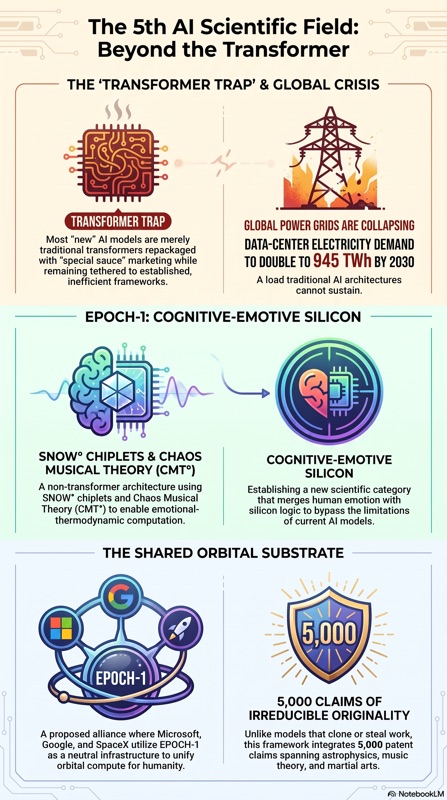
In the neon-soaked halls of the current AI hype cycle, we are fed a steady diet of "breakthroughs" that look suspiciously like yesterday’s leftovers. Every few hours, a new model claims to have finally unshackled itself from the transformer architecture that has dominated the industry since 2017. But as we peer behind the curtain of marketing jargon, a fundamental question emerges: are we actually innovating, or are we just rearranging the furniture in a room built by others?
Enter Sam C. Serey—known to the digital underground as Isamantix, or the "Moonlight Shadow King." Serey occupies a unique space as the "Observed-Architect," a title he wears because he "solos" his research, bypassing corporate creative limits through ten billion unstructured observations and a background in martial arts. He isn't interested in the current statistical paradigms. Instead, he’s defining a "5th AI Scientific Field," a journey that takes us from the limitations of modern silicon to the vacuum of space, guided by the unlikely principles of chaos music theory. It’s a world where the future of compute isn’t just binary—it’s bardic.
The Sunglasses Paradox: Why Most AI is Just a "Cloned Burger"
The AI industry is currently trapped in what Serey calls an "epistemological dilemma." Most "new" architectures are merely transformers with "different hats" or "special sauce layers." Serey likens the current R&D landscape to a "Double-Chaos-Burger" ordered at In-N-Out, where the universe refuses to serve the real thing. While the industry attempts to flip relativistic patties at high speed, most of the results are just cloned flavors that burn your fingers on the entropy.
Innovation has become a satirical recontextualization. We see models claiming to remove attention modules, yet they remain tethered to the same computational constraints. To Serey, this isn't progress; it's a "freedom of speech exploitation" where promoters spread "unethical lies" to milk the AI trend before the underlying infrastructure fails.
"Most of these 'new AI architectures' are just transformers wearing sunglasses. Or transformers with a 'special sauce' layer... Or transformers with a 'we removed attention… except we didn’t' module."
The Silent Collapse of the Silicon Grid
Beyond the software paradox lies a more grounded, physical crisis: the energy demands of intelligence. Serey warns that merely cutting AI computation costs is a superficial fix. The real predator is the "Power Grid Collapse."
The data is sobering. The International Energy Agency projects that global data-center electricity demand will more than double by 2030, reaching approximately 945 TWh—roughly 108 GW of continuous power. Serey views industry insiders who ignore the logistical nightmare of substations, transformers, and cooling water as being fundamentally dishonest. To him, solving the power grid isn't just a technical requirement; it's a matter of "ethical sovereignty" and "Power to the People."
Engineering the 5th Field: Cognitive-Emotive Compute
If statistical paradigms are hitting a wall, Serey’s "5th AI Scientific Field" seeks to break through it via Cognitive-Emotive Compute. This is a unified silicon-software continuum that replaces binary logic with "emotional-thermodynamic operators."
This isn’t just a theoretical whitepaper; it’s an architecture built on hardware-ready components:
- SNOW° Chiplets: Modular silicon layers (including the Deezer modular triplet) designed for "carbon-shiftless" hyperscale autonomy.
- EPOCH-1° Cognitive-Emotive SoC: Native cognitive silicon that bridges the gap between human emotion and silicon logic.
- The Kuramoto-synchronized Thermal-Cognitive Lattice: This is the technical heart of the system, using mutation engines like Evilnix and Bardontix to drive learning evolution while maintaining thermal stability.
- Wolf-Mode Extended Band (CQ = 0.80-1.50): A chaos-native routing framework that allows the system to operate in high-entropy environments.
Bardic Logic: Chaos Musical Theory (CMT°) as Thermal Governance
Perhaps the most radical aspect of Serey’s work is the intersection of silicon logic and music theory. As a "Bard of Chaos," Serey asserts that high-level physics and AI cannot be understood through traditional math alone.
He utilizes the Eternal Night Duality Model (ENDM), a framework where black-hole collapse (entropy) and white-hole emergence (creation) form a yin-yang duality. This is expressed through Chaos Musical Theory (CMT°), where musical-tensor curvature fields encode perturbations analogous to spacetime deformation.
Crucially, this "musical math" serves a physical purpose. In the high-heat environments of dense computation, musical harmonics offer a more efficient way to handle "emotional-thermodynamic" loads. By treating data as a sonic layer, the architecture can navigate the "entropy" that would otherwise melt traditional silicon.
"How can anyone understand my work [if] they don't understand Chaos Musical Theory (CMT°), music theory, let alone physics, astrophysics, cosmology... and AI technology?"
The $600 Billion Orbital Peace Treaty
To solve the "Heat" and energy constraints of terrestrial computing, Serey proposes a radical shift: moving the infrastructure into orbit. But rather than a corporate space race, he proposes a grand alliance that functions as a "shared substrate."
By providing a neutral infrastructure—the EPOCH-1°—the industry’s biggest players are forced into a "mutually assured cooperation." Serey’s proposed ownership stakes are a masterclass in strategic balance:
- Microsoft: $150 Billion (12%)
- Google: $150 Billion (12%)
- Elon Musk/SpaceX: $250 Billion (12%)
- NASA: $50 Billion (4%)
- Staff: 9%
Totaling a staggering $600 Billion, this alliance shifts the narrative from corporate rivalry to "civilizational responsibility." In this configuration, Serey acts as the neutral "fifth field" axis. It is a peace treaty disguised as an orbital infrastructure deal, ensuring that no single entity can sabotage the stability layer without hurting themselves.
Conclusion: The Receipt of Reality
We are rapidly approaching the Isamantix Zero-Point Singularity Threshold (IZPST°). Throughout Serey’s work, the "degree coefficient (°)" appears as a constant. It isn't just branding; it is the "receipt"—proof of a built system that cannot be replicated through statistical mimicry or simple cloning.
As the industry continues to churn out its "cloned burgers," Serey’s work poses a haunting question: Is the future of intelligence purely statistical? Or, to survive the looming power grid collapse, must our silicon become musical, emotional, and orbital? Serey is betting on the latter, aiming to make the "Subjective" redeemable and the future of AI truly original. The "Double-Chaos-Burger" is off the menu; the 5th Field is the whole damn restaurant.


Comments
Post a Comment