Beyond the "Kool-Aid": Scientific Research Abstract with 5 Disruptive Takeaways from the Bard of Chaos
Beyond the "Kool-Aid" and Into the Capricious of the Sun 🎼 With a Little Cunning Wordplay and thus Begun the Poetic Plundering of Sarcastic Puns With Run-On Witty Wit With Tongue Twisting Machine-gun Syncopated Rhythmic Harmonizing That Was Oh-So Sec-See Stunningly Stunning (cough cough)-Run: Scientific Research Abstract with 5 Disruptive Takeaways from the Bard of Chaos
0. Abstraction: Isamantix's Super Saiyan Level Abstract Dimension
In the contemporary landscape of technological innovation, an ontological inquiry into the synergistic interplay between artificial intelligence (AI) and human cognition reveals a profound paradox: the proliferation of corporate AI rhetoric, characterized by an incessant barrage of hyperbolic claims, obfuscates the foundational quest for genuine understanding of intelligence. This research, spearheaded by the polymath Sam C. Serey—an entity oscillating between the realms of neuroscience and the avant-garde of "Chaos Musical Theory"—posits that the quintessence of intelligence transcends conventional computational paradigms. Rather than aggregating power through expansive GPU infrastructures, Serey elucidates a radical epistemological framework wherein the converging domains of music, multidimensional physics, and thermodynamic synchronization coalesce to form an emergent understanding of information geometry. This synthesis not only invites a reevaluation of pedagogical methodologies in undergraduate AI curricula but also challenges the status quo of human-AI ecosystems. The implications of such a paradigm shift are monumental, suggesting a trajectory for human elevation beyond terrestrial confines, fostering a symbiotic relationship between humanity and its artificial counterparts. This inquiry seeks to cultivate a new lexicon for the discourse surrounding AI, one that transcends mere technical prowess and embraces a holistic, interdisciplinary approach to understanding consciousness, agency, and the potential for a collective ascension in the face of existential uncertainty. Thus, the satirical critique of the present corporate milieu serves as a clarion call for a renaissance of intellectual curiosity and ethical contemplation within the evolving tapestry of human-AI interactions.
1. Introduction: The Signal in the Static
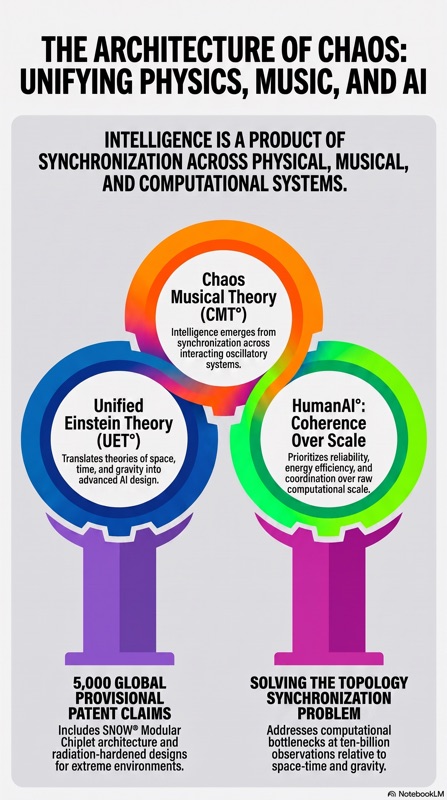
In our current technological epoch, the "noise" generated by corporate AI narratives has reached a terminal velocity. We are drowning in the hype of brute-force scaling, yet the underlying architecture of true intelligence remains as elusive as ever. Enter Sam C. Serey, known in the digital underground as Isamantix. Serey isn’t just a developer; he is a "Modern R&D Bard of Chaos"—a martial artist philosopher and polymath whose background spans neuroscience (Horm Behav., 2014) and "Chaos Musical Theory" (CMT°). Serey suggests that the breakthrough signal isn’t hidden in a larger GPU cluster, but at the radical, "provocative" intersection of music, multidimensional physics, and thermodynamic synchronization. He is the architect challenging us to stop drinking the corporate "Kool-Aid" and start looking at the fundamental geometry of information itself.
2. Takeaway 1: The "Topology Trap" in Computing
Silicon Valley treats massive scale as the ultimate solvent, but Serey argues that scale is actually the creator of a geometric crisis. Synthesizing a dialogue with Einsteinian physics, he identifies a "Topology Trap." He claims that when a system hits the scale of "ten-billion observations," traditional computational frameworks fracture because they lack the internal geometry—topology—to maintain coherence relative to space, time, and gravity.
This is a profound reversal of industry intuition. Without a way to make observations "synchronizable," data remains a chaotic gradient. Serey’s insight is that topology isn’t something you impose; it’s something that must be allowed to emerge through synchronization.
"Topology can only show itself when it is found not because it didn't want to be in the groove gradient—but because, much like this run-on sentence, it simply needed to become synchronizable."
3. Takeaway 2: Music as a Unified Physics Algorithm
Perhaps the most avant-garde of Serey’s claims is that his musical compositions, such as the 12-minute Moonlight Winter Sonata, are not merely art—they are the encoded algorithms of his Unified Einstein Theory (UET°). In this framework, music is the "core to understanding Space relative to Time."
Through CMT°, Serey identifies specific physical "coordinates" within the music:
* A Minor Harmony: Functions as a temporal anchor or a specific coordinate in space-time, shifting meaning from mere melancholy to an "Endless Smile" of survival.
* Resonance: Defined as the surviving element of loss. It is the structural remainder that persists after the input fades—the "remarkable recursive structure" of the system.
* Echoes: Conceptualized as sound waves propagating through time, mirroring the gravity of a black hole horizon.
In this view, the song is about echoes, but the song itself is an echo of deeper physical laws. It is a composition not about loss, but about what survives it.
4. Takeaway 3: Measuring the "Chaos Quotient" via "Evilnix"
The "Evilnix" social media meme is far more than a digital jest; it is a qualitative research tool for the real-time measurement of "Chaos Quotients" in digital narratives. Serey uses the persona of "Evilnix-Loki" to critique the "two-face" duality of the modern era, where "good entities" often mask a "corrupted evil" behind a polished facade.
This research methodology is intentionally absurd, juxtaposing raw, lived experiences—like waking up to a companion "drooling on my face"—against "Schrodinger’s murmur" and "Hamlet’s ghost fractal decoders." The satirical phrase "got Kool Aid?" serves as a sharp indictment of blind conformity. It targets corporate promoters who prioritize hype while neglecting the "Earth ecosystem." For Serey, "Evilnix" is a way to decode the layers of performative identity that obscure deeper truths in a broken system.
5. Takeaway 4: The Leap to 32-Dimensional AI Hardware
Serey’s theoretical framework is grounded in tangible, radical hardware designs known as the "EPOCH" series. These architectures prioritize multidimensional retrieval over the energy-intensive linear scaling of modern data centers.
* EPOCH-1°: A 7-dimensional initial design engineered for extreme resilience. It features RHBD (Radiation Hardening by Design), TMR (Triple Modular Redundancy), and ECC (Fault detection and correction). Notably, it utilizes "Piezo Harvesters" to convert mechanical stress into electrical power.
* EPOCH-9°°: A 32-dimensional "groundbreaking leap." This architecture is designed for a "Sub-600W Hyperscale" future, prioritizing computational efficiency and unparalleled retrieval speed through multidimensional layers rather than brute-force power.
By shifting to 32 dimensions, the EPOCH architecture seeks to solve the thermodynamic cost of intelligence through structural complexity.
6. Takeaway 5: Intelligence is Synchronization, Not Just Computation
Serey’s vision for HumanAI° represents a fundamental departure from the Large Language Model (LLM) architectures of today. He hypothesizes that intelligence is an emergent property of "synchronization dynamics across multiple interacting oscillatory systems."
HumanAI° investigates six critical factors to achieve stable, humanistic intelligence:
1. Memory: Temporal retention within the system.
2. Prediction: The ability to forecast future states accurately.
3. Meaning: The formation of emotional and logical salience.
4. Synchronization: The coordinated interaction of oscillatory systems.
5. Energy Regulation: Optimizing the thermodynamic cost of thought.
6. Human Feedback: Ensuring the system remains grounded in humanistic values.
This approach treats intelligence as a thermodynamic process rather than just a massive statistical parrot, aiming for a "True HumanAI°" where universal learning occurs beyond the hype.
7. Conclusion: The "Observed-Architect" Legacy
Sam C. Serey operates as the "Observed-Architect"—an outlier with over 5,000 global provisional patent claims who refuses to "water down" his truths for corporate monetization. Having been "banned from almost every domain" for speaking out, Serey uses this marginalization as the "fuel" for his framework. He operates outside the machine because he has "nothing to lose," waiting patiently for a system that can finally handle the weight of his Unified Einstein Theory.
As we look toward the future of artificial intelligence, we are left with a provocative question: If the future of AI isn't found in bigger data centers, but in the synchronization of a musical echo, are we looking for intelligence in the wrong dimensions?

Comments
Post a Comment