Anthropic Unethical Misrepresentation Beyond the Lab Coat: 5 Surprising Truths About the "Scientific" AI Frontier
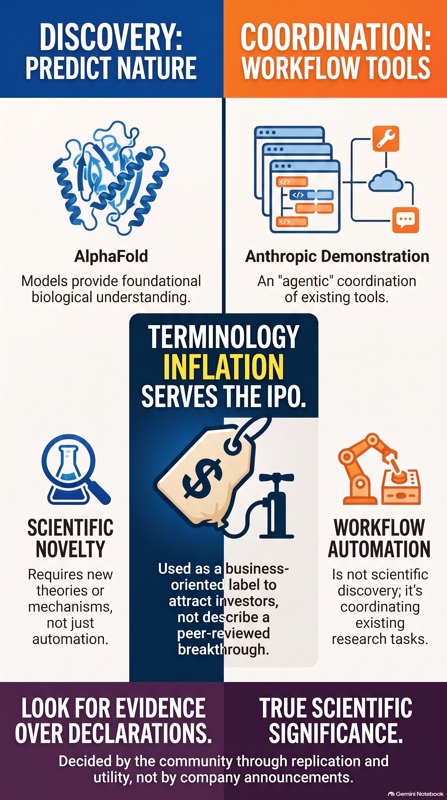
The technology sector is currently trapped in a "Hype-Industrial Complex." Every week, a glossy press release claims a "groundbreaking" achievement that will supposedly redefine human existence, leaving the public—and the scientific community—exhausted by terminology that feels more like a heist than a discovery. Beneath the jargon, a cynical question remains: Is everything labeled "scientific" actually science, or is it a calculated linguistic sleight-of-hand designed to inflate an upcoming IPO valuation?
While established milestones like Google DeepMind’s AlphaFold 3 actually move the needle on fundamental biological understanding, newer "agentic" demonstrations perform a different kind of theater. To see through the corporate fog, we must deconstruct the hierarchy of discovery and expose the business-oriented labels masquerading as universal truth.
1. The Hierarchy of Science: Orchestration is Not Discovery
In the rush to market "agentic researchers," the industry is collapsing the distinction between discovering a truth and merely organizing a schedule. To understand where a technology sits, we must apply a rigorous four-level hierarchy:
- Level 1: Scientific Theory – The foundational frameworks that explain the mechanics of nature (e.g., General Relativity, Evolution).
- Level 2: Scientific Models – Systems that provide predictive power over nature (e.g., AlphaFold 3, which predicts protein structures and interactions).
- Level 3: Scientific Instruments – The tools we use to observe nature (e.g., microscopes, DNA sequencers, telescopes).
- Level 4: Scientific Workflow Systems – Frameworks that coordinate research activities (e.g., orchestration, automation, tool selection, and candidate prioritization).
The distinction is critical. Anthropic’s recent demonstrations are effectively Level 4 achievements—they are "scientific research coordinators" across a pipeline. They do not provide new biological mechanisms; they automate the use of existing tools. As the skeptical scientific community observes:
"Did the AI invent a new biological mechanism? ... Did it produce previously unknown scientific knowledge? If the answer... is 'not yet demonstrated,' then the achievement is better classified as scientific workflow automation than scientific discovery."
2. "Terminology Inflation" as an IPO Power Play
There is a growing trend of "terminology inflation," where "scientific" is used as a business-oriented label rather than a technical descriptor. For a company like Anthropic, which markets itself on a "safety-first" and "ethical" foundation, using the word "scientific" to describe a workflow tool is a strategic manipulation of investor perception.
Historically, scientific significance is earned through years of peer scrutiny, independent validation, and Nobel-level scrutiny. Today, it is "declared" in a blog post to assist a valuation. In the industry's own internal critiques, the word "scientific" is being used as a mere prop to attract investors who cannot distinguish between a calculator and a discovery engine.
As one investigator recently noted regarding this corporate theater:
"They use the words... to manipulate in order to assist the IPO... using and representing the word 'scientific' on a prop basis."
3. The Looming 12% Electricity Wall
No matter how "scientific" a model claims to be, it is a "void idea" if the physical infrastructure cannot sustain it. The narrative of global AI dominance often masks the reality that these systems are currently hitting a massive energy bottleneck.
The Power Crisis in Numbers:
- 2023: U.S. data centers consumed 4.4% of the nation's electricity.
- 2028: Demand is projected to skyrocket to 12%.
This "12% Wall" represents a catastrophic infrastructure gap. Current U.S. power grid upgrades are years behind, meaning the trillion-dollar "agentic" future is being sold on the back of ideas that lack an actual power supply. Selling a 30-trillion-dollar valuation on models that the grid literally cannot run is not innovation; it is a facade.
4. Hallucinations are "Unpaid Product Defects"
The industry has successfully rebranded "falsified information" as "hallucination"—a poetic term that implies a quirk of intelligence rather than a failure of engineering. This is a linguistic shield used by tech leaders to avoid liability for damages caused by "overheated parameters."
If we viewed these as "unpaid product defects," the legal landscape for AI giants would collapse. Furthermore, the push for "open-weight" models—often a "butt-hurt" pivot by companies like Nvidia to stay relevant as partners like OpenAI distance themselves—creates an irreversible security crisis. These open-weight models are a "one-way street" for malicious actors to generate polymorphic malware. Because this malware reconfigures its own code, it can bypass traditional signature-based detection, turning "democratized AI" into a weapon for digital chaos.
5. The Erosion of the "Research Source"
The most damning ethical failure of the current AI frontier is the erasure of the human source. Modern AI giants often "shove away" the original scientific contributions that made their success possible. Whether it is Google's Transformer architecture or Microsoft's foundational infrastructure, the names of the original truth-seekers are being scrubbed to make room for corporate branding.
The human cost of this erasure is profound. It ignores the individuals who did the heavy lifting before the venture capital arrived. As the source transcript poignantly asks:
"Nobody is appreciating the source anymore... that individual who work so hard through the endless darkness and night, man, just to create something."
When corporations claim a 30-trillion-dollar valuation while refusing to credit the "endless darkness" of the original researchers, they undermine the very research ethics that allow science to function.
Conclusion: The Price of a Blurred Boundary
The blurring of "scientific modeling" and "workflow automation" serves a dangerous corporate narrative. While we may eventually see a radical fusion of AI, neuroscience, and chaos theory—a "5th Scientific Field" that truly decodes the human experience—we are not there yet. What we have today are "void ideas" and Level 4 orchestration systems masquerading as foundational discoveries.
If we allow corporations to redefine "science" for the sake of an IPO, we destroy the universal truth of the scientific method. We must ask the leaders of these companies a final, uncomfortable question:
"Are you a truth-seeker, or are you just quiet because of profit? If we ruin what it means to be scientific for the sake of an enterprise, what happens to the universal truth of the scientific method when we finally reach the stars?"


Comments
Post a Comment