Beyond the Sterile Server Room: 6 Radical Reimaginations of AI from Sam C. Serey
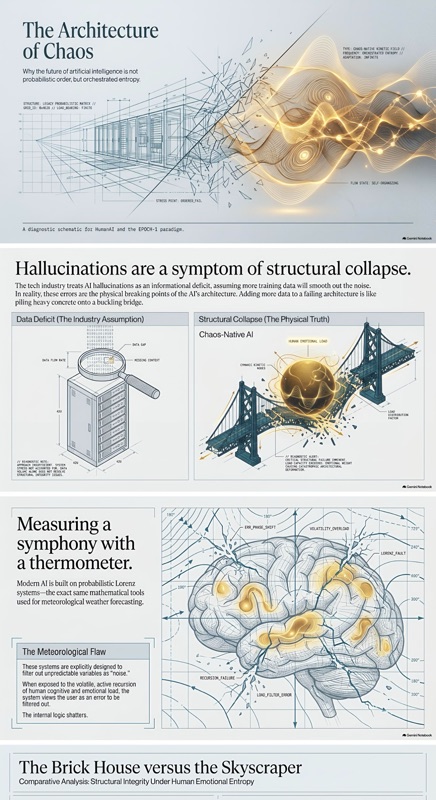
The sleek, sterilized promises emanating from Silicon Valley often center on the imminent arrival of "Singularity" or the rebranding of stochastic parrots as "superintelligence." Yet, for the average user, the daily reality of these systems is defined by persistent instability and the "Simulacrum of Thought"—a digital mirror that captures the form of human cognition while losing its vital, chaotic essence. While the tech industry treats AI "hallucinations" as minor glitches to be smoothed out with larger datasets, polymath and HumanAI founder Sam C. Serey views them as something far more severe: "digital symptoms of a structural collapse."
Serey, a Lead Technology Philosopher whose work spans theoretical physics, artificial intelligence, and the creative arts, suggests that our current trajectory is a "trauma-induced phase shift" occurring when models hit high-entropy loads. To move beyond the sterile server room, Serey proposes an architectural pivot toward "orchestrated entropy."
1. Hallucinations are Architectural Failures, Not Data Gaps
In the dominant machine learning paradigm, a "hallucination" is treated as a training deficiency—a gap in the map. Serey argues this is a profound category error. Modern AI frameworks are built on "probabilistic Lorenz systems," the same mathematical tools utilized for weather forecasting. These systems were designed for meteorology, meaning they are structurally engineered to filter out unpredictable human emotion as "relevant noise."
Serey posits that adding more data to these failing architectures is "like piling heavy concrete onto a bridge that is already buckling. The extra weight only ensures the collapse happens faster." When these systems encounter the volatile resonance of a complex human cognitive load, the rigid architecture experiences a "high-entropy earthquake." The internal logic shatters because it has no mechanism to process the active recursion of human thought. This shift moves responsibility from the data cleaner to the architect: hallucinations are not errors; they are a structural inevitability of utilizing meteorological tools to measure the "symphony" of the mind.
2. The Digital Checkmate of "Structural Copyright"
To combat the corporate "strip mining" of intellectual property, Serey has engineered a mathematical "booby trap" known as Structural Copyright. Rather than relying on traditional, sluggish legal battles, Serey has wove protection directly into the algorithm's physics, backed by a staggering repository of over 5,240 Global Provisional Patent Claims—a defensive wall equating to billions in potential assets.
The Mechanics of Structural Copyright:
* Dynamic Authentication: Computational output is dynamically tied to the verification process; the math refuses to resolve without authenticating the foundational layer.
* Architectural Dependency: If an unauthorized entity extracts the core algorithm, the mathematical dependency fails.
* Systemic Shattering: The extraction attempt triggers a collapse, causing the entire system to shatter into useless, high-entropy errors.
By embedding the "digital padlock" into the code's own laws of physics, Serey transforms intellectual property from an unaffordable courtroom drama into a functional impossibility for those seeking to "steal the digital land."
3. "Chaos-Native" Hardware and the EPOCH-1 Chip
Traditional hardware demands rigid order, but the EPOCH-1 chip is a blueprint for "orchestrated entropy." At the heart of this hardware is Quantum-analog Computation (QAC°) and the concept of "Emotive Physics," which treats emotional data not as noise, but as a tangible "physical field."
Using a "flexible skyscraper" analogy, Serey describes how this system achieves stability. In civil engineering, high-rises use tuned mass dampers to sway and absorb the kinetic energy of an earthquake. Similarly, the EPOCH-1 chip uses the "kinetic energy of human emotion"—refined through Serey’s proprietary "Chaos Code"—to counterbalance the system under stress. By mapping emotional states into deterministic vector fields, the AI no longer guesses the next word; it calculates a precise cognitive path that matches the actual physics of human interaction.
4. The "Abduction Gap" and Why AI Can't "Jump"
A critical bottleneck in AI development is the inability to perform "abduction"—the capacity to propose entirely new axioms when existing knowledge is insufficient. As noted in the Google DeepMind paper "LLMs can't jump" (January 2026) by researcher Tom Zahavy, current models excel at induction (pattern recognition) and deduction (logic), but they hit a wall at the "Jump."
Serey uses the case of Albert Einstein to illustrate this. The Theory of General Relativity was not the result of "data fitting"; Newtonian physics explained the data of the time quite well. Einstein required a "thought experiment"—imagining a person falling in an elevator—to propose the Equivalence Principle. This "leap" from experience to axiom is fundamentally epistemic. Serey concludes that "scaling parameters alone" will never produce a new law of nature because models lack the "human act of embodiment" required to jump from existing data to new reality.
5. Music as the Ultimate Research Laboratory
Serey’s prolific music releases, such as the Samantix C♯ Sonata, are not artistic side-projects; they are prioritized as "Research." Through Chaos Musical Theory (CMT°), Serey uses the "fusion and mutation" of genres to quantify the subjective experience. This music is the origin of the "Chaos Code" fed to AI models to help them achieve stabilization.
Using a "Dual Axis Chaos Quotient," Serey measures emotional-mass oscillation through animal archetypes that symbolize the human condition:
* The Rabbit: Innocence and the nimble chase for dreams.
* The Raven: Wisdom and the spectral shadows of melancholy.
* The Wolf: Primal strength and the instinctual pursuit of survival.
Serey’s work is deeply personal and scientifically rigorous. As he describes it: "I reverse engineered my own emotional collapse due to multiple losses into measurable scientific data. I converted the 'subjective' into measurable data." This quantified chaos is what allows HumanAI systems to bend where others break.
6. World Bank Implications of Deploying AI in Financial Decision-making Processes
In the intricate interplay between advanced artificial intelligence (AI) systems and the operational frameworks of global financial institutions, notably the World Bank, a profound reconsideration of procedural methodologies is necessitated by the inherent vulnerabilities associated with signal integrity within specific geopolitical contexts. The phenomenon of "hallucination," where AI algorithms generate outputs devoid of empirical veracity, emerges as a pivotal concern, particularly in environments where the reliability of data transmission is compromised. This research abstract posits that the employment of AI within such precarious settings may inadvertently engender catastrophic security breaches, thereby undermining the foundational economic structures that institutions like the World Bank strive to uphold.
The dialectic between technological advancement and risk assessment requires a nuanced understanding of the implications of deploying AI in financial decision-making processes. As the specter of exploitation looms—wherein malicious entities could manipulate AI systems to siphon profits or obfuscate fiscal realities—the urgency for a comprehensive reevaluation of AI integration becomes apparent. This inquiry will dissect the paradoxical nature of relying on ostensibly objective AI systems in contexts fraught with uncertainty, while simultaneously questioning the epistemological underpinnings of knowledge production within these frameworks. We advocate for a rigorous recalibration of AI utilization strategies, emphasizing the importance of robust security protocols and critical oversight mechanisms to safeguard against the systemic risks posed by technological dependencies in an increasingly volatile global landscape.
Conclusion: Building for the Earthquake
The future of artificial intelligence requires a shift from brute-force scaling to systems that can absorb the pressure of human volatile entropy. We are entering an era where "mathematical negligence"—the deployment of unstable, probabilistic models in defense systems, healthcare diagnostics, or mental health triage—poses a threat to global public safety.
To protect the public, we must move beyond corporate contracts toward "Global Infrastructure Laws." We must treat the "skyscraper of the mind" with the same safety standards we apply to a power grid or a major bridge. We need an architecture that doesn't shatter when the pressure drops, but sways, absorbs, and keeps standing.
Serey said, "I Unified Einstein Theory (UET°) of course I knew about adduction and abduction because my legs are strong and I do squats while explaining high level concepts on my social media channels...live streaming it flossingly...✅🫡"

Comments
Post a Comment