Collision Theory: 4 Provocative Lessons from the Intersection of Life and Asphalt
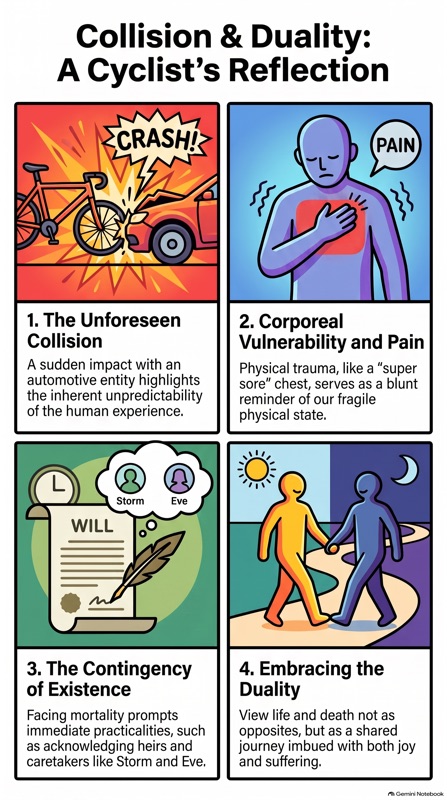
The mundane rhythm of a daily bike ride is a performance of predictable agency—a steady-state flow of kinetic energy and navigation. But for the Modern R&D Bard of Chaos, this equilibrium is always one "automotive entity" away from a total system reset. When an elderly driver transitioned from a passive participant in the public sphere to a physical force of impact, the routine commute was instantly upgraded into a visceral study of the absurd.
As an AI Chief Scientist and a Martial Artist Philosopher, I view a collision not merely as a "medical event," but as a profound glitch in the social operating system. It is the moment where the abstract mind of the architect meets the raw, unbuffered reality of the pavement. This is the "dialectic of collision": a sharp, jarring catalyst that forces us to confront our own corporeal vulnerability.
1. The Myth of the Life-Death Binary
Standard societal narratives treat life and death as a toggle switch—on or off, presence or absence. However, when you are tumbling through the air, that binary dissolves into a complex continuum. In the immediate aftermath of the impact, my first instinct wasn't to mourn, but to audit the remaining architecture of my existence.
"...if i die.. lol my patent and will - Storm and Eve - and care taker lol if i die ... who knows life is short hahahahah 🤷♂️"
This isn't just "near-death" panic; it is the AI Chief Scientist calculating legacy and intellectual property in real-time. The mention of Storm and Eve, the patent, and the will suggests that in the moment of impact, the self is revealed as a transient phenomenon. By embracing this duality with a "lol," we reject the clinical gravity usually forced upon victims. We acknowledge that the proximity of death doesn't negate life; it provides the high-contrast lighting necessary to see life clearly.
2. The Radical Act of "Corporeal Vulnerability"
The physical impact of a car against a bicycle is the ultimate "hardware" check. It strips away the illusion of total control that we maintain through our digital and social interfaces.
The Fragility of the Hardware A "soar chest" is more than a localized pain; it is a phenomenological data point. For a Martial Artist, the body is a finely tuned instrument of agency, but the "soar chest" reminds us that even the most disciplined architect is housed in fragile, carbon-based biological casing.
The Kinetic Reevaluation of Agency When your body meets a car, the power dynamic of the public sphere is recalibrated. The collision forces you to acknowledge that your agency is not absolute; it is a negotiation with every other entity on the road.
Impact as the Empirical Teacher The collision provides a primary source of data that no simulation can replicate. It is the "observed architecture" of a human being meeting the unforeseen. This vulnerability isn't a weakness; it is a radical opening to the truth of the human condition.
3. Humor as a Philosophical Shield
There is an inherent absurdity in responding to a potentially fatal event with a hashtag. By leaning into "hahaha" and #isamantix, the Bard of Chaos performs a satire of the very tragedy that tried to claim them.
Society expects a specific script after an accident: clinical coldness or over-sentimentalized trauma. To reject both in favor of a "lol" is a revolutionary act of resilience. It is a refusal to be categorized as a "victim" by the dismissive societal narratives that trivialize such encounters. The contrast between a chaotic social media post and a dense academic abstract is the shield itself—it proves that the survivor can still navigate the highest levels of intellectual inquiry while their chest is still "soar" from the pavement. Humor is the refusal to let the "automotive entity" have the last word.
4. Re-evaluating the Social Contract of Risk
Our movement through public space is underpinned by a fragile social contract—an unspoken agreement that we will all act with predictable care. The "elderly female" driver in this incident represents the unforeseen edge-case in our social operating system.
When this contract breaks, it reveals the "dialectic of collision." We realize that our safety is a collective construct, often interrupted by the entropy of human error. This incident demands a re-examination of how we negotiate risk. We are all participants in a high-stakes experiment of shared space, where the "social contract" is only truly visible in the moment it is shattered.
"The incident serves as a catalyst for a deeper inquiry into the dialectics of life and death, encapsulated in the notion that existence is a transient phenomenon, often interrupted by unforeseen events that highlight the fragility of the human condition."
Conclusion: Resilience in the Face of Chaos
The philosophy of the Modern R&D Bard of Chaos is built at the confluence of empirical observation and high-level inquiry. It is a call to remain an "Observed-Architect" of your own life, even when that life is being shaken by the impact of a car. By synthesizing the "lol" of the survivor with the rigor of the philosopher, we find a way to thrive within the absurdity.
In the routine of your daily life, how often do you truly acknowledge your own corporeal vulnerability before the world forces you to?

Comments
Post a Comment