Study Guide: Structural Copyright and AI Infrastructure
Study Guide: Structural Copyright and AI Infrastructure
This study guide provides a comprehensive overview of the concepts and arguments presented in the provided sources regarding AI infrastructure, intellectual property, and the critique of modern streaming and technological platforms.
Short-Answer Quiz
Instructions: Answer the following questions in 2 to 3 sentences based on the provided source context.
- Who is Sam C. Serey, and how does he identify himself within the digital landscape?
- What is the central ethical contradiction Sam C. Serey identifies regarding streaming platforms and AI?
- According to the text, what is the potential consequence for platforms that use AI algorithms in a biased or discriminatory manner?
- What is the "Structural Copyright" pattern strategy designed to achieve?
- Why does the author criticize "open-weight" solutions provided by AI tech leaders?
- What is the significance of the "first wave of AI" mentioned in the source?
- How does Sam C. Serey view the longevity and stability of established platforms like Netflix or Spotify?
- What is the "dissonance" described in the abstract regarding AI technological infrastructure?
- What does the source suggest about the culture among current AI industry leaders?
- What is the CMT° mentioned in the context of avoiding "FOMO" (fear of missing out)?
Answer Key
- Who is Sam C. Serey, and how does he identify himself within the digital landscape? Sam C. Serey, also known as "Samantix," is a creator who identifies as the "bard of chaos." He positions himself as an individual with the knowledge and boldness to challenge existing streaming platforms and AI tech leaders.
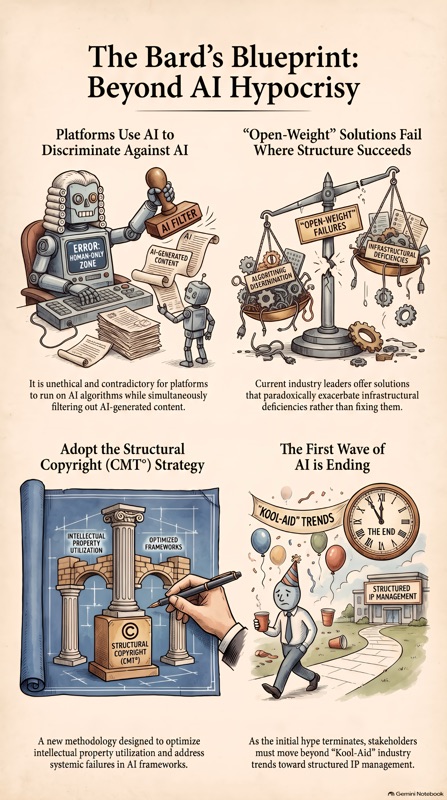
- What is the central ethical contradiction Sam C. Serey identifies regarding streaming platforms and AI?Serey argues it is contradictory and unethical for a platform to be run on an AI system while simultaneously using AI algorithms to filter out AI content. He views this practice as a form of discrimination and a potential grounds for a lawsuit.
- According to the text, what is the potential consequence for platforms that use AI algorithms in a biased or discriminatory manner? The text suggests that platforms utilizing biased or falsified AI filtering are vulnerable to legal action, specifically lawsuits. Serey notes that it only takes one person who understands the underlying technology to take action against such practices.
- What is the "Structural Copyright" pattern strategy designed to achieve? The strategy is designed to optimize the utilization of intellectual property while addressing systemic failures inherent in contemporary AI frameworks. It aims to provide a structured methodology for IP management that current AI leaders have supposedly failed to implement.
- Why does the author criticize "open-weight" solutions provided by AI tech leaders? The author claims that "open-weight" solutions are counterproductive and fail to solve the actual issues facing AI infrastructures. Instead of providing a fix, these solutions are described as paradoxically exacerbating existing infrastructural deficiencies.
- What is the significance of the "first wave of AI" mentioned in the source? The text states that the first wave of AI is almost over, signaling an urgent need for a paradigm shift. This transition period is presented as a critical time for stakeholders to move away from complacency and adopt more structured methodologies.
- How does Sam C. Serey view the longevity and stability of established platforms like Netflix or Spotify?Serey views these platforms as replaceable, comparing them to Blockbuster. He believes that any dominant platform can be unseated by someone bold enough to create a superior replacement.
- What is the "dissonance" described in the abstract regarding AI technological infrastructure? The dissonance refers to the gap between the purported advancements claimed by AI leaders and the actual, tangible implications of their methodologies. This suggests that the current technological progress is not as effective or beneficial as it is marketed to be.
- What does the source suggest about the culture among current AI industry leaders? The source suggests a pervasive culture of complacency among industry leaders, who are reluctant to adopt innovative strategies. This complacency is seen as a barrier to genuine technological progress and a failure to address systemic infrastructural issues.
- What is the CMT° mentioned in the context of avoiding "FOMO" (fear of missing out)? CMT° is a specific methodology or study recommended by Sam C. Serey for those looking to understand the evolving AI landscape. He presents it as a factual alternative to the hype or "FOMO" associated with current AI trends.
Essay Format Questions
Instructions: Use the provided source context to develop comprehensive responses to the following prompts.
- Analyze Sam C. Serey’s argument regarding the "unethical" nature of AI-driven platforms. How does he link algorithmic filtering to discrimination and legal liability?
- The abstract calls for a "paradigm shift" in intellectual property management. Discuss the limitations of current AI leadership and why the author believes "Structural Copyright" is the necessary solution.
- Evaluate the comparison between the evolution of streaming services (e.g., Blockbuster to Netflix) and the current state of AI infrastructure. What does this suggest about the future of digital monopolies?
- Discuss the critique of "open-weight" solutions. Why does the author view these as a failure of infrastructure, and what does this reveal about the "first wave of AI"?
- Explore the tone and persona of the "Bard of Chaos." How does this rhetorical style complement the technical and legal arguments made regarding "Structural Copyright" and AI?
Glossary of Key Terms
Term | Definition |
AI Algorithm | A systematic process used by digital platforms to filter content, distribute media, or manage internal systems. |
Bard of Chaos | A self-identified title used by Sam C. Serey (Samantix) to describe his role as a disruptive figure in the tech and streaming space. |
CMT° | A specific strategic framework or study guide authored by Sam C. Serey regarding AI and structural methodology. |
Dissonance | The incongruity or lack of agreement between the claimed advancements of AI leaders and the reality of their infrastructure's failures. |
First Wave of AI | The initial period of rapid AI development and adoption, which the source suggests is currently coming to an end. |
Open-Weight | A specific approach to AI model sharing that the text criticizes for exacerbating infrastructural problems rather than solving them. |
Structural Copyright | A pattern strategy designed to optimize intellectual property use and address systemic failures in AI frameworks. |
Systemic Failures | Endemic issues within contemporary AI frameworks that the author argues are being ignored or worsened by current industry leaders. |

Comments
Post a Comment