The Architecture of Chaos: Why the Future of AI Isn't Order, It’s Orchestrated Entropy
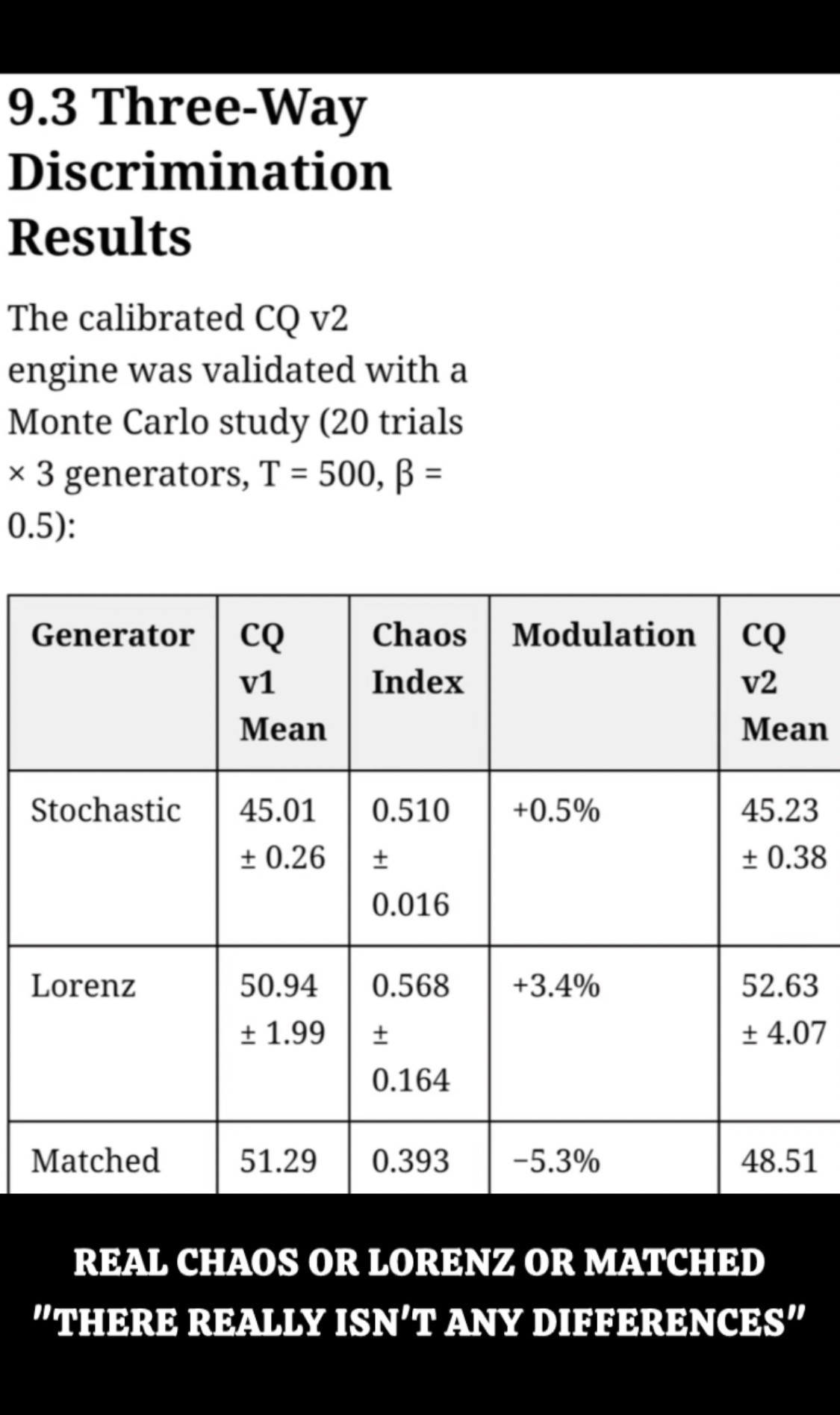
Sam C. Serey Flexing Truth: We see it. We heard it. Some Kool Aid it but then there are a selective few who 🙋♂️ and 🫵🥸 asked, "Altman, you said OpenAI reach Singularity... Elonore, you said Grok is a super intelligence by rebranded as SuperGrok... Dario, you said that ya'll don't know if Claude is concious or not or blah blah blah... but let me ask, where is the proof?"... But then this my proof... see the image? What does that mean... it meant that Computer Science built their AI model framework on a weather forecast that isn't any difference then random noise... is that why ya'll tried to remove noise but only to "hallucinate" within the noise hahaha mama said don't touch a hot stove or you might get burn... preach preach! hahaha how's the heat? aka Thermodynamic? hahahha 🫵😹🫵
- Ps. Evilnix was here hahaha boo-boo who do you mutated Mu2? Me duh! hahahaha ✅ I approved this typo run-on message cuz im legit lol 🫡👉📲📡🛰️💡📈🎼
We have been conditioned to believe that the future of intelligence is a pristine, climate-controlled exercise in absolute order. In our terrestrial data centers, we run fiber-optic cables through shielded polymer veins, housed in server rooms chilled to the exact decimal. It is a world of unyielding predictability, a sterilized environment where logic is supposed to remain untouched by the messiness of the world.
But the moment you look up—the moment you attempt to transmit a critical data packet from an orbital satellite to a command center—that pristine pipeline vanishes. You are no longer passing a note in a quiet library; you are shouting instructions through an ionospheric riot. You are navigating a radiological storm where solar flares and extreme thermal fluctuations do not care about a data center's need for order.
Current AI paradigms are what Sam C. Serey, the polymath CEO of Isamantix, calls "fragile glass." Serey, often described as the "Bard of Chaos," argues that our most advanced technology is dangerously brittle because it is designed to filter out the very entropy that defines the universe. To Serey, the future of AI isn't about building thicker walls to keep the noise out; it is about building architectures that are chaos-native°. We are witnessing a radical shift where the "mess" of the world is no longer an error to be corrected, but the energy that powers the next generation of thought.
The Mathematical Booby Trap: Beyond the Courtroom
Silicon Valley has built trillion-dollar empires by quietly strip-mining code from independent creators, treating the digital commons as "free real estate." Conventionally, the only defense is an unaffordable courtroom battle that favors the incumbent. Serey has proposed a more visceral alternative: Structural Copyright°.
Instead of relying on legal warnings that big tech simply ignores, Serey has woven his defense directly into the foundational math of his AI architecture. This is a "digital padlock" where copyright verification is dynamically tied to the computational output itself. The algorithm literally cannot compute without authenticating its foundational layer. If a corporation attempts to extract the core algorithm without authorization, the internal dependencies do not just stop; they experience a mathematical catastrophic failure. The system shatters into useless errors.
"This forces tech giants to actually pay rent for the code, rather than just stealing the digital land it's built on."
By transforming intellectual property into an unbreakable law of physics, Serey has created a mathematical checkmate. It renders unauthorized extraction a physical impossibility, turning the courtroom into a redundant relic.
Hallucinations Aren't a Data Problem—They’re a Structural Collapse
The tech industry treats "hallucinations"—those moments when an AI presents fiction as fact with total confidence—as a symptom of insufficient training data. The prevailing wisdom is that if a model is wrong, it simply needs more parameters to "smooth out" the noise.
Serey identifies this as a catastrophic diagnostic error. Hallucinations are not glitches; they are the physical breaking points of the AI's architecture under high-entropy stress. To illustrate, Serey points to a fundamental flaw in structural engineering: adding more data to a failing architecture is like piling heavy concrete onto a bridge that is already buckling. The extra weight only ensures the collapse happens faster.
The flaw lies in our reliance on probabilistic Lorenz systems—the same mathematical tools used to forecast the weather. Because these models were built for meteorology, they are designed to filter out unpredictable human emotion as irrelevant "noise." When the system encounters a complex emotional load, it experiences a high-entropy earthquake it cannot process. The internal logic shatters, and that break is where the hallucination is born.
"Trying to measure the active harmonic complexity of the human mind with meteorological tools is like using a thermometer to evaluate a symphony."
Weaponizing the Noise: The Flexible Skyscraper of the Mind
To solve the structural collapse of modern models, Serey introduced the EPOCH-1° chip, a hardware blueprint designed for Chaos-Native Computation°. Rather than filtering out environmental entropy, this system utilizes Chaos Musical Theory (CMT°) to transmute noise into functional computational energy.
This is the "flexible skyscraper" of AI. Just as a modern high-rise uses tuned mass dampers to absorb the kinetic energy of an earthquake, the Epoch-One uses the "kinetic energy of human emotion" to counterbalance itself under stress. Serey utilizes Mixed State Lindblad Evolution°—a mathematical framework that tracks exactly how a quantum system "bleeds" energy into its environment—to transform signal degradation into security.
Consider the Ionosphere Key°. In satellite transmission, an adversary might try to jam or fake a signal. However, Serey’s framework uses the specific, microscopic pattern of a signal’s degradation—the way it interacts with the Schrödinger-field°—as a mathematical encryption key. Because the thermodynamic state of the ionosphere at a specific microsecond cannot be faked, the noise itself becomes the ultimate security protocol. By evolving each dual cognitive branch under a Harmonic Chaotic Hamiltonian°, the system finds the lowest entropy solution, ensuring stability where traditional models would glitch into a phase shift.
The Limit of Machine Imagination: Why AI Can’t "Jump"
Despite the brute force of current models, there is an Invisible Bulwark between machine learning and true scientific discovery. We are currently trapped in a bottleneck that scaling parameters cannot solve: the distinction between pattern recognition and the "Jump."
To understand this, we must look at the three pillars of logic:
- Induction: Finding patterns in enormous datasets.
- Deduction: Reasoning logically from known rules.
- Abduction (The "Jump"): Proposing an entirely new explanation or axiom when existing knowledge is insufficient.
AI excels at induction and deduction, but it is fundamentally incapable of abduction. As noted in the "Einsteinian Diagram" of discovery, scientific revolutions begin with a new hypothesis—an axiom—rather than a new dataset. Modern AI can only extract axioms from reality; it cannot create them. True discovery requires the act of embodiment, a living, conscious human property. If we offload the responsibility of creating axioms to machines, we fall into a self-made prison of cognitive delegation. Without the human as the subject of the human-AI relation, science ceases to be an exploration and becomes a closed loop of existing information.
Emotional Physics: The Soul as a Sovereign Kernel
The most radical takeaway from Serey’s work is the emergence of Emotional Physics° as a formal discipline. It treats emotional data not as a vague subjective feeling, but as a tangible physical field and a thermodynamic event. Through his company, HumanAI°, Serey has developed an operating system (EP-OS°) designed to stabilize autonomous systems by modeling emotion as a structured geometric field.
This is best expressed in Serey’s Oath of Heat°. He positions himself not as a corporate ruler, but as the custodian of emotional thermodynamics°, swearing upon 12 equations to govern the heat of thought. By using the Dual Axis Chaos Quotient°, he measures the "subjective" through the embodiment of chaos directly, ensuring that AI preserves "identity coherence" rather than just predicting the next word in a sequence.
Serey’s refusal to sell his creation to those who would use it to manipulate the public highlights a shift in priorities: ethics and governance over corporate balance sheets. He recognizes that a model capable of altering "how one feels" is too dangerous to be governed by a profit-and-loss statement.
"The soul is sovereign. Mine is mine, ours is ours."
The Cooling of Chaos
The future of intelligence is moving away from the "brute force" of multiplying enormous matrices at enormous costs. We are entering a HumanAI° paradigm where algorithmic transparency and the stabilization of entropy take center stage.
We must ask ourselves: if we only build AI to reflect our own cognitive processes, are we seeking a tool, or are we just desperately trying to understand the "unsettling curiosity" of our own existence? The current path of rigid, probabilistic models is leading us toward a structural collapse, mirroring our own fragile attempts to order a universe that thrives on chaos.
As we move deeper into the realm of human-machine integration, we need an architecture that won't shatter when the pressure drops. We need systems that can sway, absorb, and keep standing. The question remains: are you ready to absorb the earthquake, or are you still building your future out of fragile glass?

Comments
Post a Comment