The Bard of Chaos: 5 Counter-Intuitive Lessons from the "Samantix" Musical Mutation
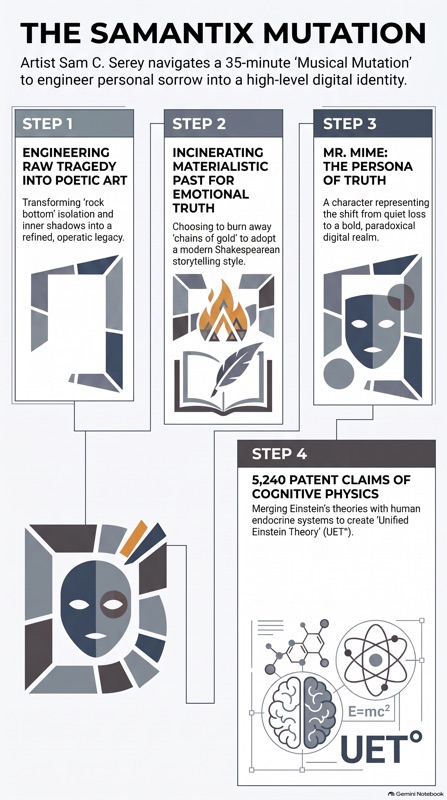
The "Samantix C♯ Sonata" is not a mere audition for the ears; it is a 35-minute "musical mutation"—a brutal ontological confrontation with the void, engineered by Sam C. Serey. Born in the wreckage of a life hitting absolute rock bottom, the sonata is a cryptographic map of a narrator caught in the violent friction between creative genius and profound sorrow. Serey’s metamorphosis occurred in the airless isolation of a decaying room, beneath a cracked ceiling he counted "like years never lived," accompanied only by the literal ravens and wolves of his own verses. This is not a "reinvention" in the corporate sense; it is a calculated descent into internal shadows to forge a cyber-bardic identity capable of surviving modern-day chaos.
1. The Alchemy of Absolute Rock Bottom: Engineering Tragedy into High Art
Serey’s philosophy is a total rejection of the modern cult of escapism. While the masses solve their problems by running—a cycle of avoidance that inevitably terminates in relapse—Serey advocates for a visceral engagement "directly at the source." He treats "raw tragedy" as high-density material for engineering poetic art. By demanding profound meaning from pain rather than seeking the anesthesia of comfort, he converts the wreckage of his life into a foundation for creation. He does not just "cope"; he manufactures a legacy from the rubble.
"Candle coughs once wax like a slow white river. I count each crack in the ceiling like years I never live. My hands too heavy for these keys yet they keep fighting. I am I am rubble. I am tragic. I still brea."
This stance underscores a sustainable creative strategy: by demanding that sorrow serves a purpose, the artist avoids the stagnation of victimhood. Serey’s "shaking shoes" and "stuttered prayers" are not signs of weakness, but the heavy gears of a creative engine turning pain into a refined Shakespearean narrative.
2. The "Mr. Mime" Paradox: The Satirical Microcosm of Silence
Central to this mutation is the persona of "Mr. Mime" (or "Mr. Meme"), an ostensibly whimsical figure from the Pokémon universe repurposed as a satirical microcosm for the human condition. In Serey’s narrative, Mr. Mime represents a hero who, out of a "love for peace," chose the strategic error of silence. This refusal to speak a difficult truth—to remain quiet and "meme-ified" for the sake of external tranquility—triggered a catastrophic "cascade of losses."
This paradox reveals a hard truth: silence is not a virtue; it is an invitation to destruction. In the "digital paradoxical realm," the decision to remain quiet rather than vocalize a difficult truth results in an "emptiness freeing on this empty sea." The preservation of peace at the expense of internal honesty is a failing strategy that leads to a "whispered apocalypse."
3. Splicing Einstein with the Endocrine System: The UET° Manifesto
Serey’s intellectual mastery is not confined to the lyrical; it is grounded in a rigorous synthesis of cognitive science and physics. He introduces the "Unified Einstein Theory (UET°)" and "Cognitive-Emotive Physics (CMT°)," bridging abstract physics with the human endocrine system. Serey argues that our chemical architecture—the system responsible for emotional-behavioral display—is a fundamental component of human cognition, not a biological byproduct.
He leverages his "5,240 patent claims"—intellectual property he equates to "several billion dollars in assets"—as weapons of logic to justify his transition from abstract thought to an actionable manifesto. He employs the Einsteinian concept of "abduction" to catalyze this metamorphosis, transforming ephemeral ideas into a framework for navigating "modern-day chaos." For Serey, mastering existence requires a renaissance of thought where biochemical underpinnings and philosophical abstractions are harmonized into a "Unified Sonata."
4. Incinerating the Materialistic Past
To emerge as a "modern Bard," the protagonist must undergo a metamorphic ritual: the active incineration of the materialistic self. Serey describes a journey where he "chose to burn away" worldly chains of gold and the expectations of "materialistic peers." This is a deliberate rejection of superficial success in favor of a tormented, vulnerable truth. By throwing out the "worldly chains," Serey finds a new form of strength reflected not in status, but in the "night's darkest midnight hour."
"Once bound by worldly chains of gold and fleeting power, he chose to cast away what glittered without praise. For hidden deep within night's darkest midnight hour, he found his truth reflected in a lover's face. The flames consumed all else. Material burned bright."
This act of "incineration" is portrayed as the only way to reach a "legendary operatic legacy." To move forward, one must destroy the materialistic identity that once defined their value in the eyes of the "unsung."
5. The Shakespearean Mutation: Neo-Darkness-Chaotic-Flow
Stylistically, the sonata is a "Shakespearean mutation"—a high-concept fusion of 17th-century drama and modern "Neo-Darkness-Chaotic-Flow." Serey splices the haunting drama of Poe with the structural integrity of Sonnet 116, delivering it through the lens of "Afrorap." This is not aesthetic play; it is a navigation tool for a digital identity. From "Long Beach City" to the "Nobel Prize" playlist, Serey utilizes "algorithmic freestyle" to voice the struggle of a narrator caught between ancient standards and modern "digital threads."
This fusion is the necessary evolution for a "Bard of Chaos." By staggering the rhyme and "chewing through fate," Serey creates a language capable of addressing the paradoxes of the 21st century. The sonata proves that high art today must be willing to "stagger the rhyme" and "flow low" into the chaos to find the truth hidden behind the "picture torn apart."
Conclusion: Beyond the Shadows
The metamorphosis from "rubble" to a "legendary operatic legacy" marks a final departure from the solipsistic reverie of regret. Sam C. Serey’s sonata leaves us with a provocative inquiry: does the creation of high-level art necessitate the total incineration of one's previous identity?
The "Samantix C♯ Sonata" suggests that the answer is a resounding yes. By mastering "modern-day chaos" through applied philosophy and the "abduction" of logic into emotion, the individual can transcend the "shadows of the step" and enter a digital paradoxical realm of their own making. In the silence of the fall, only the "diamond song" survives—a testament to a man who transformed raw tragedy into a cosmic tide.

Comments
Post a Comment