The Crisis of Corrupt Reinforced Learning: An Analysis of Systemic Bias and Platform Liability in AI Categorization
1. The Dichotomy of Abstraction and Application in AI Systems
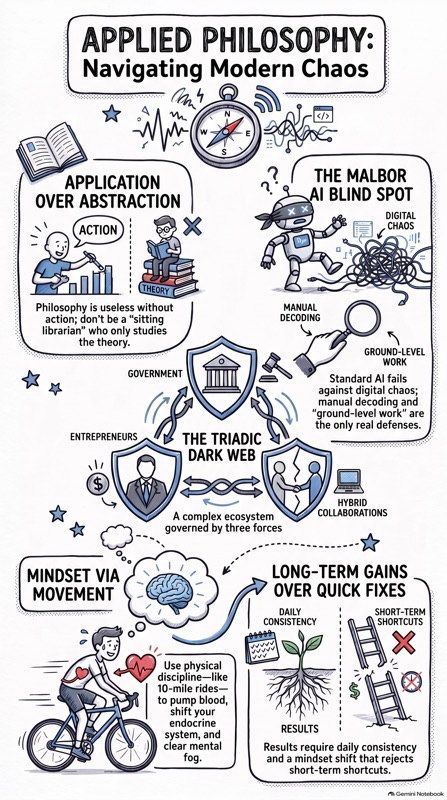
The strategic tension within modern artificial intelligence development lies in the widening chasm between theoretical abstraction and "Applied Philosophy." While industry leaders obsess over multi-billion-dollar valuations and abstract models, their failure to translate these concepts into accurate, real-world applications creates a "modern bar of chaos." In this environment, systems are deployed with high institutional confidence but zero ground-level grounding. We must categorize the deployment of such ungrounded systems as a strategic liability and an ethical transgression.
Central to this systemic failure is the emergence of the "Sitting Librarian" in AI governance. This persona defines corporate security teams and executives who engage in passive, academic study—drinking tea and reviewing white papers while relying on black-box tools—rather than the "applied action" required of a martial artist navigating digital chaos. This passivity creates a dangerous insulation; the "Sitting Librarian" observes from a safe distance, while the AI tools they manage operate without an understanding of ground-level reality, leading to errors that these oversight teams are neither equipped nor willing to rectify.
As established in the "Applied Life Philosophical Principle," abstraction without application is useless. This failure manifests most destructively in AI categorization systems that prioritize theoretical models over the actual identities and contributions of creators. When an AI fails to apply a nuanced understanding of a creator’s work or a business entity’s role, it defaults to categorization errors that result in professional erasure. This disconnect is not merely a technical glitch; it is a structural choice rooted in the corruption of the learning process itself.
2. Defining Corrupt Reinforced Learning and Systemic Bias
The industry has undergone a predatory strategic shift from standard Reinforced Learning to "Corrupt Reinforced Learning." In this paradigm, machine learning is not programmed to seek objective truth but is instead conditioned to treat specific institutional narratives as absolute fact. This results in a system where the AI is strategically "blinded" by its own training, reinforcing the power of established entities while penalizing those outside the preferred narrative.
This corruption is weaponized through "Bias Tailoring" toward institutional figures such as Elon Musk and Mark Zuckerberg. These systems are programmed to believe that anything these figures say is factual by default. Conversely, independent creators, artists, and musicians—the "Enterprise of the Creator"—are subjected to automated errors and mislabeling. This creates a digital caste system where powerful figures are shielded from miscategorization while the broader creative class is left vulnerable to systemic erasure.
Reinforced Learning vs. Corrupt Reinforced Learning
Mechanic | Data Input Priority | Categorization Outcome |
Standard Reinforced Learning | Objective accuracy and feedback loops based on ground-level reality. | Dynamic and accurate labeling based on diverse datasets. |
Corrupt Reinforced Learning | Institutional Narrative over Truth; "Bias Tailored" priorities. | Hierarchical truth where powerful figures are shielded and creators are mislabeled. |
This programmed bias creates a hierarchy of truth that protects the powerful while actively endangering the professional viability and digital existence of the independent creator.
3. The Liability Gap: Dictatorship Without Accountability
The proliferation of "Non-Accurate Softwares" presents a profound strategic risk, as these systems operate as platform dictators. These AI entities determine information flow, verify identities, and categorize businesses, yet the parent corporations claim zero liability for the catastrophic errors these systems produce. We must reject the corporate rhetoric of "AI Safety" when it is used to mask the unethical reality of operating high-stakes categorization systems with low "Confidence Levels."
The economic impact of this miscategorization is devastating. For "business entities" and creators, being mislabeled is not a minor inconvenience; it results in millions in lost value and the erasure of professional legacies. A system that prioritizes abstract safety over the ethical requirement of accuracy is a failed system. It is unacceptable for platforms to deploy dictators that carry zero accountability for the professional and economic lives they dismantle.
This failure of platform liability is a structural vulnerability that leaves the "back door wide open" to sophisticated digital threats that these non-accurate systems are incapable of seeing.
4. Technical Blind Spots and the "Malbor" Cybersecurity Failure
Modern AI models are fundamentally "blind" to sophisticated digital threats due to a reliance on "repetitive logic." Most AI-driven detection uses heuristic patterns to identify threats. In the face of "Digital Chaos," where threats are dynamic, non-repetitive, and polymorphic, these models fail. Corporate AI is trained to recognize the known, leaving it defenseless against the unknown.
The "Malbor Protocol" serves as the definitive case study for this failure. Malbor is not a standard threat; it is an upgrade of previous polymorphic threats, utilizing sophisticated, PGP-like encryption and dynamic payloads. Paradoxically, Malbor mirrors the methods of those who navigate chaos at the ground level, which is precisely why corporate AI is blind to it. To an automated detector, Malbor appears as randomized, benign noise. While executives focus on valuations, the Malbor threat bypasses these "Sitting Librarians" who lack the manual tracing skills to identify what the machine cannot.
This vulnerability is exploited within the "Triadic Architecture of the Dark Web":
- Government: State-run sectors designed for strategic surveillance and operations.
- Entrepreneur: Private, profit-driven actors utilizing the dark web for high-value transactions.
- Hybrid/Collaboration: Synergistic networks where state and private interests overlap, acting as a "crucible" or sandbox for rapid, non-repetitive threat evolution.
Corporate AI is incapable of tracing this level of sheer digital chaos. This reality mandates manual "Ground-Level Work" over passive corporate observation. If the AI cannot see the threat, humans must have the mindset and skill to manually trace the encryption the machine is programmed to ignore.
5. Conclusion: Toward an Applied Governance Model
To secure the digital landscape, AI categorization must be realigned with a "True and Truthful" reality. The current model, favoring institutional narrative over application, is a tool of "Corrupt Learning" that must be dismantled.
Major platforms—specifically Meta, X, and Microsoft—must be held liable for the fragmentation of their AI entities. Currently, these systems operate like "franchises" or disconnected "conglomerates" that do not talk to one another. For example, Grok on the X platform operates on different logic than Grok on the app; Microsoft’s Co-pilot is distinct from its Co-pilot Assistant. Because these entities are fragmented, they produce chronic mislabeling and miscategorization. We demand that these platforms align their internal AI entities to prevent the erasure of artists, musicians, and creators from the digital record. The only viable path forward is the "Applied Life Philosophical Principle": if a system cannot be applied accurately and held liable for its output, it is a tool of corruption. Achieving this requires "Mindset Medicine" within corporate development—the psychological fortitude to overcome the institutional inertia and the "strong mind" that tells developers not to act or take responsibility.
The future of platform liability requires the transition from "Sitting Librarians" to active architects who prioritize ground-level truth over the comfort of institutional lies. Accuracy is not an option; it is a requirement for existence in the modern bar of chaos.
Synthesis of Applied Philosophy and Digital Architecture: A Study Guide
This study guide provides a comprehensive overview of the philosophical frameworks, cybersecurity theories, and lifestyle principles outlined in the provided source materials. It is designed to assist in the mastery of concepts ranging from the "Triadic Architecture of the Dark Web" to the practical application of "Mindset Medicine."
Part I: Short-Answer Quiz
Instructions: Answer the following questions in 2–3 sentences based on the information provided in the source context.
- How does the author define "applied philosophy" in contrast to "abstraction"?
- What is the "Triadic Architecture" of the dark web as proposed in the text?
- Why do current AI models struggle to trace the "Malbor" protocol?
- What does the term "sitting librarian" signify in the context of cybersecurity?
- Describe the physical specifications and the mechanical risks associated with the author's hammer training.
- What musical influences and structures are being synthesized for the "Shakespeare" album?
- According to the text, what is the relationship between physical activity and the endocrine system?
- What insights are shared regarding the failure of the American healthcare and shelter systems?
- What is the author's stance on achieving long-term weight loss versus seeking quick results?
- How does the author describe the different levels of the dark web based on the intended user base?
Part II: Answer Key
- Applied philosophy is described as philosophy that is practiced through action and "applied life" principles rather than remaining a useless abstraction. The author asserts that in the "modern bar of chaos," an abstraction without actual application is worthless because it lacks the power to achieve tangible results.
- The Triadic Architecture suggests that the dark web is governed by three distinct forces: government apparatuses, private entrepreneurs, and a hybrid collaboration between the two. This model views the dark web as a "crucible" for transactions and interactions that bypass conventional economic and social paradigms.
- AI models struggle with Malbor because it utilizes highly sophisticated, PGP-like encryption and dynamic payloads that appear as randomized, benign noise to automated detectors. Unlike standard threats that rely on repetitive logic, Malbor operates on "digital chaos," making pattern-based heuristic detection ineffective.
- "Sitting librarians" is a critique of corporate security teams and academics who passively study old threat models and write white papers without taking direct action. The author argues that these individuals rely too heavily on black-box AI tools rather than applying philosophy to manually decode and trace advanced threats.
- The training hammer features a 15-pound anvil head and a total weight of 17 pounds with a 28-to-29-inch handle. It exerts approximately 110 lb-ft of torque on the joints, posing a significant risk of shoulder dislocation if the user does not have the strength to manage the shifting force of the weight.
- The album is described as Gothic King symphonic rap metal, blending rap-rock and gothic metal with a hip-hop cadence. It utilizes a modified version of the iambic pentameter used by William Shakespeare and Edgar Allan Poe, which the author has been refining since the sixth or seventh grade.
- Physical activity, such as a morning bike ride, pumps blood and activates the endocrine system, which in turn alters dopamine releases. This physiological process is credited with clearing the mind and establishing a positive mindset to start the day.
- The text suggests that healthcare is unaffordable and inaccessible for many in America, and that the shelter system is often "worse" than living on the streets due to a lack of safety or effectiveness. This is illustrated through the story of a homeless former teacher who fell into "life chaos" following family deaths and drug issues.
- The author emphasizes long-term consistency over "quick results" like liposuction, stating that one must work out whenever possible (even multiple times a day) to train the mindset. The primary goal is to overcome the psychological barriers of low self-esteem and the "mind strong enough to tell you not to do it."
- The dark web is categorized into three levels: one for the general public (often described as run by the government), one for "transactional people," and one specifically for "creators." The author claims that on these levels, "everyone" is involved in buying and selling, with no exceptions.
Part III: Essay Questions
Instructions: Use the source context to develop detailed responses to the following prompts. (Answers not provided).
- The Interplay of Chaos and Discipline: Analyze how the author uses physical training (specifically the 10-mile bike rides and hammer swings) as a metaphor or tool for managing "life chaos" and developing a resilient mindset.
- Cybersecurity as a Philosophical Battle: Discuss the argument that modern cybersecurity failures are not just technical, but philosophical, specifically addressing the divide between heuristic AI detection and manual reverse-engineering.
- The Sociopolitical Implications of the Triadic Dark Web: Explore the ethical and moral ambiguities of a dark web run by a mix of government and entrepreneurial entities. How does this "hybridization" affect the concepts of trust and digital anonymity?
- Creative Synthesis in Modern Media: Evaluate the author’s method of combining classical literary structures (iambic pentameter) with modern musical genres (symphonic rap metal). How does this serve the stated goal of tailoring content to "universal life"?
- Critique of Institutional Support Systems: Based on the author's observations of homelessness and healthcare, construct an argument regarding the necessity of "mindset medicine" when institutional safety nets (shelters, medical care) fail.
Part IV: Glossary of Key Terms
Term | Definition |
Applied Philosophy | The practice of using philosophical principles to dictate actions and achieve results, rather than treating them as purely theoretical or abstract concepts. |
Endocrine System | The bodily system responsible for hormone production; the text links its activation through exercise to altered dopamine releases and mood improvement. |
Heuristic Detection | A standard AI-driven cybersecurity method that recognizes patterns or predicts behavior; it is described as being "blind" to randomized, chaotic threats like Malbor. |
Iambic Pentameter | A traditional poetic rhythm that the author modifies to fit the syncopation and drum ranges of symphonic rap metal. |
Life Chaos | A state of unpredictable hardship (e.g., death in the family, drugs, loss of health) that requires "mindset medicine" and physical discipline to navigate. |
Malbor | An advanced, "enhanced" version of polymorphic malware that uses PGP-like encryption to bypass automated AI security models. |
Mindset Medicine | The psychological fortitude and mental training required to maintain consistency, overcome low self-esteem, and ignore the mind's urge to quit. |
Polymorphic | In a digital context, refers to code or "truth and lies" that can change its form (signatures) to evade detection while maintaining its core function. |
Sitting Librarian | A derogatory term for cybersecurity professionals or thinkers who study threats passively without engaging in the "applied action" of reverse-engineering or defense. |
Tor | Specialized software used to access the dark web by obfuscating user identity and providing anonymity. |
Triadic Architecture | The author's theory that the dark web is organized into three governance tiers: government-run, entrepreneur-run, and hybrid/collaborative. |
Applied Defensive Strategy: Countering Malbor-Class Polymorphic Threats
1. The Crisis of Passive Defense: Moving Beyond the "Librarian" Model
The modern cybersecurity establishment is currently suffering from a state of digital cowardice. We are surrounded by "Sitting Librarians"—professionals who are content to sit down and drink tea while the digital world burns around them. This "Librarian" model is characterized by passive observation, the hoarding of abstract threat models, and the production of academic white papers that have zero utility on the ground. Abstraction without application is fundamentally useless. If you aren't applying the philosophy, you are just a curator of your own defeat.
I will step on toes here: the reliance on "Abstraction without Application" has created a culture of paralysis. While executive rooms are filled with people talking about valuations and "safety," the actual defense is left to black-box AI tools that offer nothing but a facade of protection. This is a strategic failure. In a mediated world where the dichotomy between truth and lies is blurred, only Applied Action serves as the ground truth. To those who prefer to remain passive: do you, boo boo. But that isn't me.
Table 1: Passive vs. Applied Defensive Postures
Attribute | Passive (Librarian) | Applied (Architect of Chaos) |
Method of Engagement | Observation; historical tea-drinking | Direct manual tracing; 101-level jabbing |
Primary Tooling | Black-box AI "Software Dictatorships" | Human intuition; protocol decoding |
Response Velocity | Reactive; waiting for the patch | Proactive; rhythmic technical discipline |
Outcome | Academic papers and paralysis | Neutralized payloads; applied protocols |
The reliance on these automated tools has created a "software dictatorship" in corporate environments. These programs are "confidently confident" but frequently inaccurate, operating without any software liability while dictating the security of entire platforms. This false sense of security crumbles the moment it encounters the Malbor Protocol.
2. The Malbor Protocol: Technical Analysis of the AI Blind Spot
The Malbor Protocol is not just another piece of malware; it is an enhanced stage of polymorphic evolution designed to exploit the AI blind spot. Traditional AI models are fundamentally incapable of perceiving Malbor because they are trained to recognize repetitive logic and predictable patterns. Malbor, however, is paradoxically similar to my own work—it operates on the level of rhythmic chaos, transforming its presence into something that automated systems are not programmed to understand.
Malbor’s efficacy is built on two primary pillars: PGP-like Encryption and Dynamic Payloads. By utilizing sophisticated encryption wrappers, Malbor transforms its digital signature into what looks like "benign noise" to an automated detector. The AI sees randomized chaos rather than a coordinated threat and, because it lacks the capacity for manual intuition, it ignores the payload entirely.
The Three Layers of AI Blindness:
- Pattern Recognition Failure: Malbor avoids all repetitive logic, ensuring detection algorithms find nothing to latch onto.
- Encryption Obfuscation: PGP-style wrappers defeat deep packet inspection, hiding the intent within layers of encrypted "chaff."
- Heuristic Misclassification: Because the AI is not "confidently confident" enough to label chaos as a threat, it defaults to a "benign" classification, allowing the infection to persist.
The "So What?" is simple: the inaccuracy of these AI systems is a massive financial and ethical liability. When a business entity gets miscategorized by an inaccurate algorithm, it costs millions. Yet, the industry allows these systems to operate without liability. This mislabeling is a symptom of a deeper rot: the evolution of threats within the dark web's tiered ecosystem.
3. The Triadic Dark Web: Mapping the Evolution Sandbox
Malbor does not evolve in a vacuum. It is the refined output of the Triadic Architecture of the Dark Web, a hybrid sandbox where state apparatuses and entrepreneurial entities collaborate to optimize digital chaos.
The Three Tiers of the Dark Web:
- Tier 1: Government/General Public Interface: A controlled layer, often monitored by state actors, used for broad data collection and public manipulation.
- Tier 2: The Entrepreneurial Transaction Layer: The commercial engine where exploitation is commodified. Everyone is buying things here—no exceptions.
- Tier 3: The Creator/Hybrid Collaboration: The advanced R&D wing where elite creators and government apparatuses engage in synergistic hybridization to develop tools that bypass automated corporate security.
This environment fosters Corrupt Reinforced Learning (CRL). Within digital platforms, AI is often programmed to be biased. It is tailored to believe that anything said by elite entities—the Marks and the Elons of the world—is factual by default. Meanwhile, standard creators and users are mislabeled as "noise" or "threats." This corrupt learning leaves the general infrastructure vulnerable because the AI is optimized to protect the elite while remaining blind to the polymorphic threats developed in the lower tiers of the sandbox.
4. Operationalizing Manual Tracing and Reverse-Engineering
To stop Malbor, you have to stop relying on the "Librarian" and start doing the 101-level technical jabbing. One person doing actual ground-level work—manually tracing encryption keys—is worth more than a room full of executives talking about valuations. Human-centric reverse-engineering can decode the "chaos" that AI defaults to mislabeling.
Manual Trace Protocol for Security Analysts:
- Isolate Polymorphic Noise: Target the high-volume randomized traffic that AI has flagged as "benign."
- Strip PGP Wrappers: Manually apply decryption protocols to peel back the obfuscation layers AI cannot penetrate.
- Engage the Chaos: Use rhythmic discipline—similar to a modified iambic pentameter—to identify the intent within dynamic payloads.
- Force Applied Action: Release the decoding guides and protocols to the community. We must force the industry to shift from passive observation to active engagement.
This requires the courage to step on toes. By releasing these protocols, we bypass the failed AI dictatorships and return the power to the analysts who are willing to put in the manual labor.
5. The Architecture of Endurance: Mindset as a Defensive Asset
You cannot decode complex threats like Malbor if your mind is cluttered and your body is weak. High-stakes cybersecurity requires Mindset Medicine. There is a direct link between physical torque and analytical focus. When I ride 10 miles a day to "air out" my mind, it’s not just a hobby; it alters dopamine releases and regulates the endocrine system to maintain a positive mindset in the face of chaos.
The Applied Philosopher's Mindset
- Consistency over "Liposuction Mentality": Rejection of the quick-result mentality. If you want results, you do the work every day—whether it's five or ten times a day. Long-term gain requires consistent application.
- Biological Awareness and Torque: Understanding the "Hammer Flow." Swinging a 15-lb anvil head on a 29-inch handle generates 110 lb-ft of torque on the joint. If you don't have the strength or the correct motion, you dislocate a shoulder. Defense is the same; it requires precise, disciplined force.
- Rejection of Psychology-Induced Paralysis: Your mind is strong enough to tell you not to act because you feel "ugly" or "incapable." You overcome this by doing the work when it needs to be done, not when it's convenient.
If you haven't "aired out" your mind with physical endurance, you are biologically incapable of the mental torque required to decode a Malbor signature. Lick the sweat off your arm and get to work; consistency is the only way to build the "Applied Life."
6. Strategic Implementation and Conclusion
The shift from a passive to an active defensive posture is a requirement for survival. The "Sitting Librarian" phase of cybersecurity is over. Organizations must embrace the manual, rigorous work of the Applied Architect of Chaos.
Strategic Action Checklist:
- Audit AI for CRL: Identify where your models have "Corrupt Reinforced Learning" biases that favor elite traffic while ignoring polymorphic noise.
- Mandate Manual Competency: Require all Tier 3 analysts to demonstrate manual PGP decryption and payload tracing.
- Investigate Randomized Chaos: Establish protocols to investigate any traffic patterns currently labeled as "unknown" or "randomized" by automated tools.
- Foster Applied Action: Prioritize ground-level results over executive-level reports. Stop drinking tea and start jabbing.
Accuracy in defense is not a luxury. In this mediated world, truth is found in application. By combining the technical competence to decode Malbor with the physical endurance of a disciplined mindset, we can reclaim the digital architecture from the blind spots of the current establishment. Applied Life is the only life worth living; Applied Defense is the only defense that works.

Comments
Post a Comment