The Ghost in the Algorithm: 5 Surprising Truths from the Samantix C♯ Sonata
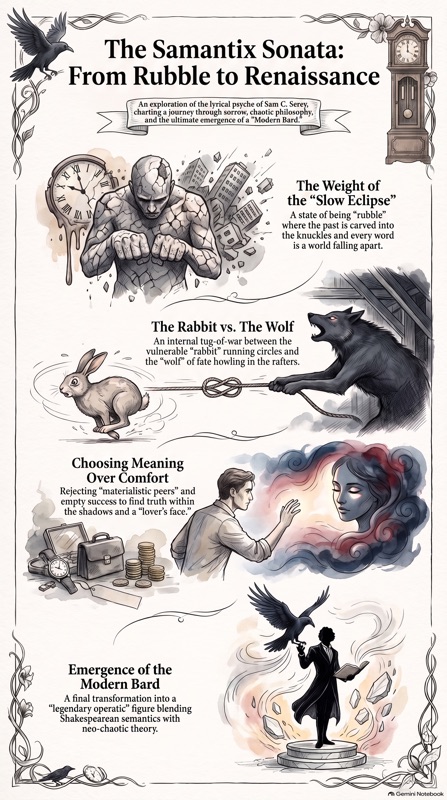
Candle coughs once, wax a slow white river; the human firmware is glitching. In the "Samantix C♯ Sonata," we are not merely listening to a musical composition, but witnessing a software patch for the soul. The Bard—a modern metamorph—navigates a landscape of object-oriented heartbreak, where the structural logic of C♯ programming collides with the compiled grief of a Shakespearean tragedy. It is an avant-garde mutation: a rap symphony where the narrator attempts to debug his own existence while the grandfather clock limps forward, out of sync with the digital sea.
1. The Choice of Meaning Over Comfort
In an era optimized for user experience and the mitigation of friction, The Bard executes a radical command: he deletes the "Mercy" protocol. In the Sonata, there is an explicit rejection of self-care in favor of "witness." This isn’t a failure of the system; it is a deliberate "staggering of the rhyme." By refusing a "straight" life and a predictable cadence, Samantix asserts that meaning is found not in the resolution of the code, but in the friction of the execution.
"I don't want mercy. I want witness. Carving little meanings in the pain."
This is the syntax of suffering. To "carve" meaning into the rubble is to transform the passive experience of disintegration into a constructive act of lyrical resistance. He is not looking for a fix; he is looking to be seen amidst the wreckage.
2. The Rabbit and the Wolf—Survival in a Kingdom of Tracks
The Sonata utilizes a recurring animalistic metaphor to describe the vulnerability of the human condition within fate’s algorithmic design. The Bard depicts himself as a "rabbit running circles in a kingdom of wolf tracks"—a visual of a processor caught in an infinite loop of pre-determined predation. It is a "slow doom," chewing through a fate that was never intended to be linear.
However, the logic gates shift when The Bard poses the pivotal rhetorical question: "Art thou the victim or art thou the crime?" This marks a transition from prey to predator—a transformation into the "wolf in the rafters" whose teeth are "full of prayer." He is no longer just the data being processed; he has become the sermon, the "cracking holy marble" of the system itself.
3. The "Sam I Am" Paradox—Success as a Tragic Play
The most striking revelation within the "Sam I Am" sequence is the internal conflict between legendary status and physical rubble. The Bard reflects on a life where "teeth like unpaid bills" and "breath like hospital glue" ground the lofty abstractions of fame. He admits that while he achieved the height of the mountain, he found "emptiness freeing"—the freedom of the void where the weight of the "Superman" promise finally evaporates.
Superman Promises and Broken Vows
The Bard presents a stark contrast between his public persona—the "unyielding light" predicted to glow—and the gritty reality of his "one-room" tragedy. He stares at a photo "fixed with black tape," a tactile reminder of promises "too scarred" to keep. In this "broken gram" of a life, success is not a victory but a "tragic play" unfolding in the gloom of Long Beach City, where the only thing left to do is float alone on an empty sea.
4. The Algorithmic Bard and "Mr. Mommy"
The Sonata introduces a bizarre, satirical identity that reconciles god-like "legendary" status with human vulnerability. The Bard calls himself a "metamorph" and a "satirical philosophical genius," but he also adopts the moniker "Mr. Mime." This is not accidental absurdity; it is a deliberate juxtaposition. He is "Elon eloquently" specifically to "charm the ladies," a "so sec-see genius" who recognizes the "cringe" and irony of his own digital dominance.
He uses "Shakespearean semantics" to mask a "restless soul caught in a tight grasp." This is "algorithmic freestyle," where the narrator’s theories are "sanding" away, being worn down by the very reality he attempts to model. As "Mr. Mime," he becomes a name whispered across chaotic seas—a RSVP to a neo-chaotic spree where digital threads intertwine with the domestic and the divine.
5. Love as the Ultimate "Incinerator"
As the Sonata reaches its terminal execution, the focus shifts from digital chaos to a primal, thermal resolution. The Bard decides to "burn down your fears" and "incinerate materialistic peers." This is the ultimate renunciation: casting away the "worldly chains of gold and fleeting power" that once bound him on his ancient hill.
Standing "on top of the mountain," loved by all and "even legendary," he reveals his final, irreducible vulnerability. For a man who has navigated infernal tears and cosmic tides, the only fear that survives the fire is the "fear of losing his dearest dear forever." The "lover's face" becomes the only mirror left unbroken, the only truth that cannot be simulated or synthesized.
Conclusion: Beyond the Digital Sea
The journey of Samantix is a transition from the flickering candle of a whispered apocalypse to a "neo-chaotic spree" across a digital sea. He moves through the "rubble" of his own history, eventually finding a way to be "synchronized within a lyrical anatomy" that accepts the flame as much as the light.
As we navigate our own modern strifes, we must ask: are our identities becoming increasingly synchronized within a broader, lyrical anatomy, or are we, too, just shadows dancing in a one-room of our own making?

Comments
Post a Comment