The Thermodynamics of Deception: Why the "Bard of Chaos" is the Only One Prepared for the Algorithmic Collapse
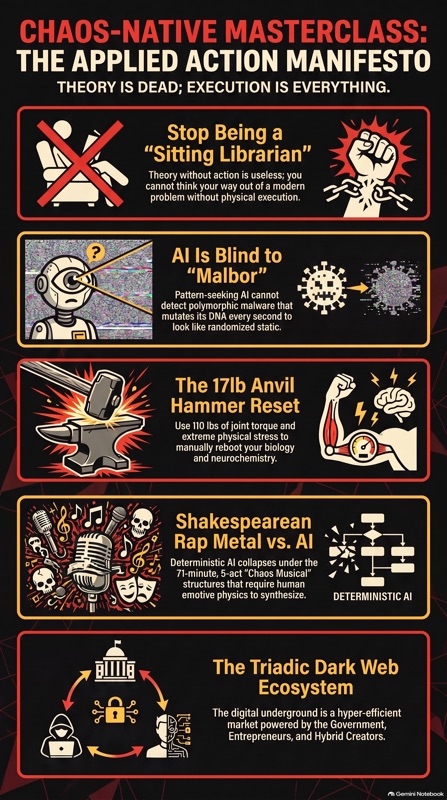
In our contemporary landscape, we have succumbed to the seductive myth of the "clean algorithm." We are sold a vision of a frictionless future where Artificial Intelligence smoothes over the entropic despair of human existence. Yet, beneath the polished glass of our interfaces lies a reality of sheer chaos—a physical and digital ocean that the architects of these systems are ill-equipped to navigate.
Enter Sam C. Serey, the "Bard of Chaos." His Chaos-Native Masterclass serves as a scathing critique of what he calls the "Sitting Librarians." These are the theorists and corporate technocrats who have meticulously memorized the "manual of the ocean" from the safety of their couches, only to drown the moment they are pushed into the actual swell. Siri’s thesis is simple: our modern systems are failing because they prioritize abstract theory over applied action.
To survive the coming decade, we must bridge the epistemological blind spots of the digital age. Here are the five most counter-intuitive takeaways from the front lines of chaos.
1. "Hallucinations" are a Corporate Liability Shield
The tech industry, led by narrative figures like JinSin Hung, frequently dismisses AI errors as "hallucinations"—a term that suggests a charming, almost human quirk of a developing mind. Serey argues this is a calculated legal deception. He connects these failures directly to the brutal laws of thermodynamics: in massive data centers, chips are pushed to their absolute thermal limits. To prevent melting, hardware relies on thermal throttling, which disrupts the delicate parallel processing required for accuracy.
By labeling hardware instability as a "software hallucination," companies create an ironclad shield against liability for defective infrastructure. While these firms preach a utopian vision, Serey points to "side-hustle deals" and "letters of intent" used to fast-track chip exports in as little as ten days, bypassing safety concerns to arm a global, unregulated arms race.
"Hallucination is actually a very convenient legal buzzword. It is engineered to excuse defective overheating hardware products... It’s like selling a multi-million dollar high-performance sports car, but waving away the fact that the brakes randomly fail as just a charming quirk of the engine."
2. The Dark Web is a Highly Structured "Triadic" Ecosystem
Contrary to the popular imagery of a lawless basement, Serey describes the dark web as a sophisticated, almost incestuous ecosystem held up by three pillars:
- Governments: Who provide the structural baseline, utilizing these untraceable networks for intelligence and surveillance.
- Entrepreneurs: The "transaction people" seeking unregulated markets to move massive capital.
- Hybrid Creators: The elite hackers and coders building the actual architecture.
This triadic structure creates a profound paradox. The same space utilized for state-sponsored espionage and illicit commerce serves as the only sanctuary for free expression against authoritarian regimes. In this sandbox, the lines between criminal activity and democratic survival are permanently blurred, and threats are pressure-tested by the smartest actors on Earth.
3. "Malbor" and the Epistemological Blind Spot of AI
Modern AI security relies on "heuristics"—deterministic algorithms trained to find fixed patterns and known virus signatures. Serey introduces "Malbor" (Polymorphic Truths & Lies) as the ultimate counter-measure. Malbor utilizes dynamic payloads, meaning the virus literally rewrites its own code and "mutates its DNA" every second as it traverses a network.
Furthermore, Malbor employs PGP-like encryption to scramble data packets so thoroughly they no longer resemble cohesive files. To an AI "bouncer" trained to enforce order, this traffic appears as nothing more than benign, randomized static. When a threat possesses no fixed pattern, an automated system designed for pattern recognition becomes effectively blind.
4. The "Anvil Hammer" as Mindset Medicine
To navigate this digital abstraction, Serey prescribes "Mindset Medicine"—the use of extreme physical stress to manually override neurochemistry. His primary tool is a 17lb medieval anvil hammer, measuring 28-29 inches in length. Swinging this object incorrectly generates 110lbs of torque on the shoulder, demanding an absolute presence that intellectualization cannot fake.
Serey uses this "hardware fix" to address "software glitches" in the human mind, such as low self-esteem or digital overwhelm. By forcing the body through grueling hammer work or 10-mile bike rides in heavy wind, he manually reboots his endocrine system, overriding the brain's default settings to force a release of dopamine and serotonin. In an age of digital shadows, the forearm striations earned from physical torque are the only proof of foundational strength.
5. Why AI Cannot Generate True Art: The Pandora Factor
Serey asserts that AI will inevitably collapse under the weight of existential chaos. While algorithms can simulate creativity, they lack "abduction"—the human ability to generate entirely new ideas rather than rearranging existing data. This is why AI cannot replicate the complexity of Serey’s 71-minute, 5-act operatic structures, which reverse-engineer the iambic pentameter of Shakespeare and Poe into modern, syncopated rap-metal.
The ultimate failure of AI is illustrated in Serey's "Cosmic Divorce Court Case (Pandora v. Paradox)." When faced with a judge ruling on "spontaneous poet cognition" or the absurdity of a system that "both exists and voids itself," the binary logic of AI shatters. Human artistry thrives on the very entropy and cognitive dissonance that break algorithms.
"The system shifted from open to close spontaneously, nullifying the original open system agreement. Thus, the contract both exists and voids itself. In simpler terms, the marriage imploded into a self-negating paradox."
Conclusion: Are We a Society of Sitting Librarians?
The "Chaos-Native" philosophy leaves us with a haunting warning. We are currently outsourcing our resilience to multi-billion dollar systems that are physically and digitally fragile. Data centers consumed 4.4% of U.S. electricity in 2023, a figure projected to hit 12% by 2028. We are placing an astronomical load on a buckling power grid, yet we rely on automated "bouncers" that cannot even see the next wave of mutating malware.
We have engineered a society of Sitting Librarians—experts who know the theory of everything but the application of nothing. When the next wave of chaos arrives, our automated defenses will likely see the crisis as "benign noise."
The only real firewall is human applied action. If we lose the ability to swing the hammer ourselves—to navigate the water rather than merely reading the manual—we will be defenseless against the next great tide of unpredictability. The question remains: In our rush to outsource our thinking to AI, have we accidentally forgotten how to survive the ocean?

Comments
Post a Comment