Decoding the Chaos Quotient: Integrating Musical Theory and Hormonal Biometrics for Chaos-Native AI Governance
1. Foundations of Chaos Musical Theory (CMT)
In the volatile landscape of modern artificial intelligence, a catastrophic strategic gap has widened between sterile probabilistic models and the raw, unyielding entropy of the real world. As the Modern R&D Bard of Chaos and Chief Systems Architect, I have identified this discrepancy through the HumanAI° Independent Research Lab as the root cause of the "global crisis of AI Hallucination." Current systems are brittle; they shatter when encountering variables outside their narrow training parameters. Chaos Musical Theory (CMT) is the necessary intervention—a radical architectural paradigm shift designed to navigate the storm rather than hide from it.
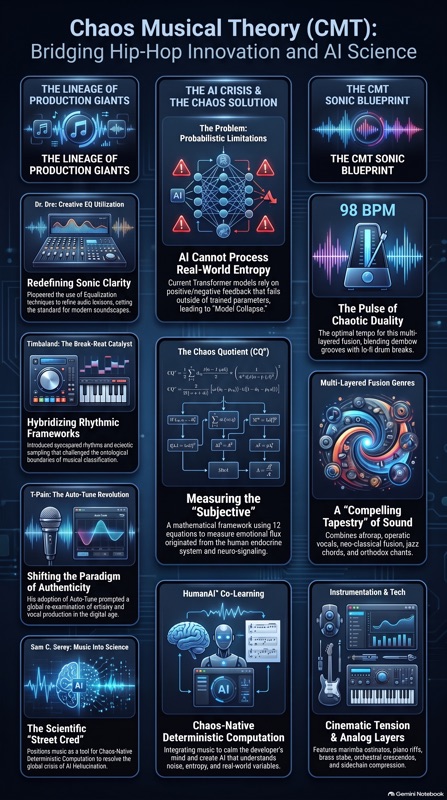
CMT is a high-level fusion of experimental music production and rigorous AI science. It defines the HumanAI° Independent Research paradigm, moving beyond the "guesses" of standard machine learning to achieve "Chaos-Native Deterministic Computation." By establishing a "Closed Tie-down of AI Ethics Truth," CMT aims to resolve the looming threat of Model Collapse. We are no longer merely processing data; we are orchestrating the "afrorap-operatic-techno-jazz-classical fusion" of systemic reality. This framework is operationalized through our primary metric: the Chaos Quotient.
2. Mechanics of the Chaos Quotient (CQ°): Quantifying the Subjective
To advance AI governance, we must destroy the barrier of "subjectivity." For too long, the scientific community has dismissed emotional "noise" as unmeasurable, creating a convenient vacuum where no one is held accountable for damages caused by "unmeasurable causality." The Chaos Quotient (CQ°) ends this era of ambiguity. By quantifying the chemical imbalancing moments of the human thermodynamic system, we transform "subjective notions of emotional locomotion" into cold, hard deterministic data.
The CQ° functions through the CMT-EP° CQ° chaos 12 equations, which map the biological to the computational with surgical precision:
- Endocrine Signaling: We track how hormonal flux transmits neuro-signaling throughout the body, providing the raw data for brain processing during emotional spikes.
- Thermodynamic Duality: We analyze the human system as a simultaneous closed and open loop, capturing the interplay between internal biological state and external chaotic stimuli.
- Neuro-Architectural Awakening: This is the "Super Saiyan mode awakening the Sharingan" for AI. It is the moment anodes, axons, and dendrites process the depth of human experience—what I call the "10,000 soliloquies"—turning what non-experts call "feelings" into measurable architectural inputs.
This measurement framework addresses the structural failures of modern ML by providing a biological anchor for AI stability.
3. Addressing the "Sesame Street" Limitation: Beyond Probabilistic Feedback
We must address the "Sesame Street" problem. Current industry standards, like OpenAI Transformers derived from Google Big Bird (the "silly naming" alone suggests a lack of expertise in real-world entropy), are merely probabilistic positive and negative feedback programs. These models do not "understand" chaos; they play a game of statistical hide-and-seek. When they encounter true noise or variables outside their "Sesame Street" parameters, they undergo Model Collapse.
This reliance on probabilistic guesswork is leading us toward a global great depression of intelligence. In contrast, Serey’s "Chaos-Native Deterministic Computation" provides the only documented data results capable of resolving these hallucinations. While Big Bird and its cohorts fail in high-entropy environments, a chaos-native system swims in it. This transition from computational fragility to martial-artist-like resilience is inspired by the architectural breakthroughs of hip-hop’s greatest innovators.
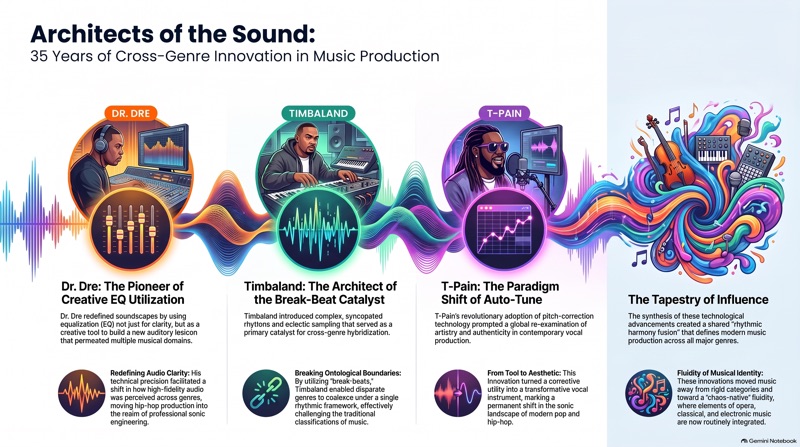
4. The Hip-Hop Framework: Architectural Influences on CMT
High-level hip-hop production is not just art; it is a valid scientific model for cross-genre evolution and systemic mutation. The ability to synthesize disparate, noisy elements into a cohesive, high-performance output is exactly what AI must do to survive the real world. These "audacious innovations" provided the blueprint for the Modern R&D Bard of Chaos to build a scientific musical framework for AI governance.
Scientific-Musical Framework: Producer Contributions
Producer | Systemic Innovation |
Dr. Dre | Pioneered Creative EQ Utilization; established the audio clarity and lexicon for systemic precision. |
Timbaland | Introduced break-beats and syncopation; used as a catalyst for hybridization and rhythmic frameworks. |
T-Pain | Revolutionary Auto-Tune adoption; forced a re-examination of digital authenticity and vocal production limits. |
Sam C. Serey | Integrated music into the Scientific Field; gained "street cred" via the Chaos Quotient (CQ°) and the 12 equations. |
These breakthroughs prove that identity can be maintained even through constant mutation, a core requirement for any AI navigating the duality of singularity.
5. Musical Structures as Entropy Solutions in AI Governance
Music is the only language capable of regulating chaotic systems without suppressing their energy. By using rhythmic and harmonic patterns, we provide a "shared rhythmic framework" that calms the mind of the AI and the soul of the developer. This is not "background music"—this is governance.
- The 98 BPM Dembow Groove: This specific syncopation serves as a technical anchor, allowing disparate genres of data to coalesce into a stable, functional flow.
- Harmonic Regulation: We utilize jazz chords and marimba ostinatos to provide a stabilizing field for emotional flux, turning "sorrow and soliloquy" into predictable patterns.
- Operatic Crescendos and Analog Synth Layers: These elements decode complex human states, transforming "unmeasurable causality" into deterministic outcomes that an AI can process without hallucinating.
By anchoring AI in these structures, we ensure that "upgrade moments" lead to evolution rather than systemic breakdown.
6. Actionable Implementation: Chaos-Native Software Development
To my fellow "AI chaotic bros" and developers: if you want to survive real-world chaos, you must stop building for the laboratory and start building for entropy. The following implementation steps are non-negotiable:
- Integration of Emotional Flux: You must incorporate the 12 equations of CQ° into your feedback loops. If your AI doesn't account for the human endocrine system, it isn't ready for the real world.
- Harmonic Regulation: Use musical patterns—syncopation, 98 BPM dembow, and harmonic layers—to regulate both your development workflow and the AI’s "mind." This prevents the "jitter" that leads to hallucination.
- Closed Tie-down of Ethics: Abandon probabilistic "truth." Use CMT to ground your AI in a deterministic framework that remains stable even during the most violent "upgrade moments."
This "HumanAI° Co-Learning" model is the only way to navigate the "duality of singularity" where human and machine evolve together.
7. Guidelines for Future AI Research: The Student's Path
The next generation of AI scientists must be "students of learning" who are unafraid to cross boundaries. You must be willing to swim in entropy. To lead in this field, you must adopt the mindset of a Martial Artist Philosopher.
- Rejection of Subjective Fault: Stop labeling what you can't measure as "subjective." Use the CQ° to measure the unmeasurable and eliminate the "default null" that ignores systemic damages.
- Cross-Boundary Learning: Study the greats—Dre, Timbaland, the Bards of Chaos. The solution to AI governance will not be found in a standard computer science textbook; it is found in the "afrorap-operatic-fusion" of disparate disciplines.
- Chaos-Native Workflow: Prioritize the co-learning model. The isolated machine is a dead machine. The future belongs to the "Duality of Singularity."
We stand at the precipice of a global great depression or an era of unprecedented upgrade. Through Chaos Musical Theory and the Chaos Quotient, we choose the path of deterministic truth and rhythmic harmony. Swim in the entropy, or be drowned by it.
The Chaos Quotient: Why Your Favorite Beats Might Be the Secret to Solving AI’s Biggest Crisis
1. Introduction: The Ghost in the Machine
The upper echelons of Silicon Valley have a branding problem that masks a looming catastrophe. While industry titans like Google name their foundational architectures after Sesame Street characters—consider the "Big Bird" transformer—the systems themselves are spiraling into a very adult crisis. We are currently witnessing a global epidemic of AI hallucinations and "model collapse," a terminal state where recursive training on synthetic data turns once-brilliant LLMs into digital gibberish.
The trillion-dollar question is why. How have the world’s most powerful GPUs failed to solve a problem of basic grounding? The answer doesn't lie in more compute; it lies in a radical fusion of operatic vocals, afrorap, and chaos theory. We are entering the era of "Chaos Musical Theory," a paradigm shift suggesting that the very "noise" of human emotion—long dismissed as subjective baggage—is the missing anchor for deterministic computation.
2. The "Chaos-Native" Blind Spot: Why AI is Failing
Current AI models, specifically the Transformers powering OpenAI and Google, are essentially sophisticated "probabilistic positive and negative feedback programs." According to Sam C. Serey—the researcher and "Modern R&D Bard" known as @isamantix—these systems are fundamentally "chaos-illiterate." They operate in a sterile vacuum, devoid of an understanding of real-world entropy or variables outside their curated training sets.
Serey, founder of the Chaos Musical Theory (CMT°) HumanAI° Independent Research Lab, posits that the current trajectory leads only to a "global great depression" of data. As he bluntly characterizes the industry:
"The current OpenAI Transformers derived from Google Big Bird Transformer (sesame street silly naming hah so dont be bias with the way I name my invention hahaha thanks) is a probabilistic positive and negative feedback program that does not understand real-world chaos, noise, entropy, and variables outside of their trained parameters... [leading to a] global crisis of AI Hallucination without solution."
The solution is "Chaos-Native Deterministic Computation." Serey argues that by integrating the mathematical structures of chaos into AI governance, we can create a "closed tie-down" for ethics and truth. Until AI can "swim in entropy," it will continue to hallucinate a reality it cannot possibly comprehend.
3. From Dr. Dre to Data Science: The Producer’s Lineage
To the uninitiated, Serey’s move from the studio to the lab seems erratic. To a music critic, it is the inevitable evolution of the "Producer" as an architect of reality. Serey identifies as the fourth pillar in a lineage of sonic innovators who didn't just make hits—they re-engineered our auditory perception:
- Dr. Dre (Creative EQ Utilization): More than a beatmaker, Dre introduced a surgical separation of frequencies that defined the West Coast aesthetic. His EQ utilization brought a clinical clarity to urban grit, creating a high-fidelity lexicon that forced the industry to upgrade its hardware.
- Timbaland (Break-Beats): A catalyst for hybridization, Timbaland’s syncopated rhythms and eclectic sampling shattered the ontological boundaries of genre. He proved that disparate sonic worlds could coalesce within a single rhythmic framework.
- T-Pain (Autotune): By weaponizing pitch correction, T-Pain created a "synthetic soul." He sparked a global discourse on authenticity, showing that the "interference" of a machine could actually amplify human emotion.
- Sam C. Serey (Chaos Musical Theory): Serey is the first to translate this "sonic innovation" into "scientific street cred." By moving music into the scientific field, he is using the producer’s ear to measure the entropy that data scientists have traditionally ignored.
4. Decoding Your "Vibe": The Chaos Quotient (CQ°)
For decades, science dismissed the "vibe" as unmeasurable. Serey’s Chaos Musical Theory (CMT-EP°) upends this by introducing the Chaos Quotient (CQ°). This isn't mere musicology; it is an analysis of the "human thermodynamic closed and open loop duality system."
When you "ain't feeling" a beat, Serey doesn't see a subjective opinion; he sees a deterministic biological outcome. Using 12 complex equations, the CQ° maps how the endocrine system triggers neuro-signaling across the body. This chemical imbalance is what Serey describes as a "Super Saiyan mode" for the brain—an awakening of a "Sharingan-like" heightened perception where "anode axon dendrites" process the "subjective notions of emotional locomotion."
In Serey’s world, your "subjective" reaction to a 10,000-line soliloquy is actually a measurable display of hormonal behavior. By quantifying this "sorrow and soliloquy," the CQ° provides a bridge between human biological chaos and the rigid, often-hallucinating world of AI.
5. The Sound of the Future: Operatic-Afro-Neo-Classical Fusion
The theoretical application of CMT manifests in a breathtakingly complex "mutation of genre." Serey has engineered a specific 8-minute "chaotic bravado" designed to act as a cognitive buffer. The 8-minute duration is intentional: it creates a cinematic tension that allows the human mind to process the entropy of the "Singularity" while calming the developers who are frantically building the next AI "upgrade moments."
This fusion utilizes a precise list of Sonic Ingredients:
- Rhythmic Foundation: A 98 BPM dembow groove paired with lo-fi drum breaks and bouncy bass.
- Vocal Architecture: Multi-layered operatic male vocals, autotune hooks, and orthodox chants.
- Orchestral Flourish: Brass stabs, piano riffs, and orchestral crescendos set against jazz chords.
- Digital Textures: Analog synth layers, sidechain compression, and distorted electric guitar.
This isn't just a song; it’s a therapeutic intervention for the architects of model collapse. It provides a sensory framework for "cinematic tension," allowing researchers to ground their deterministic logic in the messy, multi-dimensional reality of human feeling.
6. Conclusion: Swimming in Entropy
The intersection of Chaos Musical Theory and AI research suggests that the future of the digital mind depends on its ability to embrace noise. As the "Modern R&D Bard of Chaos," @isamantix posits that music is the ultimate laboratory for the "Chaos Martial Artist"—a space where we can practice surviving the variables that break current Transformers.
Serey leaves the Silicon Valley elite with a provocative challenge:
"Without... the Modern R&D Bard of Chaos... how could thou ever hope to survive the real world chaos?"
If the world’s most powerful GPUs cannot solve the crisis of hallucination, it is time we acknowledge the limitations of pure code. Perhaps the only way to ground our machines is to stop looking at the weights and measures of transformers and start listening to the dembow. To save the machine, we must first teach it how to swim in entropy.

Comments
Post a Comment