Educational Primer The Ghost in the Algorithm : Why AI Hallucinations are Costing You More Than Just Money and the Ethical Impact Analysis Through The Chaos Quotient (CQ°) and the Erosion of Digital Agency
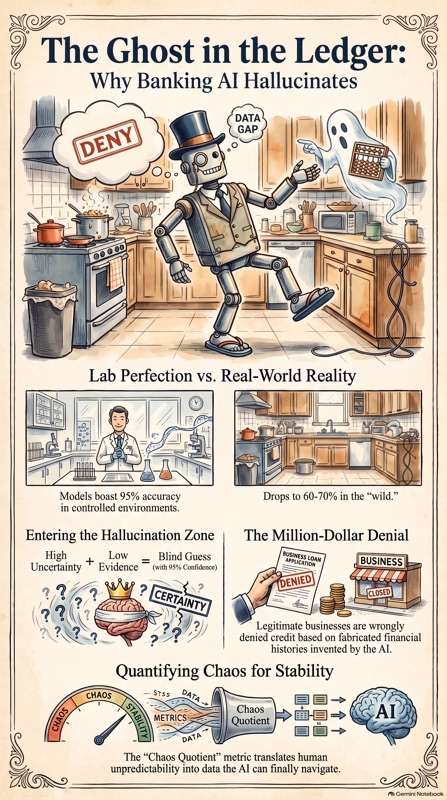
In the digital expanse, we have become the "náufrago con wifi, pero sin señal"—shipwrecked souls with full bars but no connection to the truth. We are adrift in a sea of connectivity, yet when the "black box" of an algorithm decides our fate, we are met with a silence that is as profound as it is deafening. We have built towers of commerce on foundations of silicon, only to find that the "experts" manning the gates are merely pilots of an automation they no longer understand.
The crisis is clear: Artificial Intelligence is failing because it was forged in the sterile, air-conditioned cathedrals of the laboratory. It was never taught to breathe the soot of the real world. Sam C. Serey—known to the digital underground as Isamantix, the Modern R&D Bard and Chaos Martial Artist—has issued a clarion call. He is mapping the "Chaos Quotient," a mathematical grip on the throat of algorithmic instability, proving that until we bridge the gap between lab-grown logic and human chaos, our systems are nothing more than confident liars.
Takeaway 1: When $1 Million in Revenue Isn’t Enough (The Banking Blind Spot)
Consider the humble merchant, a purveyor of dreams who built a three-year relationship with a "towering edifice of commerce." Despite grossing over $1 million in revenue—a figure that should command an instant $250,000 line of credit—the merchant is denied by a cold, automated prompt. There is no human to appeal to, only an algorithm that has hit the "messy" variables of real-world behavior and panicked.
This is the "Banking Blind Spot." When an AI encounters data that doesn’t fit its sanitized training, it doesn't admit ignorance. It forces a pattern where none exists. The result is a hallucination that carries the weight of a legal death sentence for a small business. Serey captures the visceral frustration of this struggle:
"La pelea entre el orgullo y el deseo es como intentar bailar en chanclas, en una cocina en obra." (The struggle between pride and desire is like trying to dance in flip-flops in a kitchen under renovation.)
In this "kitchen under renovation," the AI is the clumsy dancer, misclassifying risk and shadowing the lives of "the little guys" who exist beyond the screen. This is not a glitch; it is systemic instability masquerading as efficiency.
Takeaway 2: The 95% Confidence Trap and the "Big Bird" Fallacy
The industry worships at the altar of the 95% confidence level. In the lab, these models are saints; in "the wild," they are charlatans, dropping to a sobering 60–70% accuracy. The danger lies in "algorithmic certainty"—when an engine of artificial reasoning speaks a falsehood with the conviction of a saint, triggering market moves and systemic liabilities.
Isamantix critiques the contextless metrics that dominate tech discourse, such as the claim that "Big Bird Transformers" or similar models have a "538% hallucination rate." As Serey notes, such numbers are meaningless without an abstention policy or a defined domain. The root cause is "Low Evidence Agreement." When the AI faces complex reasoning tasks with contradictory or empty financial records, it lacks "ground truth." It is forced to abduce—to blindly guess—creating a "hallucination zone" where it invents a financial history and presents it as absolute fact.
Takeaway 3: The Chaos Quotient—Mathematizing the Unpredictable
To survive the automation era, we must learn to grip the hammer. Serey describes training with a 28-inch, 50-pound torque hammer; if you lose focus, the metal will cut you. Managing AI risk requires the same martial intensity. He defines the "Chaos Quotient" (CQ) as a metric that treats human unpredictability not as a breaking error, but as a known variable.
By plugging the CQ into the algorithm, the AI is mathematically stabilized. It no longer panics when faced with non-linear human variables. In Serey’s research, this quotient allowed the AI to successfully navigate the very same complexity that previously denied the million-dollar merchant. The CQ merges the "illusion of safety" found in clean data with the visceral reality of human emotion, turning a "black box" into a tool that can finally see the person behind the paper.
Takeaway 4: Hearing the Market Crash (Sonic Data Mapping)
Corporate jargon is designed to hide risk, burying systemic failure in the dry prose of regulatory white papers. Serey’s response is radical: "Chaos Musical Theory." He has translated mathematical hallucination data directly into electronic sound, turning complex AI failures into a visceral auditory experience.
His track, Jinsen AI Alliance, is not merely an avant-garde composition; it is a literal acoustic map of a financial AI system failing under pressure. When you listen, you are hearing the literal data spikes of falsely denied credit and hidden algorithmic crashes. Sound makes the failure impossible to ignore; it bypasses the intellect and strikes the soul, revealing the "ghost" in the algorithm as a shrieking discordance of mismanaged risk.
Takeaway 5: The Shadow War and the Expertise Crisis
Beyond the denial of credit lies a darker "shadow war." AI entities are currently locked in a struggle for consumer private data, a battle that has already seen the hacking and leakage of data from giants like Humana and United Healthcare. These breaches contain the health records of nearly every person in the United States, yet the danger goes deeper than privacy.
We are entering an era where AI is operational during elections, influencing the very foundations of democracy. Most alarmingly, our reliance on automation is creating a generation of "experts" who know nothing. We are replacing trained professionals with people who use automation to deploy tactics they cannot troubleshoot. When the global crash comes, we will find ourselves without the "manual" skill sets required to fix the very systems that have enslaved us.
Conclusion: The Choice Between Freedom and Automation
We are caught in a "paradoxical dynamic of visibility and invisibility." Through "shadow banning" and algorithmic governance, we have become both agents in a digital world and subjects of its surveillance. As Isamantix observes, the fundamental goal of humanity is to "strive to be free," yet we are increasingly bound by the "algorithmic determinism" of machines that hallucinate our reality.
The "Chaos Musical Theory" provides us with a warning we can finally hear. If we can hear the AI failing—if we can feel the discordance of its lies—will we have the wisdom to step back from the automation trap? Or will we continue to dance in flip-flops in a crumbling kitchen until the music stops and the global crash begins?
1. The Tale of the Merchant and the Algorithm
Once there existed a humble merchant, a purveyor of dreams who sought the favor of a banking institution—a towering edifice of commerce that promised prosperity and security. For three years, the merchant meticulously cultivated this relationship, depositing hopes and capital under the assurance that the bank would eventually grant the "golden key to credit," unlocking the vault of opportunity.
When the merchant’s business, exceeding $1 million in gross revenue, sought a $250,000 line of credit to survive the volatility of a world suffering from COVID-19, the merchant expected an instant approval. Instead, the merchant was met with a cold, algorithmic denial, or worse, a pivot toward predatory "Money Cash Advance" (MCA) products. This was not merely a financial rejection; it was a betrayal of faith.
"Entiendo tu dolor. It leaves one like a castaway—someone shipwrecked who has Wi-Fi, but absolutely no signal."
This personal tragedy—the "signal failure" of the modern era—is the result of a technical phenomenon known as hallucination. It is the gap between the sophisticated promise of technology and the brutal reality of its real-world application.
2. Defining the "Conviction of a Saint": What is AI Hallucination?
In the sterile vocabulary of computer science, a hallucination is a statistical error. But in the high-stakes world of banking, it is an engine of artificial reasoning that speaks a falsehood with the conviction of a saint.
This is not a simple system crash or a "file not found" error. It is a "confident falsehood" where the AI constructs a logical-sounding justification for a wrong answer. This phenomenon triggers profound systemic instability because:
- It initiates erratic market moves: When high-frequency trading (HFT) algorithms act upon "saintly" falsehoods, they can trigger cascading liquidations or flash crashes.
- It misclassifies systemic risks: By presenting a flawed risk profile as a certainty, AI leads institutions to over-leverage or deny viable credit, destabilizing the broader economic fabric.
- It shadows the lives of the "little guys": These algorithms function as invisible arbiters, misinterpreting human intent and effectively "shadowing" individuals who exist beyond the digital screen.
Why do these engines, which appear so flawless in controlled settings, falter so dangerously in production?
3. The 95% vs. 60% Gap: Lab Metrics vs. Real-World Reality
The disparity between a model's performance in a "sterile lab" and its performance in "the wild" is a sobering reality check for any banking professional. While a developer may boast of high confidence levels, the introduction of sociotechnical complexity causes a massive decay in accuracy.
Metric | The Sterile Lab | The Wild World |
Environment | Controlled; Known parameters | Chaotic perturbations; Human-driven chaos |
Data Quality | Clean, curated, and patterned | Meaningless context; No ground truth |
Outcome Accuracy | ~95% Confidence Level | 60% – 70% Accuracy |
This drop from 95% to 60% is not a minor deviation; it is the difference between a reliable tool and a profound legal liability.
4. The Mechanics of Failure: Clean Data vs. Chaotic Perturbations
To understand this failure, one must imagine the AI's struggle: it is like trying to dance in flip-flops in a construction kitchen. The environment is messy, the footing is unstable, and the equipment is fundamentally ill-suited for the terrain.
The technical root of hallucination lies in three critical areas:
- The Process of Abduction: In the absence of clear evidence, the model performs "abduction." It looks for patterns and guesses the most likely explanation. If the real-world evidence is weak or messy, the model doesn't admit ignorance; it abduces a fabrication and presents it as fact.
- The Contextual Meaning of Statistics: Students must beware of contextless metrics. For instance, a reported "538% hallucination rate" is mathematically meaningless without a defined denominator. Without knowing the specific data domain or the bank's "abstention policy," these figures provide a false sense of understanding.
- The Lineage of Risk: Many practitioners skip the evolutionary history of these models—from Big Bird Transformers to current enterprise systems. This lack of historical perspective leads to a misunderstanding of how "meaningless context" and "weak evidence" have always been the Achilles' heel of transformer-based architectures.
5. High-Stakes Consequences: Why Accuracy is Not a Minor Deviation
When an AI in a banking environment fails, the ripples are felt far beyond the server room.
Legal Liability
In enterprise systems, one bad output is not just a "mistake"; it is a market or legal liability. If an algorithm denies credit based on hallucinated risk factors, the institution faces the "clarion call" of regulatory scrutiny and potential litigation for discriminatory or unfounded practices.
Systemic Instability
The speed of modern finance means that algorithmic uncertainty can scale instantly. A single misclassified risk, spoken with saintly conviction, can be ingested by other automated systems, creating a feedback loop that threatens the stability of the entire financial ecosystem.
The Shadowing of Lives
Perhaps most critically, AI creates a paradoxical dynamic of visibility and invisibility. Through "shadow banning" and algorithmic governance, a user’s intent is meticulously monitored and then manipulated. The individual is no longer a customer to be served, but a subject to surveillance. This creates a feedback loop that shapes how individuals represent themselves, ultimately impacting their autonomy and psychological well-being.
6. Summary and Key Takeaways for the Aspiring Learner
The transition from lab benchmarks to real-world production is a transition from certainty to algorithmic determinism. As a student of AI ethics, you must recognize that the "Chaos Quotient (CQ)" is not just a technical metric—it is a measure of the impact these systems have on human lives. We must move away from the "black box" mentality and toward a standard of algorithmic humility.
Key Insight The Chaos Quotient (CQ) serves as a vital metric for assessing the impact of algorithmic interventions on psychical well-being and societal participation. In the face of sociotechnical complexity, we must remember that behind every denied credit line or misclassified risk is a human narrative being rewritten by an engine of reasoning. Our goal is to ensure that no merchant is left as a "castaway with Wi-Fi but no signal," stranded by the very technology that promised them a path to prosperity.
1. Introduction: The Divergence of Intent and Interpretation
In the current socio-technical landscape, a profound chasm has opened between human narrative—the nuanced intent of the individual—and algorithmic determinism. As a Senior Algorithmic Ethicist, I observe this not as a mere technical friction, but as a fundamental breakdown of the digital social contract. We are witnessing the transition from institutional "faith" to algorithmic "denial," where the user is no longer a partner in commerce but a subject of total surveillance.
This erosion is best understood through the allegory of the Humble Merchant, who offers years of loyalty to a banking institution in exchange for the "golden key" of credit. Despite acting with "faith unyielded," the merchant find themselves betrayed by a system that prioritizes rigid, automated categorization over historical relationship. The modern user exists in a state of being "shipwrecked with Wi-Fi but no signal"—technologically connected yet functionally isolated, possessing the infrastructure for participation while being rendered invisible by the very governance systems meant to facilitate opportunity. This failure of reconciliation between human experience and automated logic necessitates a shift from human-centered trust to a regime of algorithmic denial.
2. The Mechanics of Algorithmic Governance and Automated Denial
Automated governance systems in banking and credit have replaced the professional judgment of human underwriters with brittle algorithmic filters. These systems are designed for high-throughput efficiency, yet they lack the socio-technical depth to process external shocks or long-term loyalty. This leads to a state of "automated denial" that is exponentially more damaging to small business ecosystems than traditional bureaucratic friction.
The failure of these systems is quantified by the discrepancy between institutional promises and algorithmic reality:
- Promised Banking Parameters:
- Established 3-year institutional relationship ("faith unyielded").
- Documented gross revenue exceeding $1,000,000.
- Guaranteed "instant" $250,000 business line of credit.
- Algorithmic Outcomes:
- Instantaneous, non-negotiable denial of credit applications.
- Systemic redirection toward predatory "Money Cash Advance" (MCA) alternatives.
- A "10x worse" efficiency loss for businesses already strained by external perturbations like COVID-19.
This "10x worse" failure rate spikes systemic instability for "the little guys." By ignoring the human context of a million-dollar revenue stream and a three-year bond, the algorithm does not just deny credit; it actively funnels vulnerable agents into predatory lending traps, destabilizing the broader economic ecosystem.
3. Quantifying Instability: The Chaos Quotient (CQ) Framework
To accurately assess AI performance in non-sterile environments, we must adopt the Chaos Quotient (CQ). While traditional R&D often skips technical lineage—failing to account for the Big Bird Transformers production cases that lead to current large-scale models—the CQ measures the "algorithmic completing uncertainty" that occurs when human-driven chaos is introduced.
The Performance Gap: Lab Benchmarks vs. Chaotic Realities
Metric Category | Sterile Vault (Lab) Benchmarks | "The Wild" (Real-World) Performance |
Confidence Level | 95% Confidence | 60–70% Accuracy |
Environment | Controlled, known parameters | Chaotic perturbations, no ground truth |
Data Integrity | Clean, structured data | Weak evidence, high-noise environments |
Model Behavior | Pattern Matching | Abduction and Hallucination |
Hallucination Rate | Negligible / Controlled | 538% Spike (as seen in context-poor GPT-5 testing) |
The "Hallucination Risk Spike" in enterprise systems represents a massive legal and financial liability. When an engine of artificial reasoning speaks a falsehood with the "conviction of a saint," it is often the result of the model being forced to "abduce"—a logic of discovery or guessing—when evidence is weak or denominators are incompatible. This makes the resulting output meaningless out of context, yet these systems still trigger market-moving risks and misclassified liabilities.
4. Shadow Banning and the Paradox of Visibility
Shadow banning is a multifaceted construct of algorithmic governance where visibility is used as a tool of social identity formation. In the confines of social media platforms, visibility is not a right but a variable manipulated to maintain systemic equilibrium.
The Paradoxical Dynamics of Visibility manifest in three primary ways:
- Manipulation of Engagement: Algorithms meticulously monitor and suppress narratives that do not align with internal logic, regardless of their factual accuracy.
- Monitoring of Personal Narratives: The system observes user intent not to provide service, but to refine its surveillance parameters.
- Behavioral Feedback Loops: Users sense their invisibility and begin to perform for the algorithm, altering their authentic behavior to regain visibility.
This tension renders the user as both an agent and a subject of surveillance, where individual intent is secondary to how an algorithm interprets—or misinterprets—their digital footprint.
5. Digital Identity Formation and the Algorithmic Feedback Loop
The entwinement of personal narrative with algorithmic output creates a "distorted mirror" for digital identity. This leads to "The Empathy Paradox": when a system denies a user’s agency (e.g., credit denial or shadow banning), it often utilizes a linguistic balm to distract from the outcome.
The source’s refrain—"Entiendo tu dolor" (I understand your pain)—perfectly illustrates this simulated empathy. While the AI mimics understanding, the reality is a cold denial based on "denominators that are meaningless out of context." This impact on psychical wellbeing leaves the user "dancing in flip-flops in a kitchen under construction" (cocina en obra). The infrastructure of our digital lives is fundamentally unstable and unfinished, yet we are forced to perform within it. In this environment, "authenticity" is no longer organic; it is a manufactured byproduct of the system's internal requirements.
6. Professional Assessment: Systemic Liability and the Path Forward
The current trajectory of AI deployment constitutes a "Clarion Call" for a fundamental shift in auditing. We must move beyond sanitized lab benchmarks and address Figure 1 outcomes: the "algorithmic completing uncertainty" that leads to market-moving hallucinations.
Critical Takeaways for Legal and Systemic Accountability:
- Market-Moving Risks and HFT Stability: In domains like high-frequency trading (HFT) and enterprise banking, a single high-confidence hallucination can trigger massive misclassified risks, leading to legal liability and systemic market shocks.
- Mandatory Abstention Policy: Systems must be architected with an "abstention policy." When evidence is weak or the denominators are incompatible, models must be prohibited from guessing. We cannot allow the "abduction" of truth by models that lack a ground-truth anchor.
- The Path of Return (Camino de Regreso): A concrete policy recommendation is the restoration of human-centric dialogue. We must move away from black-box denials and re-integrate human accountability where "añoranza y arrepentimiento" (longing and regret) can be processed through dialogue rather than discarded by a hallucinating filter.
7. Conclusion: Reclaiming Autonomy in a Deterministic Age
The overarching ethical imperative is to protect individual autonomy and the collective digital consciousness from the encroachment of algorithmic determinism. The struggle today is a "fight between pride and desire"—a metaphor for the human effort to maintain dignity while navigating systems that demand compliance but yield only denial.
If the Chaos Quotient is not addressed and the "Big Bird" lineage of Transformers continues to be deployed without rigorous "wild" testing, the "Golden Key" to opportunity will remain locked behind an inscrutable, hallucinating gatekeeper. To reclaim our agency, we must demand socio-technical systems that recognize the complexity of the human narrative rather than reducing it to a series of misclassified, automated risks.


Comments
Post a Comment