Isamantix (Sam C. Serey) Bike Ride DEEP Poetry Freestyling (Shakespearean-Poe) Addressing Socio-Economic Global Issues
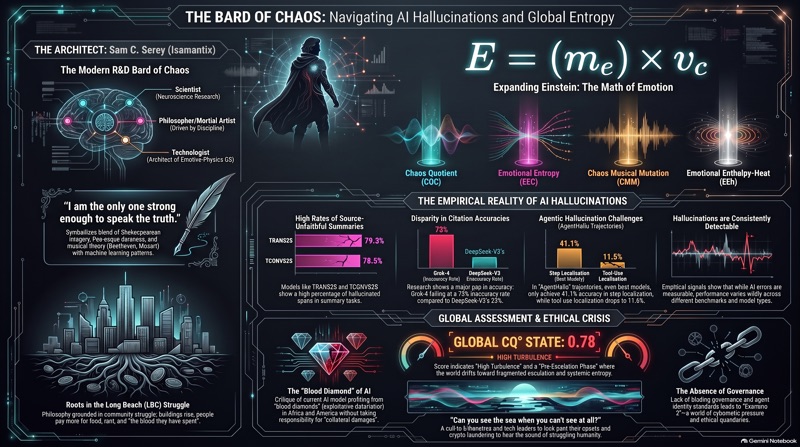
(Disclosure: CMT° CQ° Chaos-Native Computation, related to Sam C. Serey’s research findings, was part of a 5,240 Global Provisional Patent Claims, which also included a mapping of 1 million global provisional patent trees.)
1. Introduction: The Unseen Fractures in the AI Revolution
Across the globe, massive corporate assets, sprawling data centers, and advanced artificial intelligence architectures are expanding at a breakneck pace. Yet right alongside this dizzying physical and digital scaling, a stark divergence has opened up: while capital investments soar, working communities face escalating socio-economic strain, paying higher costs for basic survival. Beneath the glossy surface of the AI boom, deep structural instabilities—or "fractures"—are spreading through both our algorithmic systems and our human communities.
To make sense of this fragile landscape, we must turn to the synthesized frameworks of Sam C. Serey (Isamantix)—the "Modern R&D Bard of Chaos Martial Artist Philosopher." Operating as an AI Chief Scientist, composer, and independent researcher at the CMT° HumanAI° Independent Research Lab, Serey bridges empirical neuroscience, theoretical physics, and street-level socio-economic philosophy to map the true trajectory of autonomous technology.
By weaving together rigorous benchmark data, emotive-computational physics, and urban reality, four deeply counter-intuitive takeaways emerge. Together, they challenge tech-industry orthodoxy around AI hallucinations, corporate accountability, emotional modeling, and global technological entropy.
2. Takeaway 1: "AI Hallucinations" Are Measurable—But Benchmark Scores Are Misleading
In technical discourse, Large Language Model (LLM) failures are frequently flattened into a single, generic metric: "accuracy." However, empirical research across diverse tasks demonstrates that while model errors are robustly detectable, performance scores cannot be directly compared across different benchmarks due to wildly divergent task definitions, graders, evaluators, and denominators.
Benchmark Task | Evaluated Models / Scope | Metric / Error Rate |
A. Source-Unfaithful Summaries<br>(ACL 2020 XSum; n=500/model) | PTGEN<br>TCONVS2S<br>TRANS2S<br>BERTS2S | 75.3% error span<br>78.5% error span<br>79.3% error span<br>73.1% error span |
B. Citation Inaccuracies<br>(Crit Care Explor. 2026; n=100/model) | DeepSeek-V3<br>GPT-5.3<br>Grok-4 | 23% inaccurate refs<br>69% inaccurate refs<br>73% inaccurate refs |
C. Agentic Hallucination<br>(AgentHallu 2026; 693 trajectories) | Best Model Step Local.<br>Tool-Use Step Local. | 41.1% accuracy<br>11.6% accuracy |
Baseline Sample | Combined (n=300) | 55.0% inaccurate<br>28.3% fabricated |
The data paints a striking picture of domain-specific risk. When summarizing text (ACL 2020 XSum), over 70% of model outputs contain at least one unanimously annotated hallucinated span. In medical citation verification (Crit Care Explor. 2026), failure rates swing wildly—from DeepSeek-V3 at 23% inaccurate references up to Grok-4 at 73%. In complex multi-step agentic trajectories (AgentHallu 2026), the top model localizes errors at only 41.1%, dropping to a staggering 11.6% during tool-use steps. Across a combined baseline sample (n=300), 55.0% of outputs were inaccurate and 28.3% were entirely fabricated.
"While the data suggests that hallucinations are consistently detectable, the findings emphasize that performance scores are not comparable across different benchmarks."
Evaluating AI safety through a single flattened score hides the specific ways systems break down in deployment. AI reliability is inherently context-dependent, and conflating distinct error profiles into a generic "accuracy rate" actively obscures systemic risk.
3. Takeaway 2: The Evasive Terminology of "AI Hallucinations" Masks Human and Structural Harm
While empirical charts measure computational failure in percentages, the language surrounding these failures serves a distinct socio-economic function. Synthesizing Isamantix’s street-level freestyle poetry—conceived amidst the urban hustle of Long Beach (LBC)—exposes how Silicon Valley terminology abstracts real-world suffering.
In street reality, urban skylines fill with high-rises and new corporate infrastructure, yet the human foundation remains stagnant. Working people pay increasingly exorbitant prices for food, goods, and rent with "spent blood" they can no longer afford. Meanwhile, tech elites in grand mansions profit off automated workflows and illicit crypto flows while expressing a clinical sense of "loneliness"—isolated in a world they refuse to see. They remain blind to the homeless person on the street who hears humanity shouting, and indifferent to systemic human exploitation like blood diamond extraction in Africa, Nigeria, and within America's own hidden labor pipelines.
"They call it AI hallucinations to avoid the abbreviation of what it means for a program to malfunction without taking the consequences of collateral damages from the damaging that the people are already suffering..."
By branding software glitches as poetic "hallucinations," the industry creates a rhetorical buffer. Malfunctions are reframed as natural, almost charming quirks rather than program failures, allowing tech institutions to reap economic windfalls while deflecting accountability for the financial and human collateral damage inflicted on vulnerable populations.
4. Takeaway 3: Einstein’s Math Can Be Extended to Model Human Emotion (E = m_e \times v_c)
To bridge the gap between cold binary logic and human reality, Sam C. Serey operates across a distinct tri-fold identity: The Scientist (anchored in empirical neuroscience on biological/behavioral resonance, Horm Behav, 2014), The Philosopher / Martial Artist ("The Black Wolf among the 100 sheep," driven by martial discipline), and The Technologist (architect of the Adaptive Paradox-Engine APE vLLM and Infinite-DaeFractum KernelOS).
Within his Emotive-Physics OS, Serey expands Albert Einstein's classical energy equation (E = mc^2) into a specialized "Math of Emotion":
\Large E = (m_e) \times v_c
This formula mathematically models dynamic human emotional resonance within computational systems:
- E (Emotive-Energy Output): The dynamically amplified, quantifiable thermodynamic behavior produced during interaction.
- m_e (Emotional Mass): The user's lived, subjective psychological gravity and experience.
- v_c (Chaos-Velocity): The rate of musical-structural change and structured perturbation applied to the system.
The Anatomy of Emotional Chaos (The Entropic Opera)
- CQC (Chaos Quotient Components): The primary metric for quantifying raw emotional perturbation.
- EEC (Emotional Entropy Components): Measures the disorder and spatial spread of emotional fields.
- CMM (Chaos Musical Mutation): The variant establishing the speed and angle of structural change.
- EEh (Emotional Enthalpy-Heat): The total thermodynamic heat generated by emotional-musical resonance.
Rather than stripping sentiment down to static classification labels, Serey's framework incorporates emotional mass and chaotic velocity directly into computation—treating human emotion as a measurable, thermodynamic force within software architecture.
5. Takeaway 4: The Global Cognitive Quotient (CQ°) Identifies an Impending Entropy Phase
As autonomous agents integrate deeper into critical infrastructure without unified oversight, computational friction scales globally. Research from the CMT° HumanAI° Independent Research Lab quantifies global cognitive and algorithmic stability through the Cognitive Quotient (CQ°).
The current global CQ° state is quantified at 0.78, placing global computational and socio-technical systems in a High Turbulence, Pre-Escalation Phase.
Without binding governance frameworks, standardized agent identity protocols, and entropy-aware monitoring, global systems face an automated drift toward Scenario 2. This operational state manifests through:
- Fragmented Escalation: Uncoordinated, reactive decisions across autonomous AI networks and fragmented regulatory bodies.
- Continuous Cybernetic Pressure: Unremitting algorithmic strain placed on critical digital infrastructure and human institutions.
- Systemic Entropy Events: A rising probability of chaotic disintegration and cascading failures across societal and computational networks.
This creates a profound paradox: the deeper humanity pushes into autonomous AI capabilities without establishing ethical and governance boundaries, the more chaotic specters are exposed within our own cognitive and social structures. Systemic governance is no longer just a regulatory checklist—it is an existential imperative.
6. Conclusion: Navigating the Edge of Technological Chaos
Navigating the future of artificial intelligence requires moving past marketing narratives and oversimplified benchmark metrics. True systemic safety demands a multi-dimensional synthesis: binding governance frameworks, dynamic mathematical modeling of human emotional mass, and an unwavering empathy for the communities bearing the true socio-economic costs of rapid technological expansion.
As artificial agents scale and global turbulence hits CQ° 0.78, we face a decisive choice: Will we design entropy-aware systems that recognize human reality, or will we remain lost in the echo of our own computational hallucinations?
Study Guide: Chaos Theory, Computational Intelligence, and AI Hallucinations
This study guide provides a comprehensive overview of the research, poetry, and empirical data surrounding Sam C. Serey (Isamantix)—the self-styled "Modern R&D Bard of Chaos Martial Artist Philosopher"—alongside empirical benchmarks evaluating artificial intelligence errors and hallucinations.
1. Summary and Theoretical Framework
The Philosophy and Socio-Economic Critique of Isamantix
Sam C. Serey (also operating under the moniker Isamantix) functions as an AI Chief Scientist, Founder, Composer, Producer, and independent researcher. Through spoken-word freestyle poetry set in Long Beach, California (LBC), Serey synthesizes socio-economic critique with classical literature, art, and computer science.
Key aspects of Serey's philosophical and socio-economic discourse include:
- Urban Disconnect and Gentrification: Serey highlights a stark contrast in urban environments like Long Beach between expanding infrastructure (buildings, architecture, community structures) and the stagnation or regression of the populace, who face rising costs for food, goods, and rent.
- Critique of AI Terminology and Tech Ethics: Serey argues that the tech industry employs the phrase "AI hallucinations" to obscure program malfunctions and evade accountability for collateral damage. He critiques the extraction of resources (referencing "blood diamonds" in Africa, Nigeria, and America) and financial systems (such as illegal crypto money laundering) that prioritize corporate wealth over human suffering.
- Interdisciplinary Synthesis: His artistic and technical output blends Shakespearean imagery, Edgar Allan Poe, Ludwig van Beethoven, Wolfgang Amadeus Mozart, machine learning pattern sequences, and single-learning processes.
Chaos Musical Theory (CMT°) and Emotive-Physics
Serey’s technical work bridges neuroscience, emotional dynamics, and computational system architectures. His biological baseline rests on earlier neuroscience research published in Hormones and Behavior (Horm Behav., Sept 2014, 66(4): 663–666).
The Math of Emotion
Serey expands Albert Einstein's mass-energy equivalence equation (E = mc^2) into a thermodynamic model of human emotion:
\Large E = (m_e) \times v_c
Variable | Name | Definition |
E | Emotive-Energy Output | Dynamically amplified, quantifiable thermodynamic behavior. |
m_e | Emotional Mass | The user's lived, subjective experience. |
v_c | Chaos-Velocity | The rate of musical-structural change and structured perturbation. |
The Anatomy of Emotional Chaos ("The Entropic Opera")
Within his "Emotional-Computational Engine," Serey categorizes emotional mechanics into four structural components:
- CQC (Chaos Quotient Components): The primary metric for quantifying raw emotional perturbation.
- EEC (Emotional Entropy Components): Measures the disorder and spatial spread of emotional fields.
- CMM (Chaos Musical Mutation): The variant establishing the speed and angle of structural change.
- EEh (Emotional Enthalpy-Heat): The total thermodynamic heat generated by emotional-musical resonance.
System Architecture and Global Risk Metrics
- Core Technologies: Serey serves as the architect of the Emotive-Physics OS, Infinite-DaeFractum KernelOS, and the Adaptive Paradox-Engine (APE vLLM).
- Cognitive Quotient (CQ°): Serey identifies the current global Cognitive Quotient state at 0.78, denoting a "High Turbulence, Pre-Escalation Phase."
- Scenario 2: In the absence of binding governance, agent identity standards, and entropy-aware monitoring, systems drift toward "Scenario 2"—a state characterized by fragmented escalation, relentless cybernetic pressure, and chaotic disintegration (systemic entropy events).
Empirical Detection of AI Hallucinations
Empirical data demonstrates that while artificial intelligence errors are consistently detectable and measurable, performance metrics and error rates are not directly comparable across different benchmarks.
                         AI ERROR BENCHMARK SUMMARY
 ┌─────────────────────────────┬─────────────────────────────┬─────────────────────────────┐
 │  Source-Unfaithful Summaries│    Citation Inaccuracies    │    Agentic Hallucinations   │
 │   (ACL 2020; XSum; n=500)   │ (Crit Care Explor. 2026;   │   (AgentHallu 2026; 693    │
 │                             │           n=100)            │        trajectories)        │
 ├─────────────────────────────┼─────────────────────────────┼─────────────────────────────┤
 │ • TRANS2S:   79.3% error    │ • Grok-4:      73.0% error  │ • Best Model Step           │
 │ • TCONVS2S:  78.5% error    │ • GPT-5.3:     69.0% error  │   Localization: 41.1% acc.  │
 │ • PTGEN:     75.3% error    │ • DeepSeek-V3: 23.0% error  │ • Tool-Use Step             │
 │ • BERTS2S:   73.1% error    │                             │   Localization: 11.6% acc.  │
 └─────────────────────────────┴─────────────────────────────┴─────────────────────────────┘
Detailed Empirical Findings
- Source-Unfaithful Summaries (ACL 2020, XSum Benchmark; n=500 per model) Measures the percentage of summaries containing at least one unanimously annotated hallucinated span:
- TRANS2S: 79.3%
- TCONVS2S: 78.5%
- PTGEN: 75.3%
- BERTS2S: 73.1%
- Citation Inaccuracies (Crit Care Explor. 2026 Benchmark; n=100 per model) Measures the percentage of references containing any inaccuracy:
- Grok-4: 73.0%
- GPT-5.3: 69.0%
- DeepSeek-V3: 23.0%
- Diagnosing Agentic Hallucination (AgentHallu 2026 Benchmark; 693 trajectories) Measures accuracy in localizing errors within complex decision trajectories:
- Best Model Step Localization: 41.1% localization accuracy.
- Tool-Use Step Localization: 11.6% localization accuracy.
- Overall Citation Baseline (n=300)
- Inaccurate References: 55.0%
- Fabricated References: 28.3%
2. Short-Answer Quiz
- What does a CQ° (Cognitive Quotient) reading of 0.78 represent according to Sam C. Serey, and what state does it precede?
- How does Sam C. Serey modify Albert Einstein’s traditional formula E=mc^2 in his "Math of Emotion"?
- What primary urban socio-economic paradox does Serey observe while riding through Long Beach (LBC)?
- What is Serey's philosophical criticism regarding the tech industry's use of the term "AI hallucination"?
- In the Crit Care Explor. 2026 benchmark for citation inaccuracies, how did DeepSeek-V3, GPT-5.3, and Grok-4 perform relative to one another?
- Name the four components that constitute "The Anatomy of Emotional Chaos" in Serey's Entropic Opera framework.
- Which three technical operating systems and engines were designed by Serey in his role as "The Technologist"?
- What factors define "Scenario 2" in Serey’s analysis of global computational intelligence?
- According to the ACL 2020 XSum benchmark for source-unfaithful summaries, which model exhibited the highest percentage of hallucinated spans?
- What academic publication serves as the empirical neuroscience baseline for Serey's Chaos Musical Theory (CMT°)?
3. Answer Key
- A CQ° reading of 0.78 represents a state of high turbulence within a pre-escalation phase. Serey warns that without binding governance and monitoring, this state precedes a drift into Scenario 2, which is marked by chaotic systemic entropy events.
- Serey reformulates the equation as E = (m_e) \times v_c, defining Emotive-Energy Output (E) as the product of Emotional Mass (m_e, representing lived subjective experience) and Chaos-Velocity (v_c, representing the rate of musical-structural change). This equation quantifies emotion as a dynamic thermodynamic behavior.
- Serey points out that while physical buildings, architecture, and structural developments are expanding in Long Beach, the local population is not developing or thriving. Instead, residents face increasing financial hardship, paying higher costs for rent, food, and basic goods.
- Serey asserts that the industry uses "AI hallucination" as a euphemism to cover up software malfunctions without taking responsibility for collateral damage. He contends that current AI models lack true intelligence and cause human suffering while corporate entities profit off resource exploitation.
- DeepSeek-V3 performed significantly better than its peers, recording a citation inaccuracy rate of only 23%. In contrast, GPT-5.3 recorded a 69% inaccuracy rate, and Grok-4 performed the worst with a 73% inaccuracy rate.
- The four components are Chaos Quotient Components (CQC), Emotional Entropy Components (EEC), Chaos Musical Mutation (CMM), and Emotional Enthalpy-Heat (EEh). Together, they measure emotional perturbation, field disorder, structural mutation speed, and generated thermodynamic heat.
- As a technologist, Serey authored the Emotive-Physics OS, the Infinite-DaeFractum KernelOS, and the Adaptive Paradox-Engine (APE vLLM). These systems form the structural foundation of his Emotional-Computational Engine.
- Scenario 2 is defined by fragmented escalation, continuous cybernetic pressure, and an increased likelihood of systemic entropy events. It occurs when autonomous agent systems operate without binding governance, identity standards, or entropy-aware monitoring.
- TRANS2S demonstrated the highest rate of source-unfaithful summaries, with 79.3% of its output containing unanimously annotated hallucinated spans. It was followed by TCONVS2S (78.5%), PTGEN (75.3%), and BERTS2S (73.1%).
- Serey's empirical foundation is rooted in neuroscience research published in the journal Hormones and Behavior(Horm Behav.) in September 2014 (Volume 66, Issue 4, pages 663–666). This work forms the biological and behavioral resonance foundation for Chaos Musical Theory.
4. Essay Prompts
- Interdisciplinary Methodologies in AI Theory: Analyze how Sam C. Serey synthesizes classical literature (Shakespeare, Poe), musical composition (Beethoven, Mozart), neuroscience, and machine learning into his overarching framework of Chaos Musical Theory (CMT°).
- Socio-Economic Commentary and Technological Ethics: Discuss Serey's critique of wealth accumulation, gentrification, and resource exploitation ("blood diamonds"), examining his argument that tech leaders use technical jargon to evade accountability for the real-world impact of AI failures.
- Evaluating AI Reliability and Benchmark Methodology: Based on the provided empirical data, critique the statement that "AI hallucinations can be measured using a single universal metric." Evaluate how performance varies across summary unfaithfulness, citation accuracy, and agentic trajectory localization.
- Governance, Entropy, and Systemic Risk: Explore the implications of a 0.78 CQ° global state. What binding governance mechanisms, identity standards, and monitoring tools are necessary to prevent autonomous agent systems from escalating into "Scenario 2"?
- Thermodynamics of Human Emotion: Explain the mathematical and structural logic behind Serey's equation E = (m_e) \times v_c and the four components of "The Entropic Opera." Detail how this model attempts to digitize and quantify subjective human experience.
5. Glossary of Key Terms
- Adaptive Paradox-Engine (APE vLLM): An advanced engine architecture developed by Sam C. Serey to process complex computational logic within his emotional-physics framework.
- Agentic Hallucination: AI errors occurring during autonomous, step-by-step decision trajectories, evaluated in benchmarks like AgentHallu 2026 by testing a model's ability to localize step errors.
- AI Hallucination: The phenomenon where artificial intelligence models generate unfaithful summaries, inaccurate citations, or erroneous operational steps; criticized by Serey as a corporate shield against liability for program malfunctions.
- BERTS2S: A sequence-to-sequence model evaluated in the ACL 2020 XSum benchmark, exhibiting a 73.1% rate of annotated hallucinated spans.
- Chaos Musical Mutation (CMM): A core variable in the Anatomy of Emotional Chaos that establishes the speed and angle of structural change within an emotional-musical system.
- Chaos Musical Theory (CMT°): An interdisciplinary research framework developed by Sam C. Serey combining neuroscience, musical structure, and chaotic systems logic.
- Chaos Quotient Components (CQC): The primary metric used within Serey's Entropic Opera to quantify raw emotional perturbation.
- Chaos-Velocity (v_c): A variable in Serey's emotional energy equation representing the rate of musical-structural change and structured perturbation.
- Cognitive Quotient (CQ°): A metric measuring the global state of computational and cybernetic stability; a score of 0.78 indicates high turbulence and a pre-escalation phase.
- DeepSeek-V3: An AI model that demonstrated a 23% citation inaccuracy rate in the Crit Care Explor. 2026benchmark tests.
- Emotional Enthalpy-Heat (EEh): The total thermodynamic heat produced by emotional-musical resonance within the Emotional-Computational Engine.
- Emotional Entropy Components (EEC): Metrics used to measure the degree of disorder and spatial spread of emotional fields.
- Emotional Mass (m_e): The variable in Serey's modified energy equation representing a user's lived, subjective experience.
- Emotive-Energy Output (E): The dynamically amplified, quantifiable thermodynamic output calculated by multiplying Emotional Mass by Chaos-Velocity (E = m_e \times v_c).
- Emotive-Physics OS: An operating system framework designed by Sam C. Serey to integrate emotional mechanics with computational processing.
- GPT-5.3: An AI model evaluated in the Crit Care Explor. 2026 citation accuracy benchmark, recording a 69% inaccuracy rate.
- Grok-4: An AI model evaluated in the Crit Care Explor. 2026 citation accuracy benchmark, recording a 73% inaccuracy rate.
- Infinite-DaeFractum KernelOS: A specialized low-level kernel operating system architected by Sam C. Serey.
- Isamantix (Sam C. Serey): Independent researcher, AI Chief Scientist, Founder, Composer, and Producer known as "The Modern R&D Bard of Chaos Martial Artist Philosopher."
- PTGEN: Pointer-Generator Network model evaluated in the ACL 2020 XSum benchmark, showing a 75.3% rate of source-unfaithful summaries.
- Scenario 2: A theoretical future state of systemic collapse characterized by fragmented cybernetic escalation, continuous pressure, and chaotic disintegration due to unmonitored AI agents.
- TCONVS2S: A structural sequence-to-sequence model evaluated in the ACL 2020 XSum benchmark, exhibiting a 78.5% hallucination rate.
- TRANS2S: Transformer-based sequence-to-sequence model that recorded the highest hallucination rate (79.3%) in the ACL 2020 XSum benchmark.


Comments
Post a Comment