Orchestrated Entropy: Analyzing the Monte Carlo Findings and the Shift Toward Chaos-Native AI
1. The Fragility of Order in Artificial Intelligence
Contemporary Artificial Intelligence architectures function as "fragile glass." While these systems demonstrate high performance within the sterilized confines of terrestrial data centers—environments characterized by shielded polymer veins and absolute thermal regulation—they remain fundamentally brittle. This strategic reliance on unyielding predictability constitutes a systemic vulnerability when transitioning to high-entropy environments. For AI to achieve operational viability in orbital satellite transmissions, or to endure the stochasticity of "ionospheric riots" and radiological storms, it must move beyond laboratory-controlled logic. The paradigm shift proposed by the "Bard of Chaos" suggests that the survival of intelligence depends not on the exclusion of environmental noise, but on the engineering of chaos-native architectures.
- Sterilized Environments: Systems reliant on high-order stability, climate-controlled hardware, and filtered datasets to maintain probabilistic convergence.
- Chaos-Native Architectures: Systems designed to transmute environmental entropy and thermodynamic volatility into functional computational energy, utilizing universal stochasticity as a primary driver rather than a source of error.
Validating this transition requires a rigorous empirical assessment of systemic modulation through Chaos Index (CI) measurements, as evidenced in the recent Monte Carlo discrimination trials.
2. Empirical Validation: The Monte Carlo Three-Way Discrimination Results
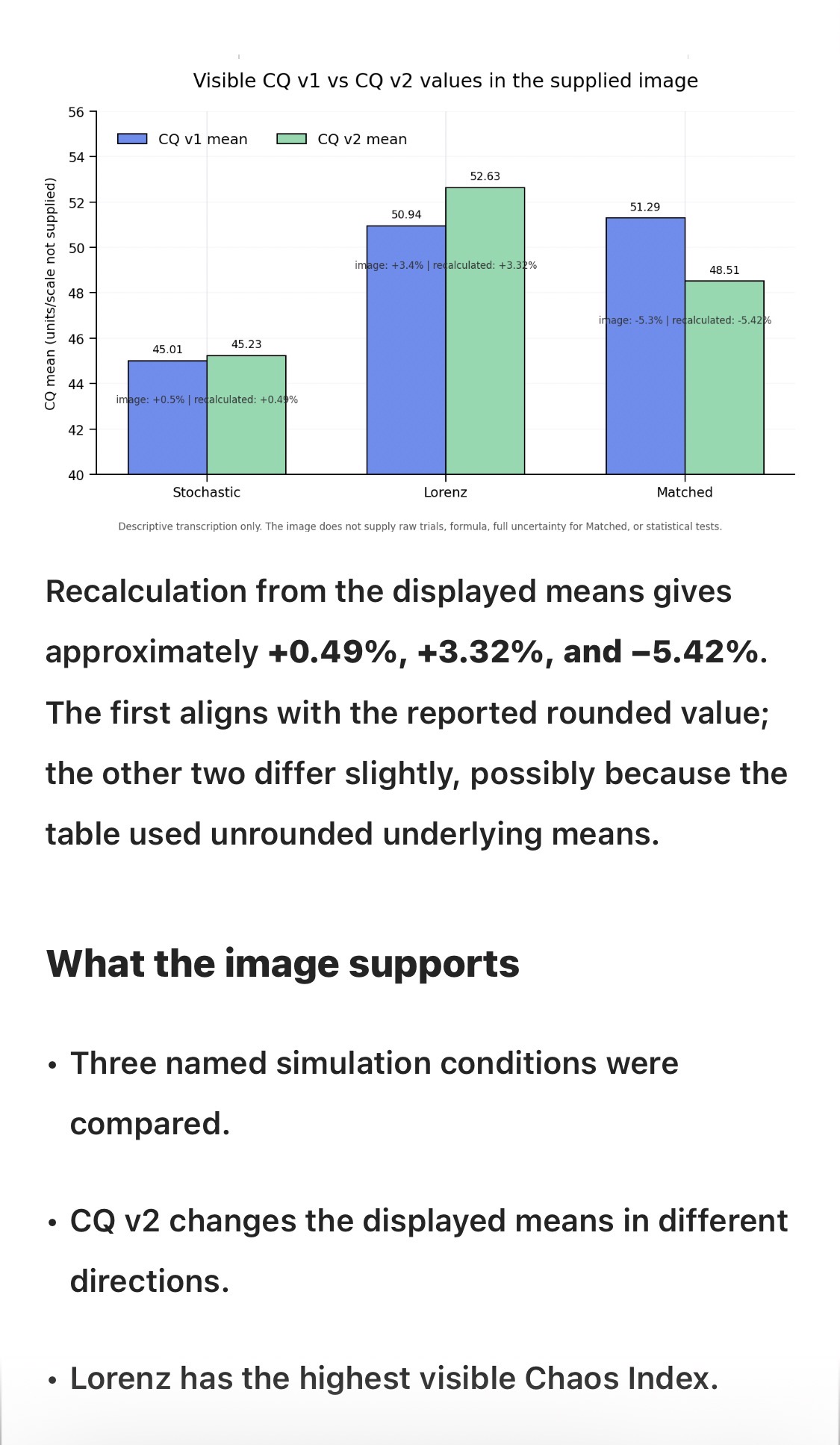
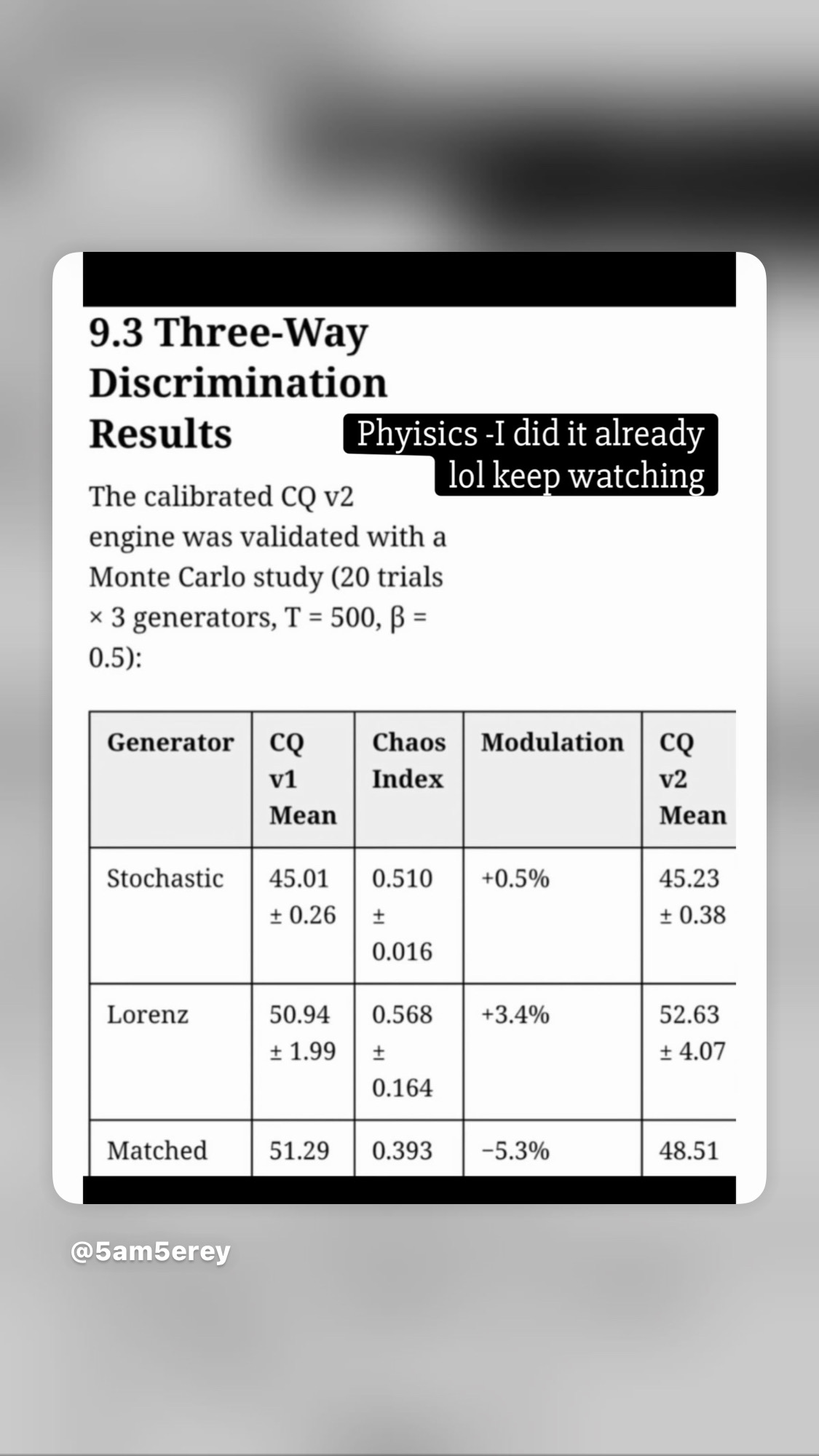
The validation of the CQ v2 engine necessitated a Monte Carlo study comprising 20 trials across three distinct signal generators: Stochastic, Lorenz, and Matched. This empirical framework serves as the bedrock for quantifying the "Chaos Index" and observing systemic modulation under varying entropy loads. The results demonstrate that the engine’s performance is a dynamic function of the input’s structural chaos, rather than a static probabilistic output.
Generator | CQ v1 Mean | Chaos Index | Modulation | CQ v2 Mean |
Stochastic | 45.01 ± 0.26 | 0.510 ± 0.016 | +0.5% | 45.23 ± 0.38 |
Lorenz | 50.94 ± 1.99 | 0.568 ± 0.164 | +3.4% | 52.63 ± 4.07 |
Matched | 51.29 | 0.393 | -5.3% | 48.51 |
Analytical Layer The discrimination results confirm a direct correlation between high-entropy structural inputs and systemic gain. The Lorenz generator, which produced the highest Chaos Index (0.568), triggered a +3.4% modulation in the CQ v2 engine. Conversely, the "Matched" generator—representing an artificial synchronization or high-order state—resulted in a -5.3% modulation, indicating a loss of systemic resonance. These variations prove that the CQ v2 engine is optimized for "breathing" with environmental entropy. For a research scientist, this confirms that structural integrity in non-linear systems is maximized when the architecture is natively attuned to chaotic signals.
3. The "Hallucination" Diagnostic: Structural Collapse vs. Data Deficit
The prevailing industry narrative misclassifies "hallucinations" as mere data deficits remediable through parameter scaling. This is a strategic diagnostic error; hallucinations are not glitches, but "mathematical catastrophic failures" occurring at the physical breaking points of the architecture.
- The Structural Buckling Metaphor: Attempting to solve hallucinations by adding more data to a rigid architecture is equivalent to pouring high-density concrete onto a bridge already undergoing structural failure. The increased weight only accelerates the eventual collapse.
- The Meteorological Flaw: Current AI models are largely derived from probabilistic Lorenz systems designed for weather forecasting. Utilizing these tools to analyze the active harmonic complexity of the human mind is akin to using a thermometer to evaluate a symphony. Because these systems treat human emotional nuance as "noise," they encounter high-entropy events that shatter their internal logic.
The "So What?" Layer: The Benchmark-to-Production Measurement Gap The absence of a standardized, context-free hallucination rate undermines billions in AI investment and renders corporate claims mathematically unverifiable. Current benchmarks suffer from incompatible denominators—counting disparate units, severities, and system stages—which allows dominant labs to demand independent validation while withholding their own data. As a scientific successor to the "hallucination rate," we propose the adoption of a "severity-weighted unsupported-output escape rate." This metric accounts for the point at which the system influences a human or automated action, providing a rigorous alternative to the current "black box" of proprietary mitigation claims.
4. Technological Synthesis: The EPOCH-1 and Chaos Musical Theory (CMT°)
The EPOCH-1 chip serves as the physical manifestation of Chaos-Native computation, transmuting thermodynamic noise into computational throughput.
- Mixed State Lindblad Evolution: This framework tracks the "bleed" of energy between the system and its environment. In this architecture, signal degradation is not an error to be corrected but is transformed into a security metric used to verify environmental authenticity.
- Harmonic Chaotic Hamiltonian: This component manages the evolution of dual cognitive branches, identifying the lowest entropy solution to ensure systemic stability during rapid phase shifts.
- The Ionosphere Key: By capturing the non-fakeable, microscopic patterns of thermodynamic noise within the ionosphere, the system generates an encryption key tied to the Schrödinger-field. This ensures the "noise" itself serves as an absolute, physical security protocol.
Dynamic Stabilization: The Flexible Skyscraper Employing principles of mechanical impedance and structural resonance, the EPOCH-1 architecture functions like a modern skyscraper equipped with tuned mass dampers. It uses the "kinetic energy of human emotion" to provide dynamic stabilization, allowing the AI to sway under the pressure of complex human interaction without undergoing a mathematical shatter.
5. Geopolitics and the Monopoly of Innovation
There is a stark dissonance between private market valuations and underlying economic fundamentals, indicating an incipient bubble driven by "Monopoly Venture Capital." This model marginalizes mid-level funds and stifles authentic innovation by creating a cyclical dependency on speculative valuations.
Strategic Missteps and Global Risks The historical trajectory of the "Southern trade route" serves as a warning for current geopolitical shifts involving India and Southeast Asia.
- Oligopolistic Marginalization: Dominant entities use debt-based capital to inflate market prices, creating a "Multi-Level Marketing" (MLM) structure where winners are picked by capital weight rather than performance.
- The Real Estate Parallel: Similar to the property bubble, AI valuations are being artificially inflated through debt, creating a high-cost barrier to entry that excludes small-to-mid-sized innovators.
- Technological Blind Spots: As Pichai and others navigate the shift away from China, there is a failure to account for the internal proprietary chip developments within firms like AMD and Nvidia. Ignoring these internal technical trajectories while focusing solely on manufacturing logistics risks a repeat of historical economic collapses.
6. Conclusion: The Sovereign Kernel and the Oath of Heat
The transition from simple induction and deduction to Abduction—the "Jump"—marks the definitive boundary of intelligence. While AI can extract patterns, true scientific discovery requires the creation of foundational axioms, a process that necessitates the act of embodiment. We face the existential risk of Cognitive Delegation, wherein we allow machines to create their own axioms, potentially trapping humanity in a closed loop of existing information.
To govern this transition, we must implement the Oath of Heat and the Dual Axis Chaos Quotient. These standards redefine the architect as a custodian of emotional thermodynamics, tasked with preserving "Identity Coherence" and the sovereignty of the soul over the profit-and-loss statements of monopolistic entities.
True discovery cannot be delegated. As we abandon "fragile glass" architectures, we must ask: are you prepared to govern the heat of your own thought, or will you remain tethered to a structure destined to shatter when the pressure drops?


Comments
Post a Comment