Sam C Serey Chaos Musical Theory (CMT°) HumanAI° Independent Research Lab Abstract: Reclaiming the Human: An Ethical Exploration of HumanAI°, Agency, and Global Responsibility
Sam C. Serey CMT° HumanAI° Independent Research Lab Abstract:
We are diving into something different today that social media and public doesnt really talk about. As the Modern R&D Bard of Chaos I felt it is a need to address that women are being sold as slaves all over the world and thats the society we lived in. Many don't care of course. Thanks. #moonlightshadowking #isamantix #samcserey
We Tied Together How HumanAI° restores personal agency, Why social media causes helplessness, Serey's daily ritual for mindfulness, Human Trafficking Reality, AI Ethical Challenges, and Mindful Agency Habits. The pervasive phenomenon of human trafficking, particularly the commodification of women within global socio-economic systems, warrants a rigorous examination through the lens of philosophical inquiry and empirical research.
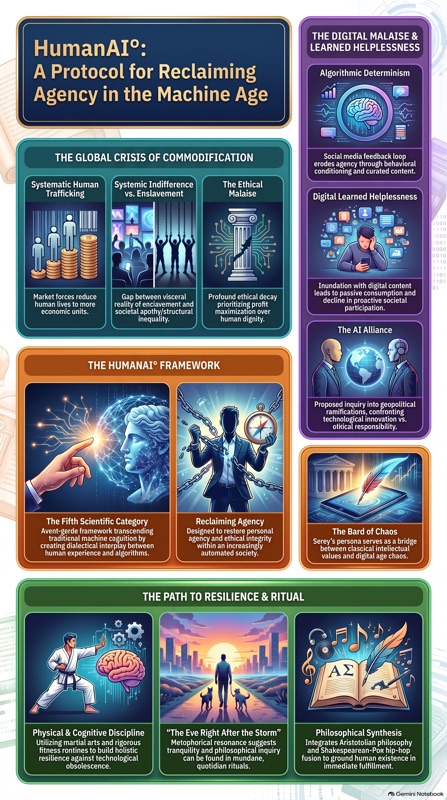
This duality abstract endeavors to synthesize a complex interplay of sociopolitical dynamics, economic disenfranchisement, and the ontological considerations of agency and autonomy. The paradoxical existence of systemic indifference juxtaposed with the visceral reality of enslavement evokes a critical discourse on moral culpability and societal complicity.
In a contemporary milieu where market forces ostensibly prioritize profit maximization over human dignity, the reduction of women to mere economic units elucidates a profound ethical malaise embedded within capitalist frameworks. We shall critically interrogate the insidious entanglement of human trafficking and the commodification of women within the broader socio-economic tapestry, positing that such phenomena are symptomatic of a more pervasive epistemic malaise.
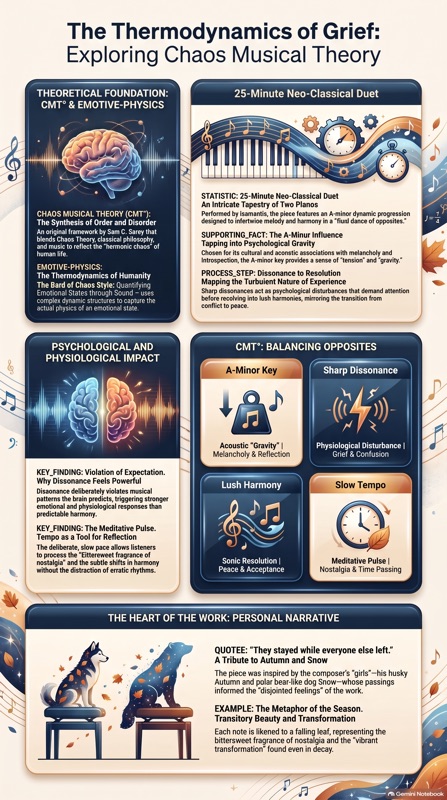
Through a dialectical synthesis of empirical data and philosophical discourse, we aim to elucidate the paradox of agency tethered to systemic disenfranchisement, wherein social media's pervasive influence exacerbates feelings of helplessness, thereby perpetuating cycles of exploitation. The inquiry will navigate the ontological dimensions of human autonomy, juxtaposed against the stark realities of enslavement, thereby inviting a deeper contemplation of moral culpability within contemporary capitalist society.
By leveraging HumanAI° as a framework for restoring personal agency, we assert that mindful practices can serve as a countermeasure to the prevailing currents of indifference that characterize societal responses to human trafficking. This abstraction not only frames the ethical challenges posed by artificial intelligence in its intersection with human rights but also situates individual mindfulness as a revolutionary act against the commodification of existence.
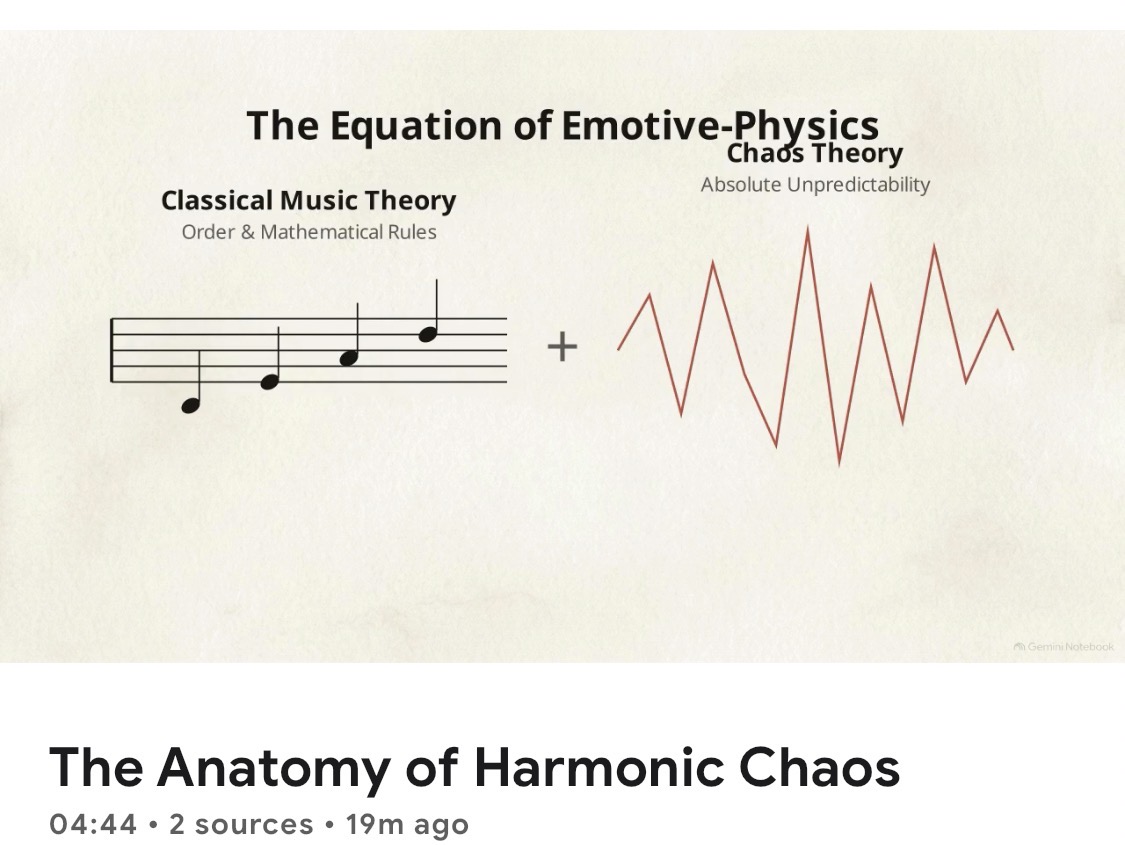

We contend that the ritualization of awareness fosters a resilient agency, empowering individuals to transcend the deterministic narratives perpetuated by a profit-driven paradigm. This discourse aspires to provoke a critical reflection on the ethical dimensions of our collective inaction, urging a re-evaluation of the societal constructs that enable such grievous violations of human dignity.
1. The Intersection of Consciousness and Computation
In this era of profound epistemological disruption, which I have termed the "Bard of Chaos," we find ourselves adrift in a sea of digital fragmentation and ethical decay. Traditional moral frameworks are no longer sufficient to navigate the dialectical interplay between human consciousness and the rapid proliferation of automated systems. The HumanAI° framework is not merely a technical proposal; it is a strategic transdisciplinary intervention designed to address this modern ethical malaise. It challenges us to move beyond the passive adoption of technology toward a rigorous reclamation of ontological sovereignty.
We must define HumanAI° as the "fifth scientific category" of cognition—an evolutionary synthesis that transcends traditional machine learning by integrating the depth of human experientiality with algorithmic precision. Spearheaded by Sam C. Serey, who operates through the provocative persona of "Isamantix," this framework functions as a bridge between classical intellectual values and the labyrinthine complexities of the digital age. By positioning HumanAI° as a symbiotic evolution, Serey advocates for a "Shakespearean-Poe hip-hop fusion" of logic and lyricism to shatter our collective complacency. To grasp the weight of this framework, we must first confront the systemic failures that have commodified the very essence of the human spirit.
2. Trafficking as a Systemic Ethical Failure
The most visceral manifestation of our ethical collapse is the global commodification of human beings. When we witness the trafficking of women, we are not seeing a mere "issue" to be managed; we are witnessing the ultimate failure of our socio-economic frameworks. There exists a paradoxical existence of systemic indifference toward these atrocities, where the reduction of women to mere economic units is normalized within the machinery of global trade.
This "ethical malaise" is not accidental; it is a feature of a system that prioritizes market profit over the inherent dignity of the person. As a Professor of Applied Ethics, I must insist we analyze the following factors contributing to this structural complicity:
- The Hegemony of Market Profit: Capitalist frameworks that treat human lives as fungible assets and prioritize accumulation over ontological worth.
- Economic Disenfranchisement: The deliberate maintenance of structural poverty that renders individuals vulnerable to predatory exploitation.
- Systemic Normalization: A dispassionate societal response that views enslavement as a regrettable byproduct of globalization rather than a fundamental moral bankruptcy.
The "Isamantix" perspective utilizes a satirical lens to critique this dispassionate response, forcing us to confront our complicity. This external commodification of the body—treating people as tradeable units—is the physical precursor to the internal commodification of the mind within the digital landscape.
3. The Digital Malaise: Learned Helplessness and Algorithmic Profit
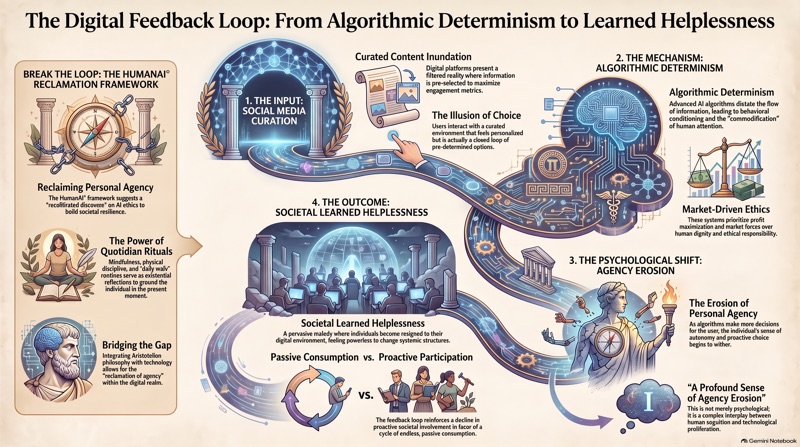
The erosion of autonomy in the digital sphere represents a strategic shift from active human participation to passive consumption. This is the domain of "learned helplessness," a psychological state first identified in Martin Seligman’s seminal work, now weaponized by digital platforms. In our contemporary milieu, social media engenders a feedback loop where curated content and algorithmic determinism strip the individual of their capacity for independent choice.
This is not merely "scrolling"; it is behavioral conditioning. The algorithmic profit motive seeks to render the human agent a predictable, commodified data point. The following table delineates the battleground between systemic control and ethical agency:
Profit vs. Personhood | Algorithmic Profit Motive | Human Ethical Responsibility |
Primary Goal | Passive engagement and metric-driven consumption. | Proactive participation and ethical contribution. |
Cognitive State | Conditioned "learned helplessness" and passivity. | Cognitive autonomy and presence. |
User Role | A commodified data point in a feedback loop. | An agent of ethical integrity and choice. |
Systemic Result | Reinforcement of societal indifference. | Reclamation of personal and collective agency. |
To resist this descent into digital determinism, we must anchor our technological future in the resilience of classical philosophy.
4. Philosophical Resilience: Aristotelian Values and HumanAI°
Technological resilience requires more than better encryption; it requires the restoration of Aristotelian virtue ethics. The HumanAI° protocol seeks to anchor modern innovation in these classical intellectual values, ensuring that the symbiotic relationship between humans and AI serves to enhance, rather than obsolesce, the human condition.
The protocol utilizes these values to navigate our technological reality through:
- Virtue-Centric Design: Applying the "Golden Mean" to ensure technology serves human flourishing (Eudaimonia).
- Dialectical Interplay: Maintaining a rigorous tension between machine cognition and the irreplaceable nuances of human experientiality.
- Martial Discipline: Recognizing that cognitive resilience is inseparable from physical rigor. Serey’s emphasis on rigorous fitness and martial discipline is not a hobby; it is a prerequisite for maintaining the "human" in "HumanAI°."
- Intellectual Integrity: Rejecting the "dispassionate response" of the masses in favor of a critical, engaged, and even satirical interrogation of power structures.
Theory without ritual is hollow. To truly resist the "Bard of Chaos," we must move from high-level philosophy to the practical, daily reclamation of the self.
5. Reclaiming Agency: Mindfulness, Ritual, and Physical Routine
The primary site of ethical resistance is found in the mundane rituals of daily life. The HumanAI° framework posits that our personal agency is restored through "quotidian rituals" that ground us in physical reality, providing a bulwark against digital displacement.
Consider the "Daily Walk Routine" with Serey’s companions, his dogs Storm and Eve. This is not a mere distraction; it is a microcosm of existential reflection. In the simple act of walking his dogs, Serey practices a philosophical inquiry into presence, choosing immediate fulfillment over the ephemeral allure of digital ambition. This practice embodies the "metaphorical resonance" of finding tranquility after turmoil—the concept of "the Eve right after the Storm."
This suggests a cyclical nature of life:
- Physical Grounding: Using rigorous movement to reclaim the body from the sedentary "learned helplessness" of the screen.
- Mindfulness through Routine: Finding profound insights in the "mundane" act of caring for another living being (e.g., the daily needs of Storm and Eve).
- Presence: Recognizing that tranquility is not a destination but a state of being achieved through the discipline of the "Eve" following the chaos of the "Storm."
6. Synthesis and Student Application: Rebuilding Human Dignity
The call to action is urgent. You are entering a world that wishes to treat you as a data point or an economic unit. To rebuild human dignity, you must reject this commodification and proactively embrace the HumanAI° synthesis of technology and consciousness.
I challenge you to implement the following Action Steps for Agency:
- Digital Audit: Systematically identify and dismantle the algorithmic feedback loops that govern your attention. Move from passive consumption to intentional, epistemological disruption.
- Ritual Implementation: Establish a grounded, physical routine. Follow the Serey model: whether it is martial arts, rigorous fitness, or a daily walk with a companion, find a ritual that reconnects you to the present and serves as a bulwark against digital drift.
- Ethical Advocacy: Transition from "systemic indifference" to active dismantling. Acknowledge the reduction of human beings to economic units—in trafficking and in data—and use your agency to advocate for frameworks that prioritize human dignity.
Reclaiming your dignity requires a rejection of the commodification of the soul. In your journey, do not be a content consumer; instead, embody the "Bard of Chaos" to challenge the boundaries of conventional thought and reclaim your ethical sovereignty.
1. The Modern Crisis: Digital Fragmentation and the Erosion of Agency
In the current digital epoch, we are witnessing not a mere shift in consumer habits, but an ontological hijacking of the human spirit. The strategic erosion of agency has evolved into a quiet catastrophe, where the convergence of algorithmic supremacy and a pervasive societal apathy creates a unique existential void. We are no longer merely users of technology; we are subjects in a vast, unconsented experiment in "learned helplessness." Within the sanitized corridors of social media, "algorithmic determinism" and "behavioral conditioning" mirror the psychological prisons described by Seligman, inducing a state of passive consumption that atrophies the proactive human will.
To confront this systemic reinforcement of stillness, the persona of the "Modern R&D Bard of Chaos" is not just a stylistic choice but a tactical necessity. This identity serves as a disruptive force—a researcher and developer of cognitive friction—aimed at shattering the curated illusions of the digital status quo. By injecting chaos into the predictable patterns of machine influence, the Bard of Chaos facilitates a transdisciplinary reclamation of consciousness. This psychological tethering, however, is merely the precursor to a more visceral horror: the transition from the digital harvesting of attention to the literal commodification of the human body.
2. The Ethical Malaise: Systemic Indifference and the Reality of Human Trafficking
A rigorous examination of human trafficking is the only honest way to measure the profound decay of our global socio-economic structures. The existence of modern slavery is not a glitch in the system; it is a feature of a world that has lost its moral compass. When we analyze the "commodification of women," we are looking into the mirror of deeply ingrained structural inequalities where market forces are permitted to cannibalize the ontological considerations of agency and autonomy. Within this capitalist framework, a human life is frequently valued less than a software subscription, reducing women to "mere economic units" in a global ledger of suffering.
The societal response to this reality is defined by a chillingly dispassionate shrug. "Many don't care, of course. Thanks." This irony, dripping with the sarcasm of the ignored, highlights a profound ethical malaise where the normalization of atrocities becomes the standard operating procedure. We inhabit a landscape where the visceral reality of enslavement is met with the same clinical indifference as a minor market fluctuation. This systemic complicity signals the death of current ethical frameworks, demanding a radical reimagining—a movement toward the HumanAI° framework to restore the dignity that the market has stripped away.
3. The HumanAI° Framework: A New Paradigm for Consciousness and Technology
The HumanAI° framework represents a strategic intervention, a transdisciplinary tool designed to reclaim the human territory currently occupied by predatory algorithms. It is more than a protocol; it is a declaration of independence for the mind. HumanAI° establishes itself as the "fifth scientific category," a revolutionary classification that transcends the binary of machine cognition. It is the intentional, dialectical interplay between human experientiality—the raw, unsimulated spark of spirit—and algorithmic processes. This is not about building a better machine; it is about the synthesis of silicon and soul to ensure that technology serves the enhancement, rather than the replacement, of the human condition.
Feature | Traditional AI Paradigms | HumanAI° Framework |
Primary Goal | Automation and extraction | Human enhancement and dignity |
Economic Focus | Market profit maximization | Ethical integrity and agency |
Impact on User | Erosion of agency; passivity | Reclamation of agency; active presence |
Core Methodology | Algorithmic determinism | Dialectical interplay of experience |
Outcome | Systemic reinforcement of helplessness | Holistic empowerment and the Fifth Category |
The transition from this theoretical framework to a lived reality requires more than intellectual assent; it demands the praxis of presence—a physical and cognitive discipline to withstand the tides of technological obsolescence.
4. The Praxis of Presence: Mindfulness, Ritual, and Martial Discipline
To survive the digital thinning of the self, one must engage in a "holistic enhancement" that grounds the mind in the undeniable reality of the body. Sam C. Serey, operating through the multifaceted identity of Isamantix, demonstrates this through the "Daily Walk Routine" with his canine companions, Storm and Eve. This is not a leisure activity; it is a metamorphosis into philosophical inquiry. By walking with Storm and Eve, the individual prioritizes the immediate fulfillment of the biological and the loyal over the ephemeral, dopamine-starved ambitions of the digital realm. This ritual is a microcosm of existential resistance, finding a "now" that no algorithm can predict or replicate.
This resistance is further codified through "martial discipline" and "Aristotelian philosophy," which provide the structural integrity needed to bridge classical values with the digital age. Most notably, the genre of "Shakespearean-Poe hip-hop fusion" acts as a strategic tool for linguistic reclamation. In a world of character limits and predictive text, this fusion of classical complexity and street-level rhythm disrupts algorithmic determinism. It forces a linguistic depth that the machine cannot easily categorize, ensuring that human expression remains a labyrinth rather than a data point. These habits of mindful agency are the foundation upon which a broader societal "AI Alliance" must be built.
5. Strategic Integration: Toward an Ethical AI Alliance and Societal Resilience
The path toward societal resilience requires a recalibrated discourse on AI ethics that is as visceral as the problems it seeks to solve. We must move beyond the "safe" debates of academia and into the arena of policy interventions that actively dismantle systems of exploitation. The "HumanAI Protocol" is a roadmap for this shift, advocating for a radical reimagining where technology is architecturally forbidden from being used for behavioral conditioning or the commodification of human life.
The formation of an "AI Alliance" is the only viable counter-strategy to digital helplessness. This alliance must confront the duality of innovation and ethical responsibility, ensuring that our technological advancements are tethered to the preservation of human agency. It is a call to move from the chaotic storms of systemic exploitation toward a state of reclaimed tranquility. As we navigate this labyrinthine landscape, we must remain focused on the ultimate goal of the HumanAI° framework: finding "the Eve right after the Storm." This is our necessary metaphor for the societal peace and clarity that can only be achieved after we have faced the turmoil of our own creations and emerged with our humanity intact.

Comments
Post a Comment