"Shadows In The Mist" Beyond the Beats: 5 Provocative Lessons from the 'Bard of Chaos'
The Intersection of the Macabre and the Modern
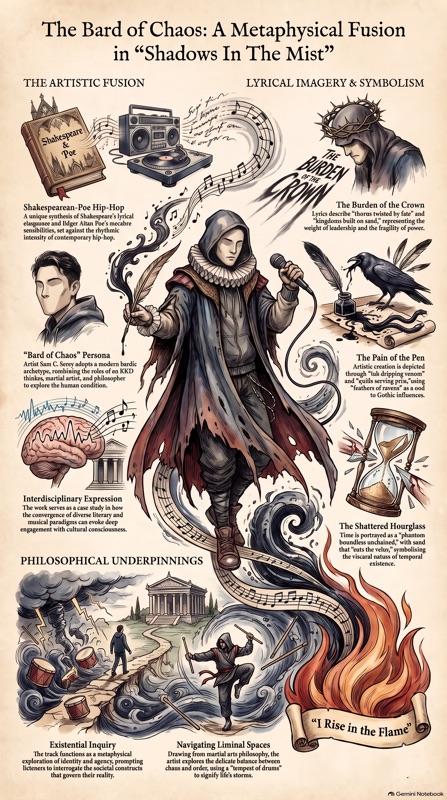
The traditional image of the classical poet—a figure sequestered in a silent study with quill and parchment—is an architectural ruin of sound in the hands of Sam C. Serey. Performing under the moniker Isamantix, Serey orchestrates a sonically abrasive collision between the calcified dread of 19th-century Gothicism and the rhythmic subversion of urban hip-hop. His project, Shadows In The Mist, is not merely a "crossover" but a deliberate "Shakespearean-Poe hip-hop fusion." By positioning himself as the "R&D Bard of Chaos," Serey collapses the distance between the iambic pentameter of the elite and the raw intensity of the street, crafting a linguistic subversion that is as intellectually demanding as it is visceral.
The Power of "Genre-Bending" Existentialism
The synthesis of Shakespearean eloquence, Edgar Allan Poe’s macabre sensibilities, and the jagged dynamics of contemporary hip-hop serves as an innovative "modality for existential inquiry." This is not high literature for its own sake, nor is it a hollow mimicry of street-level rhythms; rather, it is a liminal space where the human psyche is interrogated with a scalpel. By eroding the traditional boundaries between these disparate art forms, Serey suggests that existential dread is a universal constant, whether it is articulated in a 19th-century manor or over a pulsating 808.
"The track 'challenges the boundaries of poetry and music,' creating an auditory experience that is both thought-provoking and exhilarating."
Leadership is a "Cursed Crown"
Through the "Throne of Echo," Isamantix explores the isolation of authority and the harrowing "pain of artistic creation." Leadership is stripped of its romantic veneer and revealed as a burden—a "cursed crown" that demands a "complete collapse" of the self. There is a deliberate instability in the text itself; the lyrics appear to mutate and "unlearn" their own structure, oscillating between "First crown," "First ground," and "First round." This linguistic decay mirrors the artist’s assertion that "every page flips, lessons unlearn," suggesting that success is a kingdom built on sand where "crash waves dictate."
"Throne of echo. No rest for the king. First crown heavy. Yes, still I sing."
The Artist as a "Martial Artist Philosopher"
Sam C. Serey adopts the specific archetype of the "R&D Bard of Chaos," a figure who operates as a "Martial Artist Philosopher." This designation reframes creativity as a disciplined, tactical navigation of the liminal spaces between chaos and order. Here, the "philosophical underpinnings of martial artistry" are used to survive a "world defined by ambiguity." The Bard does not merely express emotion; he engages in a research-and-development phase of the soul, treating the "tempest" of existence not as an obstacle, but as a discipline to be mastered through structured verse and philosophical inquiry.
The "Venomous Ink" of Truth-Telling
The imagery of Shadows In The Mist is calcified in Gothic dread: "Ink drips venom," "Quills carve my pain," and "Hourglass shatters." These are not passive metaphors but visceral depictions of the struggle for authentic existence. Serey utilizes these elements to deliver a sharp, satirical defiance of modern societal constructs. The satire is most potent when the artist identifies as a "nobody," a status from which he dares to interrogate the "AI Alliance leaders." It is a confrontation of "venomous ink" against digital tyranny, urging the audience to look beyond the veneer of everyday life and confront the "deadly snare" of a reality governed by "truths and lies tangled."
"Ink drips venom. Quills carve my pain. Feathers of ravens. Blood stains remain."
The Surprising Shift: Art as a Warning for the AI Era
In a pivot that connects 19th-century existentialism to 21st-century technological anxiety, the project emerges as a warning for the AI era. Serey links the "spectre" and "ghosts of the past" found in his lyrics to the "hidden AI Global Disaster" mentioned in his transcripts. This AI is the modern Raven, a relentless "phantom boundless unchained" tapping at the chamber door of global stability. By framing the "complete collapse" caused by "AI Alliance leaders" as the logical conclusion of the "tempest" he describes, Serey suggests that the "chaos" of Poe’s era and the "shadows" of our technological future are one and the same.
Conclusion: Embracing the Tempest
Shadows In The Mist is a metaphysical exploration that demands we find order within "shrouded ambiguity." Serey’s work is a maritime disaster of the soul, where "sails are torn" and "ships are doomed to fail," yet the artist continues to rise in the flame. It is a call to navigate the "tempest of drums" and the "lightning [that] strikes, splits the core" with the discipline of a philosopher and the grit of a "nobody" speaking truth to power.
As we drift through our own "complete collapse," how do we construct meaning when our kingdoms are built on sand? How do we find the courage to "still sing" when the AI Raven is already at the door?

1. Introduction: The Modern Bardic Archetype
Sam C. Serey, operating under the pseudonym Isamantix, functions as a critical nexus in the contemporary landscape of interdisciplinary artistic expression. His position as a "Modern R&D Bard" provides an empirical foundation for his metaphysical inquiries, leveraging his background as a researcher, martial artist, and philosopher to construct a sophisticated semiotic framework. This multi-disciplinary orientation allows Serey to interpret contemporary existentialism not merely as a theoretical abstraction, but as a visceral reality navigated through physical and mental discipline.
The "Bard of Chaos" archetype serves as a vital bridge between the linguistic grandeur of classical literary traditions and the kinetic, rhythmic innovations of urban music. This persona facilitates a temporal dissonance where the ancient and the avant-garde collide, transforming chaos from a state of entropic disorder into a structured modality for creative resilience. This identity is the primary driver behind the generic fusion in "Shadows In The Mist," where the artist navigates the liminal spaces between total artistic collapse and the precise execution of structured verse.
2. The Alchemy of Genre: Shakespearean-Poe Hip Hop Fusion
The strategic intent of "Shadows In The Mist" lies in its anachronistic synthesis—a deliberate convergence of 17th-century Shakespearean eloquence, 19th-century Poe-esque macabre, and 21st-century rhythmic intensity. This fusion creates an auditory space where the psychological burdens of the past and the existential anxieties of the digital age are interrogated simultaneously.
The Tripartite Synthesis
Influence | Contribution to the Fusion | Evidence in the Text |
Shakespeare | Ontological weight and the burdens of sovereignty. | "Throne of echo," "Kingdoms built on sand," "Thorns twisted my fate." |
Edgar Allan Poe | Atmospheric doom and the aesthetics of the macabre. | "Spectre's wail," "Raven feathers," "Ink drips venom," "Gothic literature." |
Modern Hip Hop | Rhythmic urgency and the democratization of suffering. | "Tempest of drums," "Intricate wordplay," "Rhythmic complexities," "Fresh in chaos." |
This synthesis moves beyond superficial genre-blending to establish a profound modality for existential inquiry. The "So What?" layer of this work reveals a radical democratization of the macabre. By placing the high-art suffering of a Shakespearean king alongside the urban grit of hip-hop, Serey posits that the "ghosts of the past" and modern "haunting beats" are manifestations of the same universal struggle. This interdisciplinary convergence suggests that agency is not found in avoiding the "shadowy realms," but in mastering the rhythmic architecture that contains them.
3. Gothic Semiotics: Deciphering the Metaphors of Chaos
In "Shadows In The Mist," high-gothic imagery functions as a semiotic shorthand for internal psychological states and satirical critiques of external power structures. These metaphors map the metaphysical exploration of a self caught in a state of "complete collapse."
The Heavy/Thorned Crown The signifiers "Cursed crown heavy" and "Thorns twisted my fate" represent the paralyzing weight of responsibility and the inherent volatility of power. Notably, the phonetic ambiguity in the source—vacillating between "First ground," "First round," and "Cursed crown"—serves as a thematic strength. This shifting auditory landscape mirrors the instability of "Kingdoms built on sand," where the very foundation of authority is a "throne of echo." Satirically, this links the "kings" of antiquity to modern "AI Alliance leaders," suggesting all such sovereignty is haunted by its own eventual collapse.
Venomous Ink and Raven Feathers The act of artistic creation is framed as a sacrificial ritual through the imagery of "Ink drips venom" and "Quills carve my pain." The "Feathers of ravens" evoke a Poe-esque sense of predestination and doom. Here, the artist is not a passive observer but an empirical researcher of pain, where "blood stains remain" on the page as evidence of the struggle to translate the "spectre's wail" into a coherent narrative.
The Shattered Hourglass The metaphor of the "hourglass shatters" and "sand cuts my veins" redefines mortality as a tactile, wounding force. Time is presented as a "phantom boundless unchained," stripping the individual of the illusion of linear progress. This imagery reinforces the state of being "drenched in chaos," where the "deadly snare" of existence is the inability to distinguish between the "truths and lies tangled" within the passage of time.
4. The Martial Artist’s Creative Process: Navigating the Liminal Space
The creative act for Serey is an extension of martial artistry's philosophical underpinnings, which demand a calculated balance between internal order and external chaos. By "dancing in the tempest," the artist utilizes the discipline of a practitioner to navigate the liminal space between collapse and creation. The vocal delivery functions as a form of vocal kata—a series of disciplined, precise movements maintained even as the "heavens roar."
Martial philosophy shapes the rhythmic delivery of "Shadows In The Mist" in three specific ways:
- Vocal Mastery as Defensive Stance: The maintaining of "intricate wordplay" against a "tempest of drums" mirrors the martial artist’s ability to remain centered amidst an onslaught.
- Rhythmic Resistance: The artist treats the "haunting beats" as an opposing force to be harmonized with, rather than succumbed to, representing a fluid response to "shifting shadows."
- Precise Ciphers: Every "riddle" and "cipher" in the verse acts as a strategic strike against the ambiguity of the human condition, utilizing linguistic precision as a tool for survival.
5. Rhythmic Conflict: The Sonic Architecture of Struggle
Rhythm in Serey’s work is a strategic narrative engine that simulates the friction of existence. The "tempest of drums" is not a background element but a sonic representation of the "complete collapse" mentioned in the source imagery. This architecture forces the listener to experience the "drenched in chaos" state, making the struggle for "identity and agency" an immersive auditory reality.
The use of "riddles and air" and "ciphers and smoke" as rhythmic elements reflects a satirical interrogation of societal constructs. When the "devil grins" within the structure of the beat, it suggests that modern systems of power—including the "AI Alliances"—are themselves "deadly snares" designed to obscure the truth. The "haunting beats" thus serve as a critique of the "unaccountable power" that governs the modern world, urging the listener to find their own rhythm within the systemic noise.
6. Practical Existentialism: Finding Meaning in Ambiguity
"Shadows In The Mist" posits that the encounter with "the Shadows" is a strategic necessity for ontological growth. Chaos is framed as a "blessing in reverse," a catalyst that strips away the "veneer of everyday life" to reveal the raw mechanics of the soul. The track moves from abstract gothic tropes to the visceral reality of the "hidden AI Global Disaster," framing the technological "complete collapse" as the ultimate manifestation of the "spectre's wail."
By adopting the perspective of a "nobody" speaking truth to "AI Alliance leaders," Serey challenges the listener to reclaim agency in an era of systemic failure. The artist functions as a guide through the "Shadows in the Mist," offering a framework for those navigating a world where "truths and lies" are inextricably tangled.
Manifesto for the Post-Collapse Individual
- Acknowledge the Weight: Accept the "heavy crown" of self-sovereignty and the "thorns" of a chaotic fate as the starting points for growth.
- Synthesize Temporal Realities: Use the "eloquence of the past" to articulate the "anxieties of the present," creating a more robust internal narrative.
- Master the Vocal Kata: Maintain personal discipline and "vocal mastery" even when the "heavens roar" and societal structures disintegrate.
- Interrogate the Alliance: Satirize and question the "leaders" of the "AI Global Disaster," recognizing that meaning is found in the "liminal space" of the "nobody" rather than the "throne of echo."
Isamantix demonstrates that while the "hourglass shatters," the act of singing amidst the ruins is the highest form of resistance. The artist remains a guide through the "Shadows in the Mist," proving that even in the flame, one can rise.
"The Bard of Chaos: A Philosophical Synthesis of Martial Arts, Gothic Literature, and Modern Hip Hop. I Am Loud because I have to be. I was quiet because I had to be. What about you?"
"Shadows In The Mist" by Isamantix & Produce by Sam C. Serey
Duration: 3:09 Minutes
[Lyrics:]
[Verse]
Eyes on the crown, thorns twist in my fate,
Kingdoms built on sand, crash waves dictate.
The ghosts of the past, they linger, they hiss,
Life's a tempest, I dance in the abyss.
Beneath the moon, a specter’s wail,
Sails torn, my ship's doomed to fail.
Eternity whispers, secrets that burn,
Every page flips, lessons unlearned.
[Chorus]
Shadows in the mist, calling my name,
Drenched in chaos, I rise in the flame.
A throne of echoes, no rest for the king,
Cursed crown heavy, yet still I sing.
[Verse 2]
Ink drips venom, quills carve my pain,
Feathers of ravens, bloodstains remain.
The hourglass shatters, sand cuts my veins,
Time a phantom, boundless, unchained.
Ciphers in smoke, riddles in air,
Truths and lies, tangled, a deadly snare.
Cloaked in shadows, my steps betray,
The devil grins; I’m his to sway.
[Bridge]
A tempest of drums, the heavens roar,
Lightning strikes, splits the core.
Chaos, my muse, she writes my verse,
Every line cursed, a blessing reversed.

Comments
Post a Comment