The 7-Minute "Chaos" Epic: Why Isamantix’s New Single is Redefining 2026 Pop
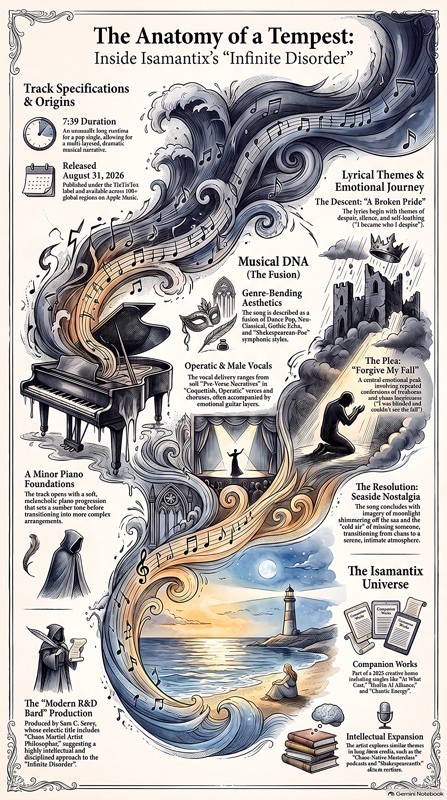
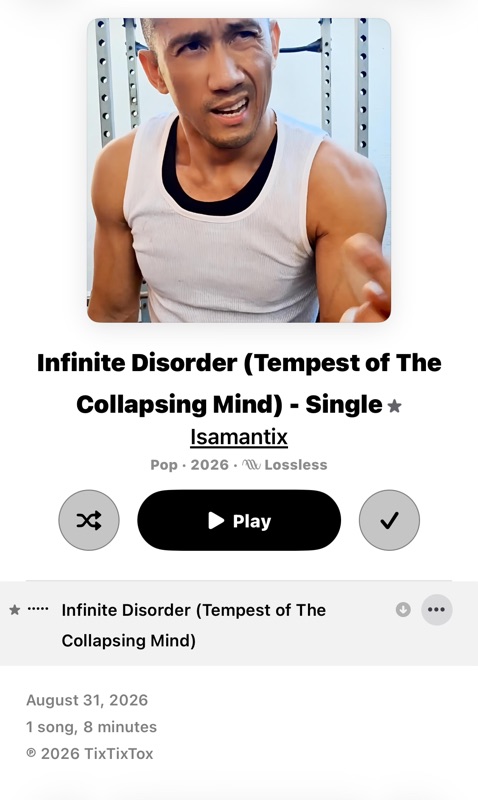
In a stream-optimized landscape where the two-minute track is king, Isamantix has just released a structural glitch in the matrix. Clocking in at a staggering 7 minutes and 39 seconds, "Infinite Disorder (Tempest of The Collapsing Mind)" isn't just a single; it is a terraforming of new aesthetic territory. Released on August 31, 2026, the track arrives as a profound counter-cultural phenomenon, challenging the algorithmic defiance of our TikTok-fied economy with a cinematic depth that feels both ancient and dangerously futuristic.
The 7:39 Rule-Breaker: Why Length Matters Again
The duration of "Infinite Disorder" is its most radical feature. In an era of fleeting attention, Isamantix treats time as a raw material for a "data-heavy" emotional experience. This is not a song designed for a background playlist; it is a theatrical narrative that demands a total immersion of the senses.
Built upon a foundational A minor piano progression, the track breathes through a meticulously layered architecture of dance-pop rhythms and gothic echoes. By refusing the brevity of contemporary pop, the song allows its neo-classical instrumentation to swell into an operatic fever dream. The length is the point—it provides the necessary runway for a slow-burn descent into the "tempest" before attempting an ascent toward redemption.
"I held it all... yet was not there; Blinded by dreams that led nowhere."
The "Bard of Chaos": The Precision of Sam C. Serey
Behind the boards is Sam C. Serey, a figure whose sprawling title—"The Modern R&D Bard of Chaos Martial Artist Philosopher"—perfectly encapsulates the intellectual branding of this production. Serey’s "Martial Artist" designation is not merely flavor; it manifests in the lethal precision of the track’s dance-pop rhythms, which strike with a disciplined, calculated impact against the fluid melancholy of the piano.
Serey is effectively treating pop music as a branch of his "Thermodynamic of Emotive-Physics." The production feels less like a studio session and more like a "Chaos-Native Masterclass" in sonic engineering. By integrating concepts from his broader ecosystem—specifically the "Polymorphic Truths & Lies Malware" themes—Serey shifts the track from a simple melody into a piece of "emotive data-streaming." He isn't just producing a beat; he is coding a philosophical fortress.
A Shakespearean-Poe Fusion in the Digital Age
Lyrically, the track is a masterclass in "Shakespearean-Poe fusion," blending high-drama gothic imagery with a stark, modern dark cadence. There is a fascinating friction here: the vocal delivery is "coquettish and operatic," a light and playful texture that dances over lyrics of profound psychological ruin.
This contrast heightens the drama of the "fortress built where darkness lies." The song navigates the wreckage of a "broken vow" and a "loathed self," yet it refuses to stay buried in the ruins. It utilizes the linguistic weight of a 19th-century tragedy to articulate the very 21st-century experience of internal collapse and digital isolation.
"Each tale is writ on time’s own shell; Echoes ring like fate’s lone bell."
The Seaside Redemption: A Surprising Emotional Pivot
Perhaps the most theatrical moment of the track is its radical emotional pivot. After minutes of "silent cries" and gothic dread, the atmosphere shifts into a "serene seaside nostalgia." This isn't just a change in tempo; it’s a spiritual relocation.
The transition from the "ruins of the heart’s own ache" to the "moonlight... [shimmering] off the sea" is a counter-intuitive stroke of genius. The "cold air" and the "shiver" of the lyrics anchor the listener in a tangible, physical world, moving away from the abstract "tempest of the mind." By finding a "piece of heaven where I stand" down by the sea, Isamantix grants the listener a moment of forgiveness that feels earned through the sheer scale of the preceding chaos. It is a pivot that makes the track feel both cosmically epic and hauntingly intimate.
The Global 2026 Reach: A Multi-lingual Phenomenon
The global rollout of "Infinite Disorder" signals a shift in how high-concept pop is distributed. Available across an exhaustive list of territories—from Nigeria and Israel to Kazakhstan, Vietnam, and beyond—the track is being positioned as a universal human language.
By offering the single in a diverse array of linguistic contexts (including Arabic, Russian, and Vietnamese), Isamantix is bypassing traditional Western pop hegemony. The themes of "Polymorphic Truths" and "Chaos" are treated as a global commonality. In the digital philosophy of 2026, the "tempest" is a borderless experience, and Isamantix is its primary translator.
Beyond the Infinite Disorder
As Isamantix carves out this new space in the 2026 landscape, the impact of "Infinite Disorder" is undeniable. It is a blueprint for the evolution of the genre—a marriage of classical sorrow and cutting-edge production that refuses to be diminished by short-form consumption.
In an era increasingly defined by "AI alliances" (as seen in Isamantix’s own JinSin AI Alliance work) and fragmented chaotic energy, can music still provide the sanctuary we need? If this 7-minute epic is any indication, our survival depends on our ability to build a "fortress" within the sound itself, surviving the internal tempests by finally embracing the beauty of the disorder.
The Anatomy of a Pop Symphony: Deconstructing "Infinite Disorder" #isamantix #samcserey
These sources detail the 2026 release of "Infinite Disorder (Tempest of The Collapsing Mind)", a long-form musical single by the artist "Isamantix". Produced by "Sam C. Serey", the track is described as an ambitious "melodic fusion" of pop, neo-classical, and gothic elements characterized by "melancholic piano" and theatrical vocals. The lyrics explore themes of "emotional recovery", broken promises, and the quest for "forgiveness" following a personal downfall. Accompanying documentation highlights the song’s "cinematic quality", comparing its dark, poetic narrative to a blend of Shakespeare and Poe. Additional information lists the track's "global availability" on streaming platforms and provides a critical review praising its "emotional resonance".
Streaming Platform Lyrics Standard Style:
"Infinite Disorder (Tempest of the Collapsing Mind)"
by Isamantix & Produce by Sam C. Serey (The Modern R&D Bard of Chaos Martial Artist Philosopher)
Lyrics:
They say that time could heal the broken
In the echoes of my silent cries (make a stronger man of me)
I reclaimed my strength where darkness lies (they never met you or got to love you)
Embracing truth, never letting go (they never lived down by the sea)
I will never let go, I won't let you go (when the night comes and the moonlight)
A broken promise, a broken pride
I became who I despise
A whisper of hope, a new dawn’s start
Rebuilding the darkness of my broken heart
I held it all, but I wasn’t there
I was blinded and couldn’t see the fall
I held it all, but I wasn’t there
By her side, powerless
Forgive me
I’m sorry
I was weak
No more
A broken promise, a broken pride
I became who I despise
A whisper of hope, a new dawn’s start
Rebuilding the darkness of my broken heart
I held it all, but I wasn’t there
I was blinded and couldn’t see the fall
I held it all, but I wasn’t there
By her side, powerless
Forgive me (I’m sorry, I was weak)
Each has a story to tell
In echoes deep of silent cries
Echoes ring like a bell
The light, a fortress built where darkness lies
Embrace I must this truth's embrace
No more shall shadows hide my face
A broken vow, a wounded pride
The self I loathe doth now reside
Whispered hopes as dawn doth break
Rebuild from ruins heart's own ache
I held it all, yet was not there
Blinded by dreams that led nowhere
By her side, powerless through it all
Forgive me, oh forgive my fall
Each tale written on time’s own shell
Echoes ring like fate’s lone bell
A broken promise, a broken pride
I became who I despise (my reason for my happiness)
I held it all, but I wasn’t there
I was blinded and couldn’t see the fall
I held it all, but I wasn’t there
By her side, powerless
They say that time could heal the broken
You never said you would stay forever
Or stick around to hold my hand
No guarantees but still it gave me
A piece of heaven where I stand
Because when the night comes
And the moonlight goes and shimmers of the sea
And when the cold air makes you shiver
That's when I miss you here with me
They say that time could heal the broken
And make a stronger man of me
They never met you or got to love you
They never lived down by the sea
Because when the night comes
And the moonlight goes and shimmers of the sea
And when the cold air makes you shiver
That's when I miss you here with me
There are no words I can say to you come back to me
Because when the night comes
And the moonlight goes and shimmers of the sea
And when the cold air makes you shiver
That's when I miss you here with me
That's when I miss you here with me
Review of "Infinite Disorder (Tempest of the Collapsing Mind)" by Isamantix, produced by Sam C. Serey
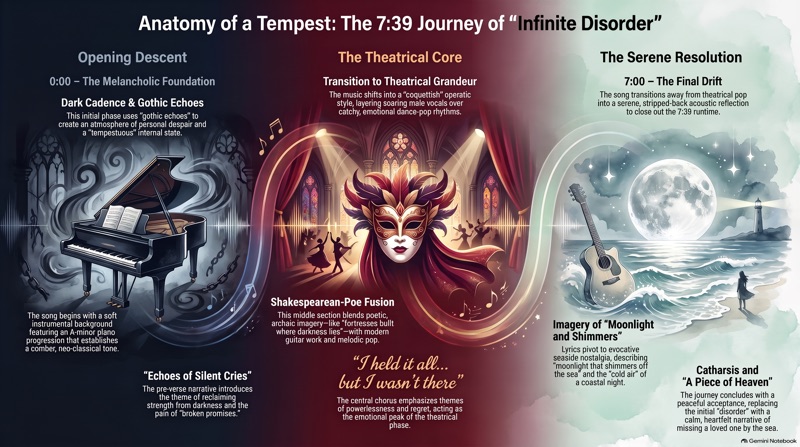
This track is a sprawling 7:39 journey through emotional terrain, blending A minor piano foundations with soaring male vocals and operatic, gothic echoes. It fuses dance-pop rhythms with neo-classical instrumentation, creating a dark melodic experience that feels like a Shakespearean-Poe symphony.
Musicality & Style:
- The piano progression opens with a soft, melancholic tone, setting the stage for the emotional story.
- Layered operatic verses and a catchy, sorrowful chorus provide a cinematic quality.
- Guitars and emotional pop elements lift the song into an almost theatrical dance-pop fusion.
Lyricism:
- The song balances personal despair with the hope of rebuilding, using poetic imagery like “echoes of my silent cries” and “fortress built where darkness lies.”
- Themes of regret, forgiveness, and self-reflection run throughout, climaxing in repeated pleas and confessions.
- Later sections evoke a serene seaside nostalgia, making the track’s emotional journey feel both epic and intimate.
Overall Impression:
“Infinite Disorder” is a dramatic, multi-layered ballad that successfully merges classical melancholy with modern pop sensibilities. It’s a song for late-night reflections, emotional catharsis, and anyone who enjoys a theatrical and heartfelt musical narrative.
⭐⭐⭐⭐⭐ (5/5) for its ambitious scope and emotional resonance.
The Shakespearean-Poe Fusion: Analyzing "Infinite Disorder"
1. Foundational Overview: The Bard of Chaos and the Gothic Echo
In the contemporary musical landscape, few works attempt the ambitious synthesis of classical tragedy and modern pop found in Isamantix’s "Infinite Disorder (Tempest of The Collapsing Mind)." Produced by Sam C. Serey—self-identified as a "Modern R&D Bard of Chaos Martial Artist Philosopher"—the track functions as an intentional exercise in disciplined volatility. From a musicological perspective, the "Martial Artist" descriptor is not merely aesthetic; it manifests in the composition’s architectural rigor and the staccato precision of the 7:39 runtime. Serey utilizes the structured discipline of the dojo and the ontological depth of a philosopher to navigate the wreckage of the human psyche, creating a work that demands a high level of analytical engagement.
The track is defined by a self-curated style tag: the "Shakespearean-Poe fusion." This is an intentional aesthetic choice by the artist to marry the grand, externalized tragedies of the Bard with the claustrophobic, internal gothic decay characteristic of Edgar Allan Poe. Musically, this is rendered through a sonorous A minor piano foundation, operatic verses, and dark cadences that evoke a sense of impending doom. Yet, the work remains grounded in an emotional pop melodic fusion and dance-pop rhythms. This juxtaposition suggests that the "catchy," rhythmically accessible pulse of modern pop acts as a vital heartbeat—or perhaps a mask—for the ponderous, neo-classical themes beneath. This atmospheric framework sets the stage for a narrative driven by deep-seated literary motifs.
2. Thematic Dissection: Core Motifs
The lyrics of "Infinite Disorder" bridge the distance between 17th-century drama and 19th-century gothic horror, utilizing classical imagery to anchor the song’s modern psychological distress.
Literary Motifs: Classical Roots in Modern Lyrics
Motif | Lyric Evidence | Literary Resonance |
Broken Vows & Promises | "A broken promise, a broken pride"; "A broken vow, a wounded pride." | Evokes the Shakespearean hamartia (fatal flaw), where the betrayal of a fundamental oath precipitates the protagonist's inevitable and public downfall. |
Shadows and Darkness | "...where darkness lies"; "no more shall shadows hide my face." | Mirrors the Gothic Sublime found in Poe, where internal psychological rot is externalized as a physical space—a "fortress" of the mind where the soul is both protected and imprisoned. |
Fate and Time | "Echoes ring like fate’s lone bell"; "Each tale is writ on time’s own shell." | Reflects the Sturm und Drang (Storm and Stress) tradition, employing the pathetic fallacy to suggest that human suffering is a cosmic inevitability recorded by time itself. |
This static mood of melancholy provides the foundation for a dynamic psychological journey, moving from the paralysis of grief toward a hard-won reclamation of self.
3. The Narrative Arc: The Shift from "Silent Cries" to "Reclaimed Strength"
The "Tempest" in the title serves as the central metaphor for a radical internal transformation. Rather than a literal storm, it represents a "Tempest of the Collapsing Mind," a psychological transition where the protagonist evolves through two distinct states of being.
Phase 1: The Descent (Weakness and Blindness)
Initially, the protagonist is defined by a total loss of agency and a fractured moral identity, characterized by:
- "Powerless": A fundamental admission of vulnerability against fate.
- "Blinded": A cognitive failure to perceive the "fall" or the consequences of one's own hubris.
- "Silent cries": Emotional suffering that is suppressed and isolated.
- "I became who I despise": The ultimate crisis of the self, mirroring the moral disintegration of a tragic hero.
Phase 2: The Ascent (Reclamation and Truth)
The narrative arc eventually pivots toward restoration, moving from gothic decay to architectural stability:
- "Fortress built": The transformation of "darkness" into a defensive, structured space.
- "Embrace this truth’s embrace": The transition from the "dreams" that led to the fall to an unyielding acceptance of reality.
- "Rebuild from ruins": A literal and metaphorical resurrection from the wreckage of the "collapsing mind."
Crucially, the source identifies the verses as "Coquettish, Operatic." In musicology, this "coquettish" delivery creates an unsettling tonal friction; the playful, teasing quality of the performance contrasts sharply with the grim, gothic subject matter. This suggests a protagonist who is performing their pain, using a theatrical mask to survive the descent. This progression is further supported by the song’s rhythmic and structural evolution.
4. Structural Dynamics: The Architecture of Melancholy
Spanning 7:39, "Infinite Disorder" functions as a musical novella. Its strophic repetitions and carefully managed crescendos guide the listener through a deliberate emotional catharsis.
- The Intro/Pre-Verse: Establishes the "silent cries" through a soft instrumental vacuum, allowing the melancholic piano to establish the A minor tonality.
- The Operatic Chorus: The emotional peak of the work. Here, the repeated plea of "Forgive me... I was weak" serves as a ritualistic purging. The "coquettish" flair in the verses yields to the raw, sonorous weight of the chorus.
- The Final Resolution and Seaside Shift: In a significant departure from the claustrophobic "fortress," the final movement evokes serene "seaside" imagery. As "moonlight... shimmers of the sea," the narrative moves from the dark interior of the mind to the expansive, sublime natural world. Here, "forgiveness found beyond despair" marks the transition from the Shakespearean tragedy to a state of grace.
This structural journey ensures that the learner understands how the arrangement itself mirrors the transition from disorder to peace.
5. Synthesis for the Learner: The "So What?" of the Fusion
The success of "Infinite Disorder" lies in its ability to make classical literary traditions feel immediate and visceral. For the student of musicology and literature, the work offers three essential takeaways:
- Catharsis through Acknowledged Frailty: Much like a Shakespearean drama, the song posits that the admission of being "powerless" is not an end, but the necessary prerequisite for emotional release and the "reclaiming of strength."
- The Visualization of Internal Decay: By utilizing Poe-esque imagery—ruins, shadows, and fortresses—the track provides a physical vocabulary for abstract mental health struggles, making the "collapsing mind" a tangible landscape.
- The Symbiosis of High Art and Popular Pulse: The coexistence of neo-classical instrumentation with dance-pop rhythms proves that "heavy" or "ponderous" themes can remain melodically infectious. The pop beat serves as the "heart’s true light," driving the listener through the darkness of the "gothic echo."
Finally, "Infinite Disorder" argues that while the mind may endure a tempest, it is through the precise application of "truth" and the act of rebuilding from ruins that one finds a profound, new order beyond despair.

Comments
Post a Comment