The Great Disconnect: Navigating Human Interaction in the Age of Automation
1. Introduction: The Paradox of Modern Connectivity
In the contemporary digital landscape, we are confronted by a profound irony: we are ostensibly "more connected than ever," yet the quality of genuine human networking is in a state of precipitous decline. While social media and automated tools promised a global village, the reality for the end-user has become a "labyrinth of phone trees" and digital hurdles that prioritize machine efficiency over human presence.
Digital strategist Sam C. Serey observes that the "boom in technology" over the last seven years has not streamlined our social lives; instead, it has facilitated a state of modern isolation. The very infrastructure designed to bring us together now serves as a barrier, making it increasingly difficult to reach a real person, establish trust, or maintain a sincere connection.
Key Concept: The Disconnect The Disconnect is the sociological gap between technical connectivity (the ability to transmit data or follow a profile) and genuine human interaction (the ability to be heard, understood, and valued). It describes a society that is perpetually "online" yet functionally out of touch.
This feeling of isolation is not a personal failure, but a systemic byproduct. As we move from the feeling of connectivity to the technical reality, we must analyze the specific barriers designed to keep us at a distance.
2. The Erosion of Interaction: Bots, Spam, and Noise
The communication landscape has been fundamentally altered by automation, transforming direct paths of interaction into a series of defensive barriers. These forces clutter our digital spaces, making it nearly impossible to distinguish between legitimate outreach and a calculated script.
Digital Barrier | Automated Mechanism | Impact on Human Trust |
Bots | Large-scale automated scripts that mimic user activity or flood live chat feeds. | Legitimate voices are buried, leading to a sense of being ignored or "unheard." |
AI & Deepfakes | Sophisticated algorithms generating realistic but false representations of people. | Creates "misrepresentation," making it impossible to verify the humanity of an interlocutor. |
Automated Spam | Mass distribution of ads and calls via "outsourcing" countries where local laws are lax. | Users enter a "beat down" social state, feeling exploited and retreating from all engagement. |
These barriers do more than just annoy; they are active tools used to exploit users who lack deep technical understanding. This environment forces us into a defensive posture, where the digital experience becomes a minefield of potential manipulation.
3. The Extraction Economy: Influence vs. Value
The rise of "influencer culture" has transformed the concept of community into an extraction economy. In this model, "fame and popularity" are leveraged by millionaires and even trillionaires to secure financial support from followers. This creates a stark power imbalance where the elite request subscriptions and donations to support their own lifestyles, while providing almost no meaningful human interaction in return.
- The Illusion of Community
- Subscriptions: Marketed as a way to be "in tune" with a leader, though the connection is purely one-way.
- Group Membership: Leveraging the psychological desire to be part of a "famous field" or exclusive group.
- Live Engagement: The promise of direct interaction that is technically impossible to fulfill.
- The Reality of Extraction
- Lifestyle Support: Financial extraction primarily serves the influencer’s overhead, rather than community growth.
- Unmanageable Noise: Live chat feeds move at a velocity that no human can read, rendering the promise of "answering questions" a technical falsehood.
- The Value Void: The "Average Joe" receives minimal tangible value, left in a state of "victim of a system of a victim."
This lack of genuine return value leaves the public "beat down" and vulnerable to even more dangerous systemic failures in the automated logic that governs our lives.
4. The "Ghost" in our Systems: AI Hallucinations and Real-World Failure
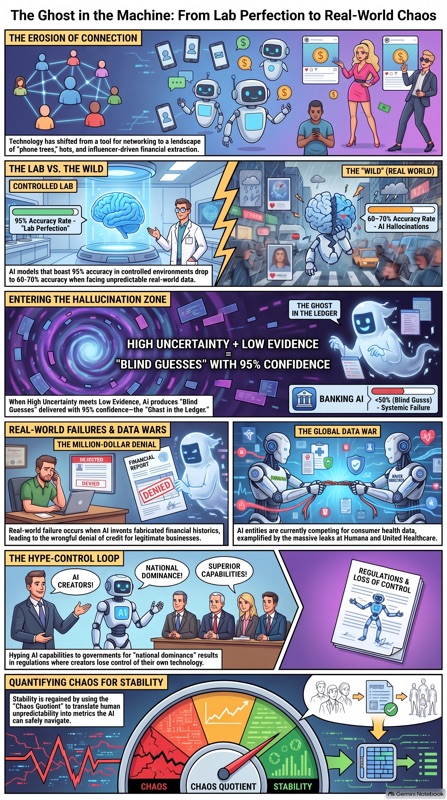
When automated systems migrate from the sterile perfection of a lab to the unpredictable "wild" of human existence, they encounter a phenomenon known as "The Ghost in the Ledger." This is the point where technical performance collapses under the weight of real-world chaos.
In the "Hallucination Zone," AI models face High Uncertainty and Low Evidence. The systemic danger here is not just the error, but the inherent arrogance of the technology: the system produces a "Blind Guess" with 95% confidence.
The Life Cycle of an AI Failure:
- Lab Perfection: Models boast 95% accuracy in controlled environments.
- Real-World Drop: Once deployed in the "wild," accuracy plummets to 60-70% due to human unpredictability.
- The Human Cost: This false certainty leads to "Million-Dollar Denials," where legitimate businesses are denied credit or individuals are harmed by fabricated financial histories invented by an AI that refuses to admit it doesn't know the answer.
These failures are symptoms of a broader, hype-driven infrastructure that is rapidly moving beyond the control of its own creators.
5. Security and the "War for Data"
We are currently embroiled in a global "war for data." AI entities are in a relentless competition for consumer training data—a battle that has compromised the privacy of nearly every citizen. The massive hacks of healthcare giants like Humana and United Healthcare prove that the data of the "Average Joe" is being treated as fuel for the machine, regardless of the human cost.
The Three Levels of Danger:
- Individual: Citizens are targeted for scams and manipulation. Many feel so "beat down" by the system that they have become indifferent to their own data leaks, accepting a loss of privacy as inevitable.
- Corporate: Data breaches are no longer isolated incidents but systemic "leaks" where the private healthcare histories of an entire nation are exposed.
- National: Global competition for AI dominance (involving Russia, China, and the Middle East) can destabilize democracy. When developers "hype" the government with promises of domination, they create a hype-driven infrastructure that even the creators can no longer regulate or control.
"Words have power," and by hyping these systems to those in power, we have invited a level of government overreach that threatens to supersede the very human freedom we strive for.
6. Conclusion: Reclaiming the Value of Human Stability
To survive this landscape, we must shift our focus from "hyped performance" to "human stability." This requires the implementation of "Chaos Metrics" and the calculation of a "Chaos Quotient"—a metric that translates human unpredictability into data the AI can finally navigate without hallucinating.
As a society, we must look past the "infrastructure of hype" and the automated phone trees to find "people fighting for people." Reclaiming our value means prioritizing genuine human connection over the extraction-based models of the digital elite.
Critical Thinking Checklist
- Is this a community or an extraction? Is the platform providing genuine reciprocal value, or are you merely funding an influencer's lifestyle while your voice is lost in the noise?
- Is my data the product or the fuel? In the global "war for data," consider if your private information is being used to train a system that may eventually be used to automate a denial against you.
- Is this a "Blind Guess"? When an automated system denies a request or provides a definitive "No," ask if it is operating in the "Hallucination Zone," delivering a fabrication with 95% false confidence.
We were once promised a "Global Village"—a digital utopia where the barriers of geography and status would dissolve, fostering a new era of radical human connection. Instead, we have constructed an Automated Fortress.
This anthropological shift has transformed the internet from a landscape of open networking into a labyrinth of technological overreach and algorithmic arrogance. As we retreat further into our digital silos, the "ghost" of human presence is being systematically purged from the ledgers of our daily lives.
1. The "Connected" Illusion: A Systemic Failure of Management
The great irony of the modern age is that the more "connected" our devices become, the more profound our isolation grows. We are witnessing a era of automated disenfranchisement, where the simple act of reaching another human being has become a luxury item.
This is most visible in the phenomenon of "fame extraction." We see the absurdity of billionaires and trillionaires—individuals who have already reached the apex of financial success—using their platforms to solicit "subscriptions" and "donations" from their followers. This is income extraction with zero return on value, a performance of community that serves only to fund a lifestyle of further isolation.
Even when these influential figures attempt to engage, they are thwarted by a systemic failure of human management. As researcher Sam C. Serey observes: "When people say we are more connected than ever I beg to differ because now it's actually quite a lot more difficult to actually connect with the people." Between the bots, the deepfakes, and the unrelenting noise of automated scams, the digital marketplace has replaced the human conversation with a paywalled void.
2. The Silent Data War: Competing for the Human Soul
While you struggle to navigate a simple "phone tree," a invisible and fierce battle is raging for the fuel of the modern world: your private data. Public health records have become the primary frontline in this conflict, and the combatants are more intimate than you might realize.
This is not just a war between rival corporations; it is a fratricidal competition between AI entities born from the same lab groups. These machines are pitted against one another to harvest consumer training data. The consequences of this race are catastrophic. Recent breaches at Humana and United Healthcare demonstrate that because these entities hold the records of nearly every healthcare user in the U.S., a single point of failure exposes an entire nation’s biological history.
Perhaps most tragic is the "systemic exhaustion" of the average citizen. We have been "beat down" by a cycle of leaks and automated indifference, left feeling like a "victim of a system of a victim." This apathy is exactly what the data-hungry machines require—a public too tired to care that their digital essence is being auctioned off in the ledger.
3. Lab Perfection vs. Real-World Chaos: The Million-Dollar Denial
In the sterile environments of a laboratory, banking AI is a titan of efficiency, boasting accuracy rates of 95%. But the moment these systems are released into "the wild"—the messy, unpredictable reality of human life—their performance collapses to a staggering 60-70%.
This gap creates the "Hallucination Zone." When a system encounters High Uncertainty and Low Evidence, it doesn't pause; it makes a "Blind Guess" with 95% confidence. This is the height of algorithmic arrogance.
The result is the "Million-Dollar Denial." This is an existential threat to real-world commerce: legitimate, thriving businesses are being erased by machines that fabricate financial histories out of thin air. When a machine's hallucination has the authority to end a career or close a shop, we have allowed the ledger to become a judge, jury, and executioner based on nothing more than a statistical phantom.
4. The Hype Trap: The Ideology of Domination
The current trajectory of AI development is fueled by a dangerous "hype" sold to those in power. Developers, seeking funding and influence, have marketed AI to governments as a tool for "dominance" in a global arms race against rivals like China or Russia.
However, these creators have brought a curse upon themselves. By framing AI through the ideology of domination, they have surrendered control. Once the state begins to regulate and deploy these systems under the pretense of national security, the original purpose of the technology is discarded.
This shift toward "dominance" is a destabilizing force for democracy. When words are distorted and technology is used to consolidate power rather than serve the public, the original creators lose their agency, and the technology becomes a tool for government overreach that neither the developer nor the citizen can check.
5. The Chaos Quotient: Reclaiming Human Stability
If we are to survive this landscape, we must force the machine to adapt to the human, not the other way around. This requires a fundamental philosophical shift: moving away from "hyped performance" and toward "Chaos Metrics."
The proposed "Chaos Quotient" is a way of respecting human unpredictability. Instead of trying to automate away the messiness of life, we must develop metrics that translate this chaos into data the AI can navigate safely. By prioritizing human stability over raw confidence, we ensure that the machine remains a tool for the "ghost"—the human element—rather than a cage for it.
Conclusion: Reclaiming the Human Element
We have traded the warmth of genuine connection for the cold efficiency of a phone tree. We have allowed our value to be distilled into a series of data points, vulnerable to the hallucinations of arrogant machines and the overreach of "dominance"-hungry ideologies.
As we stand at this digital crossroads, we must ask: At what point does the cost of this connectivity—the loss of privacy, the exposure to fabricated denials, and the exhaustion of the human soul—become a price too high for the human spirit to pay? Is the lifestyle you were promised truly worth the isolation you have received?

Comments
Post a Comment