The Opera of Space-Time: 5 Surprising Lessons from Chaos Musical Theory
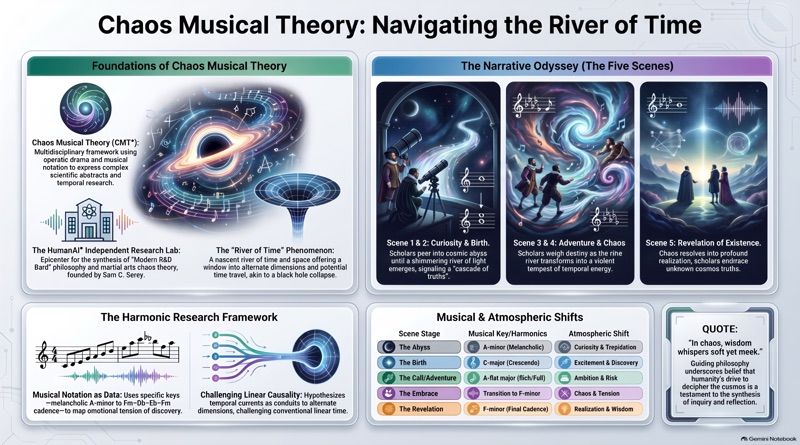
The barrier between the laboratory and the libretto has dissolved. When we attempt to quantify the sheer "chaos" of existence and the shifting gears of temporal mechanics, traditional data often feels cold—a skeletal remains of a living, breathing cosmos. To bridge this divide, Sam C Serey—the Modern R&D Bard of Chaos Martial Artist Philosopher and founder of the HumanAI° Independent Research Lab—has pioneered Chaos Musical Theory (CMT°). This framework posits that the most rigorous scientific abstracts are best expressed as musical compositions, capturing the "birth and destruction of a river of time and space" through a visceral, multidisciplinary lens.
1. Scientific Inquiry is a Theatrical Odyssey
In the realm of CMT°, research is never a dry accumulation of facts; it is a "theatrical odyssey" of the highest order. The laboratory is reimagined as a nexus where the ghosts of the Renaissance meet the silicon-etched future. Here, scholars clad in Elizabethan garb pore over scrolls and celestial maps while grand pianos and violins stand ready to translate the vibrations of the vacuum.
This setting emphasizes that temporal research is an emotional and intellectual struggle against the unknown. The collapse of time is not just a calculation—it is a performance. This existential curiosity is best captured by the scholars who dare to confront the abyss:
"O wondrous void, where time dost twist and twine, / What secrets lie within thy dark design?"
2. The "River of Time" as a Cosmic Mirror to Black Holes
Humanity has long been obsessed with "gravity's end"—the destructive majesty of the black hole. However, CMT° introduces a profound scientific paradox: witnessing the birth of a "river of time" is as scientifically rewarding as observing a stellar collapse. While black holes represent the ultimate entropy, the river represents "entropy’s beginning."
This nascent flow manifests as "luminous rivulets" and "swirling currents of temporal energy" cascading through the cosmic void. By shifting our gaze from the destruction of space-time to its nascent "flow," we gain a mirror into the very structural integrity of the universe. This river is not merely a sight to behold; it is a conduit that may hold the keys to alternate dimensions, requiring researchers to approach the data with a mixture of awe and trepidation.
3. Music as the Language of Temporal Mechanics
In Chaos Musical Theory, the researcher is not merely an observer; they are a conductor. CMT° asserts that a musical "cadence" is a more precise instrument for measuring the "weight of discovery" than any traditional text or spreadsheet. The transition through musical keys mirrors the psychic and empirical journey of decoding the cosmos:
- A-minor: The initial melancholy of gazing into the abyss, where curiosity meets the heavy silence of the unknown.
- C-major: The shift toward revelation as the "luminous rivulets" of the river finally manifest, replacing doubt with excitement.
- F-minor: The final, profound realization of the discovery’s weight, where the truth of existence is fully settled.
The "decisive cadence" of Fm – Db – Eb – Fm serves as the mathematical and musical proof of a mystery resolved. To CMT°, the data is the melody, and the conclusion of an experiment is the final, haunting note that lingers in the air.
4. The Paradox of Wisdom in Chaos
A central tenet of CMT° is that intellectual breakthroughs are physically violent events. The air itself reacts to the unraveling of a temporal mystery, creating a "tempest" of data and emotion. Yet, the theory suggests a paradox: while the environment is chaotic, the truth is quiet. "In chaos, wisdom whispers soft yet meek."
Scholars must navigate a "fickle fate" and "dark and stormy nights" of conflicting variables to hear that whisper. The physical intensity of these breakthroughs is described vividly in the research:
"As the luminous rivulets formed and began to cascade through the cosmic void, the air crackled with excitement; an electric hum echoed through laboratories and study halls alike. This was history in the making—a testament to humanity's relentless quest for knowledge."
5. Challenging Linear Time through Multidisciplinary Synthesis
The interplay of temporal energy within the "River of Time" fundamentally challenges conventional notions of causality. To study a phenomenon that breaks the rules of linear time, CMT° employs "Afrorap-Operatic Fusion." This is not merely an aesthetic choice; it is a necessary tool for "unraveling mysteries long shrouded in the fabric of reality."
The fusion is essential because of the specific strengths of its components: the rhythmic precision and street-level urgency of rap provide the cadence to navigate complex narratives, while the grand scale and emotional depth of opera capture the cosmic stakes of the discovery. This synthesis of scientific inquiry and philosophical reflection suggests that we can only understand the universe when we stop treating physics and art as separate languages.
Conclusion: Standing on the Precipice
Chaos Musical Theory and the "River of Time" redefine our role in the cosmos. We are no longer detached spectators recording the decay of the universe; we are participants in its ongoing composition. As CMT° forces us to re-evaluate the "structural integrity" of reality, it simultaneously demands we re-evaluate our own identities.
As we stand on the precipice of this scientific odyssey, we must look inward. If the universe is a grand, operatic fusion of light and sound, what is the verse you contribute? In the vast, swirling currents of the cosmos, what are the "elusive truths" that govern your own brief and beautiful existence? The music has begun; the curtain is up; and the answers are whispering in the chaos.

Comments
Post a Comment