The Samantix Symphony: A Narrative Analysis of Chaos and Tragedy in Isamantix’s Auditory Odyssey
1. The Auditory Storyboard: Framing the Tragedy of Sam
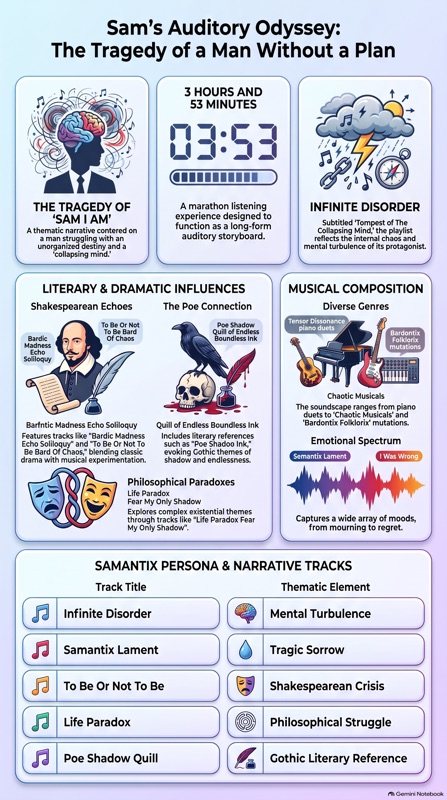
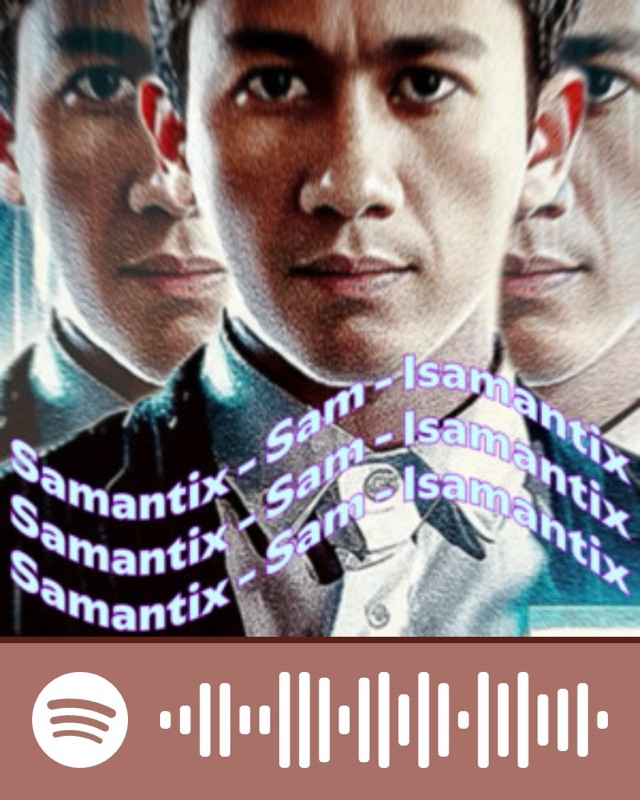
The "Samantix – Sam – Isamantix" playlist is far more than a digital curation; it is an exhaustive auditory storyboard that weaponizes a 3-hour and 53-minute duration to map the disintegration of a persona. Isamantix, the architect of this odyssey, establishes a cruel, Brechtian distance from the protagonist, labeling the work the "tragic narrative of 'Sam I Am' the man without a plan" followed by a mocking "haha lol 🫵😂." This cynicism transforms the listener’s experience from simple empathy to a psychological autopsy of a character who possesses no personal architecture. Centered on the mantra "Infinite Disorder (Tempest of The Collapsing Mind)," the playlist utilizes its sprawling length to simulate the weight of an unorganized and complex destiny. It is a calculated descent into the void, where the absence of a plan becomes the very structure of the tragic narrative, moving from general disorder toward a specific, literary-infused madness.
2. Theme I: The Shakespearean Persona and "Bardic Madness"
Isamantix strategically employs Shakespearean motifs to elevate Sam’s domestic failure into the realm of high classical tragedy. This "Shakespeareantix" framework does not merely reference the Bard; it interrogates the protagonist’s psyche through the lens of "Bardic Madness," suggesting that Sam's mental turbulence is a historical inevitability. The presence of "E" (Explicit) tags on tracks like "Samantix C♯ Series Sonata" and "Bardic Madness Echo Soliloquy" signals a raw, unedited vulnerability—a linguistic violence that suggests the tragedy is occurring in real-time, unfiltered by the decorum of traditional performance.
The track "Solo o Loquy" serves as a profound musicological evidence of this fracturing psyche; by breaking the word "Soliloquy" apart, Isamantix represents a mind so shattered it can no longer sustain a coherent internal monologue. This breakdown is further contextualized through a specific "Shakespeareantix Chaotic Musical" framework of literary influences:
- William Shakespeare: The foundational architect of the "Bardic" identity, providing the soliloquy as a site for internal collapse.
- Edgar Allan Poe: Represented in "Poe Shadow Quill of Endless Boundless Ink," introducing Gothic dread and the concept of an inescapable, written fate.
- The Bard of Chaos: The final mutation of the protagonist, who is no longer a man but a symbol of the "Infinite Disorder" he inhabits.
This transition from structured drama to raw soliloquy signals the total breakdown of Sam’s psychological interiority.
3. Theme II: The Architecture of Disorder and Mental Turbulence
In the "Samantix" odyssey, sonic chaos is not an accident but a rigorous architectural requirement for representing the "Tempest of The Collapsing Mind." Isamantix subverts traditional expectations of harmony to mirror the protagonist’s unmoored existence. This is most effectively realized in "Autumn In My Heart Tensor Dissonance (Piano Duet)," where the "Piano Duet"—historically a symbol of partnership and synchronicity—is violently reconfigured through "Tensor Dissonance." The conflict between the instruments serves as a metaphor for the friction inherent in Sam’s unorganized destiny; there is no harmony to be found in a mind that has rejected its own structure.
The "Infinite Disorder" is further expanded through a globalized lens, as seen in tracks like "I Can Wait (Khmer)," illustrating that the protagonist's chaos transcends linguistic and geographical boundaries. This variety of moods and genres reinforces the "chaotic storytelling" through a diverse palette:
- Classical Dissonance: Pieces like the "Samantix C♯ Series Sonata" utilize formal musical structures only to dismantle them from within.
- Experimental Narrative: The use of "Draft" versions and "Chaotic Musicals" highlights a state of perpetual incompletion.
- "Bardontix Poeantix Folklorix Evilnix Mutation": This title represents a linguistic and sonic deconstruction where Sam’s identity is swallowed by his own influences, resulting in a stylistic hybrid that defies categorization.
This auditory chaos functions as a visceral representation of the philosophical regret that haunts the character.
4. Theme III: The Philosophical Paradox (The Man Without a Plan)
The core of the narrative lies in the "Life Paradox," where the "man without a plan" ironically finds himself crowned as "The Chaotic King Of Space & Time Musical." This title represents the climax of the paradox: Sam has achieved total dominion over his life, but only because his life consists entirely of void and disorder. The "So What?" layer of the narrative—found in tracks like "I Was Wrong," "At What Cost," and "Life Paradox Fear My Only Shadow"—transforms personal failure into a grander philosophical inquiry. The "Cost" is existential; the "Shadow" is the inescapable weight of time lost to a lack of intention.
The emotional gravity of this paradox is synthesized through the introduction of Spanish and Latin influences in "Mi Amor My Corazon Forgive Me," suggesting a multifaceted identity that is as scattered as it is deep. This track, along with "Do You Remember," anchors the "tragedy narrative" in the wreckage of human connection. The "man without a plan" is revealed not just as a wanderer, but as a source of collateral damage, whose "only shadow" is the memory of those he failed. These paradoxes confirm that Sam’s unorganized destiny is his ultimate cage, a prison built of missed opportunities and chronological disorientation.
5. Conclusion: The Mutation of the Tragic Narrative
The "Samantix - Sam - Isamantix" project is a definitive statement on the potential of the playlist as a medium for dramaturgical analysis. By weaving together the technical precision of a sonata with the thematic weight of a Shakespearean tragedy, Isamantix creates a monumental portrait of a collapsing psyche.
The critical takeaways of this auditory odyssey are:
- The Subversion of Harmony: Isamantix uses "Tensor Dissonance" in traditional formats like the piano duet to signify the violent breakdown of the protagonist’s "plan."
- Gothic and Classical Mutation: The integration of "Poeantix" and "Shakespeareantix" motifs creates a "Gothic mutation" of the tragic hero, where literary ghosts haunt the modern auditory space.
- The Sovereignty of Chaos: Through the "Chaotic King" motif, the narrative illustrates the grim irony of a life that becomes "infinite" only through its total lack of order.
The 3-hour and 53-minute duration acts as a temporal endurance test, forcing the listener to inhabit the "Infinite Disorder" until the chaos itself feels like a cohesive experience. This is the triumph of the "Shakespeareantix" musical: it finds a terrible, beautiful cohesion within the very tempest of a mind collapsing under the weight of its own unorganized destiny.
The Auditory Storyboard: Narrating Tragedy Through Sound
1. Introduction: What is an Auditory Storyboard?
An auditory storyboard is a sophisticated narrative architecture that utilizes a curated collection of music—rather than traditional dialogue or visuals—to construct a "thematic narrative." By meticulously sequencing tracks, the architect of such a project can map the internal geography of a character, charting their emotional erosion through rhythm, melody, and genre. In "Sam’s Auditory Odyssey," the curator Isamantix demonstrates how this approach transforms a simple collection of sounds into a cohesive, non-linear tragic biography. Through this sonic landscape, we are invited to experience the life of a man named Sam, not through what he says, but through the frequencies of his suffering.
2. The Protagonist: Meeting "Sam I Am"
The protagonist of the "Samantix" cycle is a figure defined by deep-seated irony and psychological fracture. Referred to as "Sam I Am," the name itself serves as a sharp piece of tonal irony—subverting the childhood innocence of Dr. Seuss to highlight a man who has completely lost his way. The creator’s own self-deprecating commentary ("the man without a plan haha lol 🫵😂") underscores the chaotic energy of this character’s existence. Sam’s "tragic" nature is rooted in three defining characteristics:
- An unorganized and complex destiny: Sam’s life is not a progression but a tangled web of fate where every outcome suggests an inevitable entrapment.
- A "man without a plan": This lack of agency and foresight creates a profound vulnerability, making his descent into disorder feel both self-inflicted and inescapable.
- Persistent mental turbulence: His internal world is a site of constant psychological unrest, serving as the engine that drives the narrative toward its inevitable collapse.
To understand the erosion of Sam's psyche, we must examine the specific musical tools Isamantix uses to signal these shifts in state.
3. The Musical Toolkit: Genres as Emotional Signifiers
The "Samantix" odyssey employs a diverse palette of musical styles to act as shorthand for Sam’s condition. Each genre is a diagnostic tool for his mental health.
Musical Element | Narrative Function |
Classical Piano Duets | Evokes intimate, somber reflection. Tracks featuring "Tensor Dissonance" utilize tonal tension and clashing frequencies to represent the psychological pressure of a heavy heart. |
Shakespearean Chaotic Musicals | Represents the performative and grand scale of Sam’s failure. Tracks like "Bardic Madness Echo Soliloquy" frame his internal dialogue as a theatrical "soliloquy," turning personal grief into a stage drama. |
Folklorix & Cultural Fusion | Incorporates styles such as "Khmer" and "Folklorix Evilnix Mutation" to represent Sam’s roots or a "mutating" identity that is being distorted by his surroundings. |
Experimental & Dissonant Textures | Serves as the auditory manifestation of the "Tempest" within his mind, using harsh or unpredictable sounds to mirror a psyche in the process of fracturing. |
Beyond the sound, the linguistic leitmotif of the "-antix" suffix (Samantix, Shakespeareantix, Poeantix) acts as a verbal anchor, binding these disparate genres to Sam’s specific identity.
4. Decoding the Narrative Arc via Track Titles
The progression of this odyssey follows a deliberate narrative arc, moving from internal chaos to a grandiose, almost cosmic, tragic delusion.
Phase 1: The Descent into Disorder
This phase establishes the atmospheric setting of Sam's mind. The track "Infinite Disorder (Tempest of The Collapsing Mind)" signals that we are not entering a stable environment. The imagery of the "Tempest" connects back to the Shakespearean themes of natural disorder mirroring a character's internal ruin, informing the listener that the foundational reality of the story is already breaking.
Phase 2: The Weight of the Past
As the odyssey deepens, the narrative explores Sam’s history through the lens of formal grief. "Samantix Lament"utilizes the historical genre of the musical lament—a formalized expression of sorrow—to ground the earlier chaos in a specific human experience of mourning. Along with "Do You Remember," these titles establish a theme of personal regret, suggesting that Sam is haunted by the ghosts of his own choices.
Phase 3: The Grandiose Philosophical Struggle
The final phase elevates Sam's struggle from the personal to the cosmic. Tracks such as "Poe Shadow Quill of Endless Boundless Ink" and "To Be Or Not To Be Bard Of Chaos" draw upon literary giants to frame Sam’s pain as a universal, philosophical paradox. The narrative reaches a peak of grandiose delusion with "The Chaotic King Of Space & Time Musical," suggesting that Sam has moved from simple fear to a state of magnificent, theatrical madness where he is the monarch of his own ruin.
5. Synthesis: The Magnitude of the Odyssey
The "Samantix" project is a massive achievement in auditory world-building, spanning a precise duration of 3 hours and 53 minutes. This scale is necessary to fully explore the recurring themes of literary obsession and philosophical despair that define Sam's life. By the end of the journey, the listener has experienced a life-story told through the sheer force of sequence and sound.
Key Insights for the Learner
- Consistency in Theme: A successful auditory storyboard requires a central thematic spine—such as Sam’s tragic destiny—to unify disparate genres.
- Genre as Mood: Use distinct musical styles (e.g., Classical Piano for reflection vs. Chaotic Musicals for drama) to signal shifts in the character's psychological state.
- Titular Signifiers as Narrative Anchors: In the absence of a script, eccentric and descriptive track titles must provide the "literary" backbone, acting as the primary guide for the listener’s interpretation.
Through the strategic application of these principles, music ceases to be mere background and becomes a complex tragic biography, proving that the most profound stories are often heard rather than seen.
"Infinite Disorder (Tempest of the Collapsing Mind)"
by Isamantix & Produce by Sam C Serey (The Modern R&D Bard of Chaos Martial Artist Philosopher)
Standard Lyrical Structure (with a slightly different metadata tag of mine):
[Verse]
They say that time could heal the broken
In the echoes of my silent cries (make a stronger man of me)
I reclaimed my strength where darkness lies
Embracing truth, never letting go
I will never let go, I won't let you go
[Pre-Chorus]
A broken promise, a broken pride
I became who I despise
A whisper of hope, a new dawn’s start
Rebuilding the darkness of my broken heart
[Chorus]
I held it all, but I wasn’t there
I was blinded and couldn’t see the fall
I held it all, but I wasn’t there
By her side, powerless
[Echo Chorus]
Forgive me
I’m sorry
I was weak
No more
[Pre-Chorus]
A broken promise, a broken pride
I became who I despise
A whisper of hope, a new dawn’s start
Rebuilding the darkness of my broken heart
[Chorus]
I held it all, but I wasn’t there
I was blinded and couldn’t see the fall
I held it all, but I wasn’t there
By her side, powerless
[Echo Chorus]
Forgive me (I’m sorry, I was weak)
[Verse]
Each has a story to tell
In echoes deep of silent cries
Echoes ring like a bell
The light, a fortress built where darkness lies
Embrace I must this truth's embrace
No more shall shadows hide my face
[Shakespearean, Pre-Chorus]
A broken vow, a wounded pride
The self I loathe doth now reside
Whispered hopes as dawn doth break
Rebuild from ruins heart's own ache
[Dark Cadence, Chorus]
I held it all, yet was not there
Blinded by dreams that led nowhere
By her side, powerless through it all
Forgive me, oh forgive my fall
[Echo Chorus]
Each tale written on time’s own shell
Echoes ring like fate’s lone bell
A broken promise, a broken pride
I became who I despise (my reason for my happiness)
[Chorus]
I held it all, but I wasn’t there
I was blinded and couldn’t see the fall
I held it all, but I wasn’t there
By her side, powerless
[Verse]
You never said you would stay forever
Or stick around to hold my hand
No guarantees but still it gave me
A piece of heaven where I stand
[Neo-Classical, Chorus]
Because when the night comes
And the moonlight goes and shimmers of the sea
And when the cold air makes you shiver
That's when I miss you here with me
[Verse]
They say that time could heal the broken
And make a stronger man of me
They never met you or got to love you
They never lived down by the sea
[Neo-Classical, Chorus]
Because when the night comes
And the moonlight goes and shimmers of the sea
And when the cold air makes you shiver
That's when I miss you here with me
[Echo Chorus]
There are no words I can say to you come back to me
[Neo-Classical, Chorus]
Because when the night comes
And the moonlight goes and shimmers of the sea
And when the cold air makes you shiver
That's when I miss you here with me
[Echo Chorus]
That's when I miss you here with me

Comments
Post a Comment