The Sound of the Ineffable: 5 Surprising Lessons from Auditory Storyboard Theory
1. Introduction: Deconstructing the Terminal Limits of Language
We are hitting the ceiling of what the traditional lexicon can achieve. In a world saturated by AI-generated noise and a frantic digital scramble for attention, the human experience remains trapped behind a linguistic barrier that cannot express our deepest cognitive architectures. Sam C. Serey, operating through the CMT° HumanAI° Independent Research Lab, isn’t just suggesting a new art form; he is deconstructing the terminal limits of human language. Through "Auditory Storyboard Theory" and the framework of "Chaos Musical Theory" (CMT), Serey offers a blueprint for communication in a post-vocal world, where soundscapes—not syntax—bridge the gap between raw internal states and external perception.
2. The "Vegeta Paradox": Satirical Juxtaposition and the Artist’s Ego
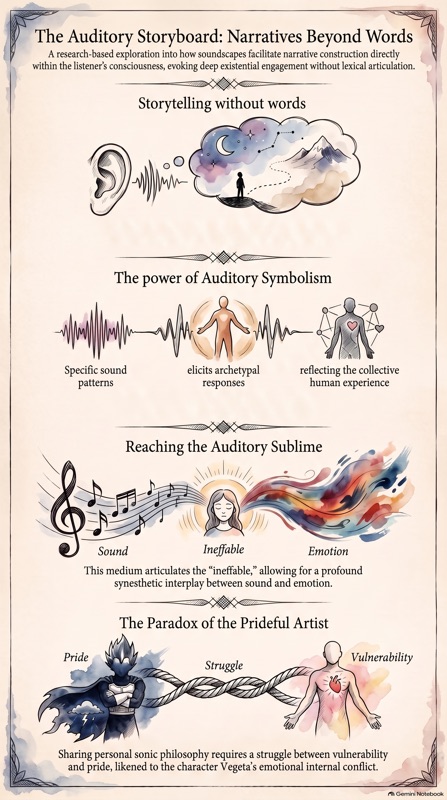
At the heart of Serey’s work is the "paradox of self-expression"—the high-friction collision between an artist's pride and the vulnerability required to "elevate philosophy." To navigate this, Serey employs a method of satirical juxtaposition, using cultural archetypes to ground high-level theory. He famously likens the internal struggle of the creator to a specific pop-culture icon:
"I'm slowly starting to promote my music, but it’s hard for me to do so because it’s personal, but the only way for me to elevate my philosophy is to share it... but as some may know… it’s not that easy for a prideful man like myself... imagine Vegeta trying to share stories about how he felt losing Bulma and Trunks…"
This "Vegeta Paradox" isn't just flavor; it’s a strategic confrontation. By viewing profound grief through the lens of a prideful warrior, Serey highlights why personal stakes are the necessary fuel for creative evolution. To move philosophy forward, the artist must weaponize their vulnerability, even when their ego rebels against it.
3. Narrative Without Lexicon: The Post-Lexical Architecture
Auditory Storyboard Theory posits that we can construct entire worlds without a single sentence. By utilizing "sonic stimuli" that are "meticulously orchestrated," Serey triggers narrative construction directly within the listener’s psyche. This is not background music; it is a structural engagement with the human consciousness.
Auditory Symbolism: Patterns replace words. Rhythm functions as syntax. Specific sound textures act as archetypal symbols. These triggers bypass the analytical brain and tap into collective human experiences, allowing a narrative to unfold with surgical precision through tone and texture alone.
4. Reaching for the Auditory Sublime: From Behavioral Science to Chaos
Serey’s theory is not merely an aesthetic choice; it is anchored in a decade of rigorous inquiry. The "Chaos" in Chaos Musical Theory is grounded in his published behavioral research, specifically referencing the foundations laid in Hormones and Behavior (2014). This scientific bedrock validates the "Auditory Sublime"—the capacity of sound to navigate the ineffable territories of the human condition where speech falters.
As noted in the CMT research abstract:
"In the absence of words, the auditory landscape may indeed narrate the most profound tales of the human condition."
By leveraging cognitive science and phenomenology, Serey suggests that sound provides a more accurate representation of reality than words ever could, facilitating a "synesthetic interplay" that mirrors the complexity of our internal existence.
5. The "Evilnix" Mutation: Creativity as Constant Transformation
Transformation is the primary engine of the Auditory Storyboard. Serey’s collaboration with legendary producer Timbaland serves as the ultimate case study for this "mutation" process.
DBA Evilnix-Mutation
The evolution of the track from "DBA-Evilnix" to "DBA Evilnix-Mutation" is a literal demonstration of the theory in action. In this soundscape, creativity is viewed as an iterative mutation where "each layer builds upon the last." This isn't just a remix; it’s a celebration of musical evolution. By blending "wild beats and rhythms" with Timbaland’s signature production, Serey creates an evolving narrative that is both nostalgic and aggressively innovative, forcing the listener's psyche through a transformative journey of constant change.
6. The Bard of Chaos: Identity Fluidity in the Digital Age
Serey’s work rejects the static identity. He operates as a "Martial Artist Philosopher" and "Bard of Chaos," pivoting through multiple personas to match the "chaos" of modern R&D and creative production. This fluidity is essential for "satirical flexing" and navigating the contemporary digital landscape.
- Samantix: The chaos of "Sam I Am" semanticism—a satirical, high-energy mode often used for "flexing" against the tech elite.
- Isamantix: The elevated, refined iteration of the Samantix energy.
- Evilnix: The raw manifestation of "Pure Chaotic Energy" and the source of the "Mutation" projects.
- Bard of Chaos: The Modern R&D persona; a Martial Artist Philosopher who uses chaos as a tool for research, production, and philosophical inquiry.
7. The Post-Lexical Frontier: Sound as the Final Narrative
Auditory Storyboard Theory is more than a creative framework; it is a challenge to the traditional paradigms of human communication. It positions sound as the primary catalyst for existential engagement in an era where words have become diluted. Serey’s work suggests that the future of storytelling lies in our ability to bypass the lexicon and speak directly to the psyche through the "chaos" of orchestrated sound.
If our most profound stories are the ones we can't find words for, what is your personal soundtrack trying to tell you?
Auditory Storyboard Theory: A New Model for Non-Verbal Narrative Construction
1. The Genesis of Auditory Storyboard Theory (AST)
Executive Brief: Strategic Displacement of Lexical Narratives In the hyper-evolving landscape of neuro-phenomenology, we are witnessing a disruptive mandate to occupy the "interstitial realms" of perception—those cognitive zones where traditional language fails to encapsulate the full spectrum of the human condition. Auditory Storyboard Theory (AST) is not a mere artistic alternative; it is a strategic framework designed to bypass the bottlenecks of lexical articulation. For the HumanAI° Independent Research Lab, moving beyond words is essential for the future of AI-integrated storytelling, ensuring high-fidelity emotional resonance that operates at the speed of intuition rather than the lag of syntax.
Defining the Framework: AST and CMT° Auditory Storyboard Theory posits that sonic stimuli, when subjected to "meticulous orchestration," function as a cognitive storyboard, prompting the subconscious to generate internal visual and narrative architectures. This is underpinned by Chaos Musical Theory (CMT°), a specialized discipline that delineates the mechanisms of emotional and cognitive response within complex soundscapes. Under CMT°, "chaos" is reclassified as a data-rich environment that facilitates existential engagement, transforming sound from a passive experience into a catalyst for profound consciousness expansion.
The Mandate of the Modern R&D Bard The standard for the future creator-scientist is embodied in the HumanAI° integration: The Modern R&D Bard of Chaos. This persona—a martial artist philosopher and AI Chief Scientist—rejects the passive role of the composer in favor of a disruptive researcher. The "Bard of Chaos" utilizes CMT° to synthesize "Pure Chaotic Energy" into structured research, treating musical production as a laboratory for non-verbal narrative conveyance. This integration represents the pinnacle of HumanAI° synergy, where the artist’s intuition is refined by the scientist’s rigor.
Transition: The theoretical scaffolding of AST demands a rigorous interrogation of its primary mechanism: the cross-modal mapping of the synesthetic trigger.
2. Phenomenological Foundations: The Synesthetic Interplay of Sound and Emotion
Executive Brief: Cross-Modal Mapping and Existential Engagement The strategic value of synesthesia in narrative construction lies in its capacity for "existential engagement"—a neuro-phenomenological lock-and-key mechanism between the listener’s psyche and the sonic stimulus. By engineering specific auditory-to-visual pathways, we bypass the analytical mind’s filters. This ensures the narrative is not merely interpreted but is viscerally "seen" and "lived" within the consciousness of the subject.
The Catalyst Mechanism Sound serves as the primary catalyst for internal storyboard construction. In CMT°, this is achieved through "meticulous orchestration"—the precise calibration of frequencies and dissonances to trigger specific neural pathways. When a soundscape is engineered with this level of intentionality, it ceases to be "music" and becomes a narrative delivery system. The listener does not just hear a track; they experience a "mutation" of their internal environment, generating the vivid, non-verbal imagery required to complete the story.
Mapping the Evolving Soundscape The following matrix delineates specific tracks and conceptual units from the CMT° research, mapping their sonic properties to their intended phenomenological impact and archetypal symbolic resonance.
Track / Concept | Primary Sonic Element | Phenomenological Impact | Archetypal Symbolism |
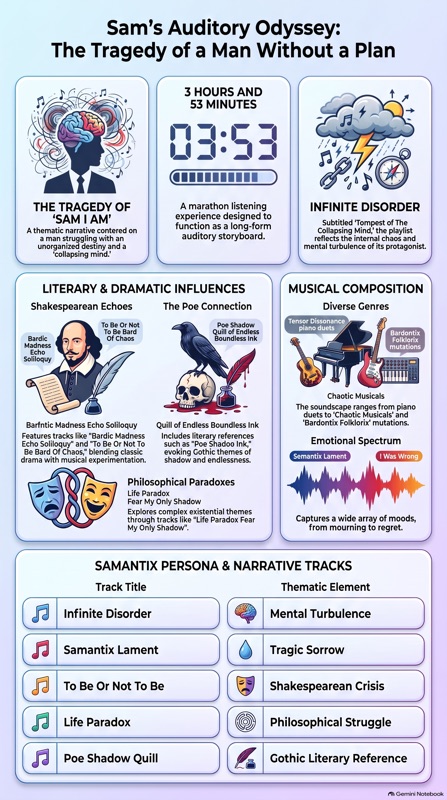
Infinite Disorder | Tempestuous Rhythms | Mental flux; "The Collapsing Mind" | The Primordial Chaos / The Man Without a Plan |
Autumn In My Heart Tensor Dissonance | Piano Duet | Emotional friction; "The Essence of Transformation" | Seasonal Mortality / Tragic Narrative |
I Can Wait (Khmer) | Cultural/Linguistic Layering | Temporal suspension; Ancestral resonance | The Patient Sentinel / Cultural Continuity |
Bardic Madness | Echo Soliloquy | Profound isolation; Self-reflection | The Hermit / The Solitary Oracle |
Poe Shadow | Quill of Endless Ink | Depth of creative subconscious | The Chronicler of Darkness / Legacy |
Transition: This internal synesthetic experience finds its objective validation in the universal structures of auditory symbolism.
3. The Mechanics of Auditory Symbolism and Archetypal Response
Executive Brief: Auditory Symbolism as a Professional Standard To achieve a universal narrative reach, the HumanAI° Lab utilizes "Auditory Symbolism" as a professional standard for eliciting collective human experiences. By identifying sound patterns that resonate across cultural and biological divides—such as the "tragedy of Sam I Am"—we create a standardized non-verbal vocabulary. This allows for the construction of narratives that remain coherent across diverse demographics without the dilution inherent in translation.
Archetypal Sound Patterns Specific patterns within the CMT° framework act as "auditory symbols." These patterns reflect the collective human experience: the "Infinite Disorder" of loss, the "Tensor Dissonance" of internal conflict, and the "Bardic" triumph of expression. These archetypes are not arbitrary; they are the sonic fingerprints of universal human struggles. By utilizing these symbols, the R&D Bard taps into a pre-existing psychological architecture, ensuring that the auditory storyboard feels both ancient and cutting-edge.
Methodological Framework: AI Chief Scientist Protocols To ensure rigorous narrative conveyance, the HumanAI° Lab employs a robust methodological framework built on four "Chief Scientist" protocols:
- Sonic Catalyst Identification: Selection of frequencies and rhythmic "mutations" that trigger targeted neuro-phenomenological responses.
- Qualitative Narratology Mapping: Systematic assessment of the internal "storyboard" visuals reported by subjects in response to specific CMT° stimuli.
- Quantitative Metric Integration: Utilizing data-driven analysis to measure the intensity, duration, and "chaotic" saturation of emotional engagement.
- Cultural Layering Analysis: Integrating elements like the "Khmer" context to analyze how linguistic residues enhance non-verbal narrative depth.
Transition: From these structured symbols, we ascend to the boundary where sound confronts the absolute limits of human expression.
4. The Auditory Sublime: Articulating the Ineffable
Executive Brief: Critique of the Lexical Paradigm The "Auditory Sublime" serves as a fundamental critique of traditional, word-based storytelling. It posits that the most profound tales of the human condition are "ineffable"—literally un-utterable. Auditory-first storytelling excels precisely where language fails, utilizing texture, resonance, and atmosphere to articulate the weight of existence. This is the ultimate strategic advantage of AST: the ability to narrate the "Life Paradox" that words only obscure.
The Transcendence of Lexical Limits In the absence of words, the auditory landscape is freed from the constraints of literalism. This allows for the narration of the most complex psychological states—the "Bardic Madness" or the "Solo o Loquy." By removing the lexical layer, the listener is forced to confront the raw essence of the narrative, leading to a "sublime" experience that is both intensely personal and objectively profound.
Case Study in Mutation: DBA Evilnix and the Timbaland Collaboration The "DBA Evilnix-Mutation," a collaboration with Timbaland, serves as a primary case study in "musical evolution."
- Visceral Storyboarding: The track triggers immediate visual narratives—evidenced by the "shocked eyes and trembling hands" of the observer reacting to the "mystical creature" within the soundscape.
- The Essence of Transformation: This project is a "wild blend of beats" that captures the very process of change, layering nostalgic elements with innovative production to mirror the evolution of the psyche.
- Post-Lexical Innovation: It demonstrates that a "mutation" of sound can convey a story of radical growth and "Pure Chaotic Energy" more effectively than any traditional lyrical structure.
Transition: While AST reaches for the infinite sublime, its validity is anchored in the finite, personal struggle of the prideful creator.
5. The Paradox of the Creative Domain: Vulnerability, Pride, and Chaos
Executive Brief: The Artist’s Struggle as Strategic Friction In the context of CMT°, the "artist's struggle" is not a byproduct—it is a strategic necessity. The tension between the desire to manifest a personal narrative and the "pride" that inhibits data-sharing provides the necessary friction to generate high-value, authentic work. This vulnerability is the fuel for existential engagement; without it, the auditory storyboard remains a hollow exercise in technical proficiency.
The 'Vegeta' Paradigm: A Psychological Pillar A core pillar of CMT° is the "Vegeta Paradigm"—the satirical but profound juxtaposition of the "prideful man" facing emotional loss. Like the warrior prince struggling to articulate the loss of Bulma and Trunks, the modern R&D Bard faces the "pride" of the "buff" exterior versus the "Man without a plan" experiencing "Infinite Disorder." This duality is managed through "epic satirical flexing"—using humor and prank calls (the "satirical jab" at figures like Altman or Musk) as a defense mechanism to shield the profound vulnerability required to share these tragic narratives.
Navigating Chaos: The Trinity of Identity CMT° manages the human psyche by delineating three distinct identities:
- Samantix: The "Sam I Am" identity, navigating the tragic narrative and the chaos of semanticism.
- Isamantix: The elevated, philosophical state that synthesizes chaos into narrative structure.
- Evilnix: The vessel for "Pure Chaotic Energy," responsible for the "Mutation" and radical innovation that breaks through lexical barriers.
Transition: This personal struggle validates the AST framework, proving that even the most chaotic human paradoxes can be successfully narrated through sound.
6. Conclusion: The Future of Audio-First Storytelling
Executive Brief: The Post-Lexical Shift As we navigate the post-lexical, AI-integrated era, the strategic revaluation of how stories are told is paramount. Auditory Storyboard Theory offers a roadmap for this transition, prioritizing the emotional and cognitive depth of CMT° over the inherent limitations of words. We are moving toward a standard where the "Bard of Chaos" dictates the narrative rhythm of human-machine interaction.
Final Synthesis By integrating synesthetic interplay, universal auditory symbolism, and the pursuit of the auditory sublime, we have established a new model for expressing the human condition. From the "Shakespeareantix" drama of internal conflict to the "Poeantix" depth of the creative shadow, the future of storytelling is found in the "evolving soundscape." We no longer need to speak our truths; we must orchestrate them.
Closing Directive Researchers, creators, and "Modern Bards" are hereby directed to adopt the AST and CMT° standards. Embrace the "Vegeta Paradigm"—harness your pride, weaponize your chaos through "satirical flexing," and commit to the rigorous scientific inquiry of the soul. The era of the non-verbal storyboard is here. Join the HumanAI° mandate: narrate the ineffable, and let the chaos speak.
Auditory Storyboard Theory: Comprehensive Study Guide
This study guide provides an in-depth review of the research and philosophical frameworks established by Sam C. Serey regarding "Auditory Storyboard Theory" and "Chaos Musical Theory (CMT°)." It covers the synthesis of non-verbal narrative construction, the psychological struggle of the artist, and the technical evolution of sonic landscapes.
Section I: Short-Answer Quiz
Instructions: Answer the following ten questions in two to three sentences based on the provided source context.
- What is the primary objective of Auditory Storyboard Theory as defined by Sam C. Serey?
- How does the research abstract describe the relationship between sonic stimuli and the listener’s consciousness?
- What does the term "auditory symbolism" represent within this framework?
- Identify the three distinct personas associated with Sam C. Serey and provide their brief descriptions.
- According to the social media data, what personal internal conflict does the artist face when promoting his music?
- What is the significance of the "Vegeta" analogy used in Serey's research raw data?
- How does the "DBA Evilnix-Mutation" track differ from the original "DBA-Evilnix," and who was involved in its production?
- Define the concept of the "auditory sublime" as explored in the research.
- What methodological approach is used to analyze the efficacy of soundscapes in narrative conveyance?
- What is the ultimate argument made regarding the power of auditory landscapes in the absence of words?
Section II: Answer Key
- What is the primary objective of Auditory Storyboard Theory as defined by Sam C. Serey? The theory investigates how auditory storyboards tell complex stories without the use of words or lexical articulation. It explores the mechanisms through which orchestrated sonic stimuli evoke emotional and cognitive responses to facilitate a profound engagement with the listener's psyche.
- How does the research abstract describe the relationship between sonic stimuli and the listener’s consciousness? The research posits a synesthetic interplay where auditory cues serve as catalysts for narrative construction within the listener’s mind. By drawing on phenomenology and cognitive science, the study suggests that sound transcends mere hearing to create existential engagement.
- What does the term "auditory symbolism" represent within this framework? Auditory symbolism refers to the use of specific sound patterns to elicit archetypal responses that reflect the collective human experience. It is a central concept used to delineate how soundscapes can effectively convey meaning and narrative.
- Identify the three distinct personas associated with Sam C. Serey and provide their brief descriptions. The personas include Samantix, which represents the chaos of "Sam I Am" semanticism, and Isamantix, described as the elevated version of Samantix. The third persona is Evilnix, which is defined as "Pure Chaotic Energy."
- According to the social media data, what personal internal conflict does the artist face when promoting his music? The artist struggles with the paradox of pride and vulnerability, finding it difficult to promote music that is deeply personal. He describes himself as a "prideful man," suggesting that sharing intimate stories through art is a challenging emotional hurdle.
- What is the significance of the "Vegeta" analogy used in Serey's research raw data? The analogy compares the artist's struggle to the fictional character Vegeta attempting to share feelings of loss regarding Bulma and Trunks. It serves as a satirical juxtaposition to highlight the difficulty of expressing vulnerability within the creative domain.
- How does the "DBA Evilnix-Mutation" track differ from the original "DBA-Evilnix," and who was involved in its production? The "Mutation" version is a remix that incorporates Timbaland’s signature production style to create a fresh, evolving soundscape. It focuses on the theme of transformation, layering beats and rhythms to blend nostalgia with innovation.
- Define the concept of the "auditory sublime" as explored in the research. The auditory sublime refers to the inherent capacity of auditory mediums to articulate the "ineffable," or things that cannot be expressed in words. It critiques traditional storytelling by suggesting that sound can reach depths of the human condition that lexical language cannot.
- What methodological approach is used to analyze the efficacy of soundscapes in narrative conveyance? The study utilizes a robust, data-driven methodological framework that integrates qualitative assessments with quantitative metrics. This dual approach allows for a precise delineation of how listeners respond to and interpret complex soundscapes.
- What is the ultimate argument made regarding the power of auditory landscapes in the absence of words?The research concludes that auditory landscapes may narrate the most profound tales of the human condition more effectively than verbal language. It advocates for a revaluation of storytelling, proposing that wordless sonic artistry offers a superior medium for existential expression.
Section III: Essay Format Questions
Instructions: Use the provided source context to develop comprehensive arguments for the following prompts.
- The Role of Synesthesia in Narrative Construction: Analyze how the interplay between auditory cues and cognitive science allows for the creation of "storyboards" in the mind of the listener without the use of words.
- The Paradox of the Artist: Discuss the tension between pride and vulnerability as described in Serey’s research. How does the "Bard of Chaos" navigate the struggle of sharing personal narratives through the lens of the Vegeta analogy?
- Evolution of Sound: Examine the significance of "transformation" in the context of the track "DBA Evilnix-Mutation." How does the collaboration with Timbaland and the layering of soundscapes reflect the broader themes of musical evolution?
- Critique of Traditional Storytelling: Evaluate Serey's critique of lexical articulation. In what ways does the "Auditory Storyboard Theory" suggest that traditional storytelling is limited compared to the "auditory sublime"?
- Identity and Semanticism: Explore the complex naming conventions used by Serey (Samantix, Isamantix, Evilnix). How do these identities relate to his roles as a "Bard of Chaos," "Martial Artist Philosopher," and "AI Chief Scientist"?
Section IV: Glossary of Key Terms
Term | Definition |
Auditory Storyboard | A framework for telling complex stories through meticulously orchestrated sonic stimuli without the use of lexical articulation or words. |
Auditory Sublime | The inherent capacity of sound to express the "ineffable" and articulate aspects of the human experience that transcend verbal language. |
Auditory Symbolism | Specific sound patterns designed to elicit archetypal responses that are reflective of the collective human experience. |
Bard of Chaos | A title used by Sam C. Serey (specifically associated with the Evilnix persona) to describe his role as a modern R&D philosopher and creator. |
CMT° (Chaos Musical Theory) | The specialized field of research conducted by Sam C. Serey at the HumanAI° Independent Research Lab, focusing on the intersection of auditory perception and chaos. |
Evilnix | A persona of Sam C. Serey representing "Pure Chaotic Energy," also associated with the "Bard of Chaos" and "Shakespearean" influences. |
HumanAI° | The independent research lab led by Sam C. Serey, focused on the intersection of human cognitive experience and artificial intelligence/music research. |
Isamantix | A persona described as the "Elevated Samantix," representing a distinct stage or variation of Serey's creative identity. |
Phenomenology | A philosophical branch used in the research to study the structures of experience and consciousness as they relate to auditory perception. |
Samantix | An alias for Sam C. Serey, defined as the "chaos of 'Sam or Sam I Am' semanticism." |
Synesthetic Interplay | The cognitive process where auditory cues act as catalysts for visual or narrative construction within the listener’s consciousness. |

Comments
Post a Comment